- +86 13922774531
- info@gionar.com

English


English
November 26 , 2026
Are you running a handbag brand? Have you considered where would be the best place to manufacture your handbag collection?
Italy: Italy has a strong heritage in craftsmanship and design, with exceptional attention to detail. However, production costs are high, minimum order quantities (MOQs) are demanding, and lead times are often long. Communication and sampling can also be slow, while many manufacturers are reluctant to take on small orders. This can make it particularly challenging for emerging brands to enter the market.
China: Over the past few decades, China’s manufacturing capabilities have advanced significantly. With mature technology, modern equipment, and a well-established supply chain, Chinese manufacturers can produce virtually any type of bag. Economies of scale help keep costs competitive, while flexible pricing offers room for negotiation. Manufacturers are generally responsive, service-oriented, and quick to address production issues. They are often willing to support emerging brands with small-batch orders and help them grow, while established brands can also benefit from the production capacity needed to scale up.
India: India’s leather goods manufacturing industry is still developing in many areas. Craftsmanship and quality control can be inconsistent, and many suppliers operate as small, informal workshops with only a handful of workers. There have also been cases of suppliers becoming unresponsive after receiving deposits, creating significant financial and delivery risks. Before entering into a partnership, it is essential to thoroughly verify a supplier’s credentials, production capabilities, and payment terms.
Ultimately, choosing between China, Italy, and India for leather bag manufacturing depends on your brand’s budget, product positioning, quality requirements, risk tolerance, and target market.
Manufacturing leather bags in Italy is often associated with luxury, craftsmanship, heritage, and exclusivity. For high-end fashion brands, choosing Italy as a manufacturing base can be a powerful strategic and marketing decision.
However, beyond the prestige associated with the “Made in Italy” label, brands must also consider practical factors such as production costs, minimum order quantities (MOQs), lead times, quality control, supplier relationships, and scalability.
For luxury brands and B2B sourcing teams, Italian-made leather bags have long been regarded as the gold standard for premium positioning. Yet, this choice also involves a clear trade-off between heritage-driven prestige and operational practicality.
In 2024, Italy’s leather goods exports reached USD 5.81 billion, making it the world’s second-largest exporter of leather handbags. It therefore remains a preferred sourcing destination for brands targeting premium markets where heritage, craftsmanship, and exclusivity are highly valued.
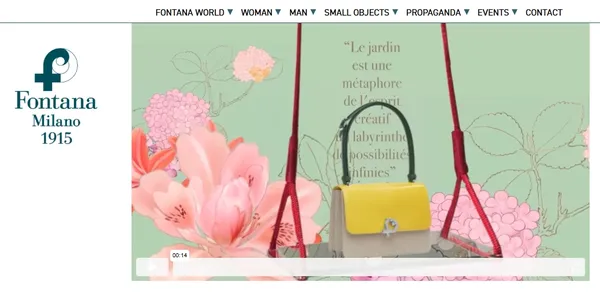
Made in Italy can significantly enhance brand value.
The reputation of Italian manufacturing is built on centuries of craftsmanship and a deeply established industrial heritage. Tuscany, particularly the area between Florence and Pisa, is at the heart of this tradition.
Santa Croce sull’Arno is one of Europe’s most important leather tanning hubs, supplying materials to some of the world’s leading luxury fashion brands. Meanwhile, Florence’s leatherworking heritage dates back to the 13th century, when leather artisans first established their guilds.
The Scandicci area is widely recognized as a major center of Italian leather craftsmanship, supported by generations of technical expertise and highly skilled artisans. Together, these capabilities have established Tuscany as a global benchmark for leather goods manufacturing. This highly integrated ecosystem is difficult to replicate elsewhere.
This heritage translates directly into brand value. Industry analyses consistently identify the “Made in Italy” label, exceptional craftsmanship, and a well-developed industrial ecosystem as key competitive advantages.
Italy is particularly attractive when luxury heritage, the Made in Italy story, exclusivity, and premium brand positioning are central to a brand’s identity.
For brands whose customers place a high value on country of origin, artisanal traditions, and product exclusivity, manufacturing in Italy is more than just a sourcing decision — it is an integral part of the product’s identity.
Italy has several specialized leather manufacturing districts, each with its own strengths. Choosing the right region can be just as important as choosing Italy itself.
Ideal for premium handbags, fashion accessories, sample development, and handcrafted leather goods. The region is particularly well known for its design expertise and artisanal craftsmanship.
Renowned for leather tanning, particularly traditional vegetable tanning and specialized leather processing.
A major industrial leather tanning hub with a well-established network of leather suppliers and supporting industries.
An established manufacturing district specializing in leather goods and handbag production.
Well known for leather processing and tanning, with a long-standing tradition in the leather industry.
These manufacturing districts offer access to specialized skills, quality materials, and well-developed supporting industries, making Italy a strong choice for brands seeking premium leather goods production.
| Consideration | Italian manufacturing | Lower-cost manufacturing |
|---|---|---|
| Brand prestige | Strong premium positioning | Depends on brand and factory |
| Craftsmanship | Excellent specialist capabilities | Varies significantly |
| Production costs | Generally higher | Often lower |
| Minimum quantities | Can accommodate small batches, depending on supplier | Varies; often competitive at scale |
| Lead times | Can be longer due to artisan processes and capacity | Depends on location and factory |
| Quality control | Easier to work closely with local workshops when based in Europe | May require more travel and coordination |
| Flexibility | Good for specialised and premium products | Often stronger for standardised high-volume production |
| Marketing value | Strong association with Italian heritage | Less inherent geographical prestige |
| Business situation | My assessment |
|---|---|
| New luxury handbag brand | Strong option |
| Established premium fashion label | Strong option |
| Small exclusive collections | Attractive option |
| Handmade or limited-edition bags | Very attractive option |
| Mass-market handbags | Often difficult to justify |
| Highly price-sensitive customers | Potentially unsuitable |
| Large-volume standardised production | Compare international alternatives |
| Experimental products with uncertain demand | Start with prototypes and small batches |
Despite these traditional strengths, Italian manufacturing also comes with significant operational constraints, making it difficult for many mid-market and high-volume brands to achieve cost-effective production in Italy.
Production costs typically start at around €60 per unit for entry-level quality, rise to approximately €80 for mid-range products, and exceed €120 for premium craftsmanship. These costs are generally two to three times higher than those of comparable products manufactured by large-scale leather goods factories in Asia.
A typical Italian handbag factory produces only 500 to 1,000 units per month on average. The entire production cycle, from initial prototyping to final shipment, can take between 5 and 11 weeks. This is considerably slower than the turnaround times required by mass-market retailers and brands operating on fast-moving production schedules.
Despite Italy’s well-established leather industry ecosystem, many manufacturers still rely on imports from Asia for hardware, lining materials, and auxiliary components. This can create hidden supply chain complexities, additional coordination requirements, and operational friction — factors that sourcing and procurement teams often overlook when evaluating Italian manufacturing.
China’s leather bag manufacturing ecosystem is primarily concentrated in Guangzhou, Dongguan, and Wenzhou. Its key strengths lie in vertical integration, tightly controlled production precision, and the ability to respond quickly to market demands.
Unlike Italian workshops, which are renowned for traditional craftsmanship and brand heritage, China’s high-end OEM/ODM manufacturers, such as Gionar, offer consistent production standards, expertise in working with diverse materials, and scalable manufacturing capacity. These capabilities make China a competitive manufacturing destination for accessible luxury, contemporary fashion, and direct-to-consumer (DTC) brands.
For brands that prioritize rapid product development, engineering precision, and supply chain agility, China offers a combination of speed and production scale that is difficult to replicate elsewhere.
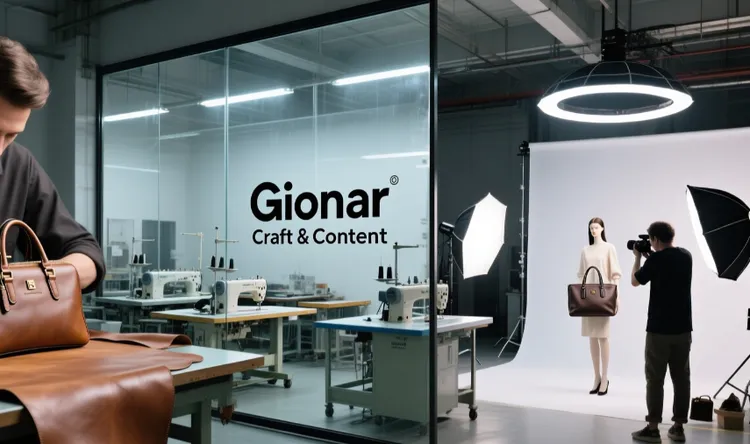
The real strength of China’s leather goods industry lies in its manufacturing clusters. Areas such as Baiyun and Huadu (Shiling) in Guangzhou, Shenzhen, and Dongguan have developed into extensive, interconnected ecosystems for bag manufacturing.
In these key regions, particularly around Guangzhou, the entire supply chain is concentrated within a 50-kilometer radius. Brands can source premium leather, custom hardware (including clasps, zippers, and D-rings), lining fabrics, edge-painting materials, and packaging supplies from specialized suppliers, then have everything delivered directly to nearby manufacturing facilities.
This level of vertical integration eliminates much of the logistical friction and communication delays commonly associated with fragmented supply chains. If a specific hardware component is out of stock or a sample requires a different lining material, replacement components can often be sourced and delivered within hours rather than weeks.
This highly integrated ecosystem enables an exceptional level of collaboration and problem-solving among brands, factories, and material suppliers.
China’s manufacturing precision has advanced dramatically. The industry has evolved from labor-intensive, predominantly manual production toward highly engineered, technology-driven smart manufacturing.
Modern Chinese factories widely adopt advanced CAD/CAM software, automated laser cutting (which maximizes leather utilization and ensures precise pattern symmetry), and computerized sewing machines capable of accurately controlling stitches per inch (SPI).
Factories also implement AQL (Acceptable Quality Limit) sampling, multi-stage quality control systems, and rigorous material testing, including testing and verification by organizations such as SGS and UL, to meet international quality standards.
Craftsmanship has also evolved to meet the expectations of premium global fashion brands. Chinese artisans are now proficient in complex techniques such as double-needle saddle stitching, flawless edge painting (often requiring multiple thin coats), and precision hardware installation.
By combining skilled craftsmanship with industrial precision, Chinese manufacturers can produce leather goods that meet the aesthetic and functional expectations of mid-range to high-end consumers worldwide.
At the upper end of the manufacturing market, the traditional perception that “China means low cost, while Italy means high quality” is outdated.
Today, precision is documented, measurable, and auditable — not simply determined by a craftsman’s experience or visual judgment.
A qualified OEM manufacturer’s quality control framework typically includes the following stages:
Quality inspections are conducted at four key stages: incoming materials, cutting tables, sewing lines, and finished products.
Key requirements include:
Digital technologies are making production accuracy more consistent and measurable.
Gerber / Lectra CAD pattern engineering: Manual pattern drafting can introduce dimensional errors of ±3 mm, which may accumulate during assembly. Digital pattern engineering helps minimize these deviations and maintain consistency.
CLO3D / Browzwear virtual sampling: 3D virtual prototyping can reduce the number of physical prototype rounds from approximately 5–6 to 2–3, accelerating product development and reducing sampling costs.
Pantone color matching: Standardized Pantone references, combined with approved leather samples from previous production runs, help maintain consistent brand colors across repeat orders.
For moderately complex bag structures — including camera bags, tote bags, bucket bags, and crossbody bags with partially hand-stitched construction — dimensional tolerances of ±1–2 mm can be maintained consistently.
This level of manufacturing precision is particularly evident in China’s advanced edge-painting capabilities.
High-end Chinese OEM manufacturers typically follow a controlled process involving heating, sanding, priming, and applying 3–4 thin layers of edge paint. The result is a smooth, seamless, rubber-like edge finish designed to withstand years of use.
The underlying process is based on the same core sequence used in professional edge-finishing systems, including Fenice SECTION LACQUER, Stahl EDGION, Xianke DAS680/C and DHS-05, as well as DISSONA’s five-coat, three-sanding technique:
Adhesion promoter → Filler → Color coating → Curing agent
Rather than relying solely on traditional hand-finishing techniques, Chinese manufacturers have industrialized this specialized chemical and finishing process, making consistent edge quality achievable at scale.
For international B2B buyers, compliance and traceability have become essential parts of supplier evaluation.
The following certifications and documentation are increasingly important when assessing a manufacturing partner:
Factory compliance: BSCI, Sedex, and ISO 9001, together with compliance with applicable REACH requirements.
Leather sourcing: LWG Gold or Silver ratings for full-grain leather tanneries, supported by chemical management practices compliant with REACH Regulation (EC) No. 1907/2006.
Sustainable materials: For rPET linings, suppliers should provide a valid GRS (Global Recycled Standard) Transaction Certificate (TC) with a verifiable certificate number.
GRS certificates can sometimes be expired or falsified, a risk frequently identified during supplier audits. Therefore, certificate authenticity and validity should always be verified directly with the relevant certification body or authorized verification platform, rather than relying solely on certificates presented in a supplier’s product catalog.
For brands sourcing leather bags internationally, these requirements provide a more transparent and reliable foundation for evaluating manufacturing partners, ensuring material traceability, and maintaining consistent product quality.
| Node | Role | What you buy there |
|---|---|---|
| Zhongda, Haizhu | Upstream materials & trims | Linings (cotton twill, canvas, rPET, coated cotton), zippers, D-rings, magnetic snaps, feet, edge paint, thread, interfacing, webbing, woven labels, dust bags, packaging; PU/faux leather at 五凤东场, hardware in 国际轻纺城 B1 |
| Baiyun / Sanyuanli / Guihuagang | Genuine leather, finished goods, OEM/ODM | Real hides (佳豪), top-grain bags (中港), hardware (亿森), 白云世界皮具贸易中心 1F–3F factory stores, custom hardware moulds |
| Shiling, Huadu ⭐ | Assembly base — “China’s Leather Capital” | 5 specialist markets (leather, hardware/zippers, lining/interlining, packaging/printing, finished-bag wholesale), 7 industrial parks, 13,000+ bag enterprises and 63,000+ sole proprietors, 700M+ bags a year, >60% of the European/American mass bag market |
| Dongguan (Houjie / Times / Lite) | Premium OEM for international labels | Full-grain programmes starting ~$18 ex-works, designated edge-paint supply from Xianke D&A, luxury-brand contract work |
| Shenzhen | Brand-owned atelier + SLG | DISSONA’s own R&D/manufacturing centre, 400+ traceable processes, saddle stitching, 200+ hand operations |
| Baigou (Hebei) / Pinghu & Haining (Zhejiang) / Yiwu | Volume, budget, small-MOQ fast fashion, leather & textile alternatives | Overflow capacity and price-tier coverage |
If Italy represents heritage and deliberate exclusivity, China represents speed and agility. The fast-fashion model in leather goods relies heavily on China’s ability to deliver rapid prototyping and short production lead times.
Rapid Sampling: In Europe, developing a single sample can take several weeks or even months. By contrast, Chinese factories can often produce complex physical prototypes within 7–10 days. This allows brands to iterate designs quickly, evaluate multiple options, and make timely adjustments based on market trends before committing to mass production.
Flexible Minimum Order Quantities (MOQs): Although large-scale factories generally prefer high-volume orders, many Chinese suppliers offer highly flexible MOQs. This is particularly valuable for emerging brands, allowing them to test the market with initial orders of just 50–100 units per style before gradually scaling production to thousands of units.
Production Speed: Mass production lead times are typically between 15 and 30 days, depending on product complexity. This speed enables brands to maintain lean inventory levels, adopt direct-to-consumer (DTC) business models, and respond quickly to emerging fashion trends and seasonal demand.
Although manufacturing in China generally remains more cost-effective than production in Europe, the cost gap is gradually narrowing as domestic labor costs rise and the industry shifts toward higher-value manufacturing.
Nevertheless, China’s cost advantage remains significant. A high-quality leather bag featuring complex hardware components can cost only a fraction of the price of a comparable product manufactured in Italy or France.
This cost efficiency does not come at the expense of quality. Instead, it is driven by optimized supply chains, economies of scale, and highly efficient production processes.
For accessible luxury and premium contemporary brands, China offers an outstanding balance between product quality, manufacturing costs, and overall value.
Ongoing U.S. tariffs on Chinese-origin goods have had a significant impact on the landed cost of bags manufactured in China.
To mitigate these risks, many brands are adopting a China+1 sourcing strategy. Under this approach, they continue to manufacture precision-intensive, complex products with demanding delivery schedules in China, while shifting simpler, high-volume products to alternative manufacturing destinations such as Vietnam and Cambodia.
This diversified sourcing model helps brands balance manufacturing efficiency, cost competitiveness, and exposure to trade policy changes.
Verified Factory-Gate Cost Benchmarks: Based on audited suppliers and production batches of 500 units.
| Item | China | The catch |
|---|---|---|
| PU shoulder bag (30×20×10 cm) | $5.20–7.50 | — |
| Vegan-leather crossbody, custom logo (300 u) | $6.80–9.50 | — |
| Full-grain cowhide tote | $22.00–34.00 | Mid-tier Shiling PU/leather runs $4–12 ; Dongguan premium OEM from ~$18 |
| Custom hardware mould | $250–600 one-time | Amortised over repeats; the hidden cost of a logo puller |
| Sample fee | $50–150, credited back on first order | Italy: €200–600 per style, 21–30 days |
| Cost structure inside the quote | Materials 45–55%, labour 15–20% (one sewer = 6–10 standard bags/day), factory margin 8–12% | Trading companies add 15–30% and blur accountability |
| Dimension | China (Guangzhou) | Italy |
|---|---|---|
| FOB, mid-tier | $15–25 | $80–150 |
| Relative FOB cost | 1.0× baseline | 3–6× |
| Factory labour | ~$5–8/hr | ~$15–25/hr |
| MOQ | 100–500 (300–500/style/colour typical; 100–150 trial at +10–15%; 50-piece sample runs in some clusters) | 30–100 atelier / 100–300 mid-size / 200–500 in some benchmarks |
| Production lead time | 25–45 days (40–45 with custom moulds; screening tables extend to 35–50 / 50–65 for complexity) | 60–90 days; concept→warehouse 9–18 weeks |
| Sampling | 7–14 days, $50–150 | 21–30 days, €200–600 |
| Monthly capacity | 30,000+ pcs at scale | 500–2,000 pcs |
| Hardware ecosystem | ⭐⭐⭐⭐⭐ | ⭐⭐⭐⭐⭐ |
| IP protection | ⭐⭐⭐ | ⭐⭐⭐⭐⭐ |
| English support | ⭐⭐⭐⭐ | ⭐⭐⭐ |
| Certifications | BSCI / Sedex / ISO 9001 / REACH / OEKO-TEX | ISO / OEKO-TEX / SA8000, Italian Chamber |
Minimum order quantities (MOQs) and lead times depend on the specific combination of materials and manufacturing facilities, rather than the country of production alone. Custom-dyed leather, exclusive tooling, and specialty leather materials can affect these requirements regardless of the manufacturing location.
Please treat all the pricing figures above as indicative benchmarks for supplier evaluation and initial screening, rather than as firm quotations.
| Italy keeps | China cannot retrofit |
|---|---|
| 20–50% accessible-luxury retail premium for the origin label | “Made in China” carries no provenance premium — yet |
| 20–50 pc atelier micro-runs with heritage framing | Trial orders exist, but the story of a 30-piece Florentine capsule does not |
| Quota, VIC relationships, above-retail resale | No scarcity, no secondary market, heavy discount-channel history |
| Stronger IP protection and auditable artisanal provenance | IP ⭐⭐⭐ vs ⭐⭐⭐⭐⭐ |
| EU-market landed cost: no 3% duty, short freight | China-origin pays 3.7% into the EU plus freight |
| Ultra-premium consistency: $2,500+ retail, multi-cavity structured builds, 2–3 hides rejected per bag | Asian factories dominate $0–1,000 retail without quality compromise; top-tier stitch precision and long-term shape retention begin favouring European lines at $1,000–2,500 |
| Your situation | Choose | Why |
|---|---|---|
| Retail €150–450, 300+ pcs, 6–10 SKU testing, <60-day launches | China | Cost ceiling, 7–14 day samples, 25–45 day production, component density |
| Woven / raffia / technical / multi-component bag | China / Asia | The fibre, the weaving and 20–50 trims are all in the same corridor |
| Chinese domestic market, Chinese brand | China, with honest material sourcing | 90.7% prefer domestic; Bain validates local supply-chain price advantage |
| Micro-capsule 20–50 pcs at €450–800+, EU/US market, provenance is the product | Italy | Premium covers 3–6× factory cost |
| US-bound, tariff-sensitive, >1,000 pcs/style | China + Vietnam/Cambodia split | Origin switching removes the Section 301 layer |
| $2,500+ heirloom build | European atelier | Consistent ultra-premium construction remains the benchmark |
| Any fold-heavy, draped, frequently flexed design | Neither location decides this — spec does | Embossed/rigid leathers crack at flex points regardless of postcode |
Source Tuscan vegetable-tanned or Veneto chrome-tanned leather with batch traceability and LWG certification, then assemble the finished products in Dongguan, Guangzhou’s Baiyun District, or Shiling, Huadu District.
Products can be marketed with the statement “Made with vegetable-tanned leather from Santa Croce sull’Arno, Italy” — but not “Made in Italy.”
China’s established imports of raw materials from Italy and France demonstrate that this hybrid supply chain is both commercially viable and operationally established.
Use water-based PU systems from Fenice, Stahl, or Xianke, combined with a controlled process involving 3–4 layers of heated, sanded edge coating and primer application.
The finished products should be tested and verified against the following performance requirements:
These requirements form part of the comprehensive technical specifications outlined earlier in this series.
Maintain the craftsmanship and brand storytelling of limited-edition hero collections through initial production runs of 30–100 units. Once the technical specifications and manufacturing processes have been validated, scale production to 300–1,000 units across Asian manufacturing facilities.
Always evaluate suppliers based on the same cost scope, including:
A tote bag quoted at $22 per unit does not necessarily cost $22 once customs clearance, applicable EU TARIC duties (such as a 3.7% rate) or cumulative U.S. tariffs (potentially around 50%, depending on the applicable measures) are factored in.
The real comparison should always be based on the total landed cost, not the factory quotation alone.
Evidence from Chinese consumer brands shows that premium positioning is increasingly achievable. However, premium pricing must be supported by demonstrable product quality, craftsmanship, and overall value.
Permanent discounting risks reinforcing the outdated perception that “Made in China” automatically means low-cost products — a pricing trap also highlighted in analyses by Bain and 2026 market research.
Build your pricing strategy around verifiable value, not continuous discounting.
India holds a distinctive position in the global leather goods manufacturing industry, ranking as the world’s second-largest producer of leather footwear and apparel. Its highly vertically integrated supply chain covers every stage of production, from raw hides and leather tanning to surface finishing and export-oriented manufacturing.
India’s handbag market is valued at approximately USD 4.3 billion and is projected to grow at a compound annual growth rate (CAGR) of 8.80% through 2032. The country’s broader leather industry employs approximately 4.42 million people.
In FY2025, India’s leather exports reached USD 5.7 billion, representing a year-on-year increase of 25%. The Council for Leather Exports projects that exports will reach USD 6.5 billion in FY2026.
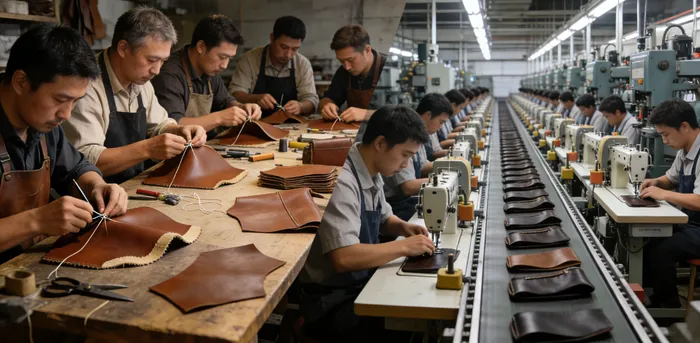
However, India’s competitive advantage is not simply about offering a “low-cost alternative.” Rather, it lies in a distinctive manufacturing ecosystem built around two key strengths: abundant raw material resources and deeply rooted regional traditions of artisanal craftsmanship.
For brands whose product concepts embrace — or even celebrate — organic textures, handmade construction, and artisanal finishing, India offers a unique value proposition that cannot easily be replicated by Italy’s premium manufacturing heritage or China’s precision-driven industrial production.
| Strength | Details | Benefit for Brands |
|---|---|---|
| Raw material access | Large domestic hide supply and tanning capacity | Better cost control and material options |
| Artisanal skills | Strong tradition of handwork and detailed finishing | Distinctive, character-rich products |
| Cost competitiveness | Generally lower than Europe; competitive with or better than China on some premium handcrafted styles | Good value for quality |
| MOQ flexibility | Often more accommodating for smaller or medium runs than large Chinese factories | Easier for emerging or niche brands |
| Compliance progress | Increasing adoption of international standards (REACH, LWG, social audits) | Better suited for Western markets |
Speed and Scalability: Production is generally slower than China’s leading manufacturing clusters, particularly for high-volume orders and fast-turnaround production. Scalability can also be more limited.
Consistency: Quality standards vary considerably between factories, making rigorous supplier selection, quality inspections, and ongoing production supervision essential.
Brand Prestige: Compared with the “Made in Italy” label, “Made in India” carries less immediate luxury brand recognition in international markets.
Infrastructure and Logistics: Compared with more established export hubs, manufacturers may face longer lead times and additional logistical challenges.
Modern Industrial Precision: Although India has capable manufacturers, it is generally not the first choice for highly standardized, technology-driven, large-scale production.
India’s leather industry is built on abundant domestic supplies of cattle, goat, and sheep hides. This is more than a simple sourcing advantage; it is a fundamental factor shaping India’s manufacturing cost structure and distinctive material characteristics.
Buffalo leather is one of India’s most distinctive raw materials, particularly in the northern regions around Kanpur. Known for its thickness, high density, and exceptional durability, buffalo leather is well suited to products that require strength and longevity, including belts, wallets, saddlery, and structured bag components.
By contrast, goat and sheep leather are generally finer, lighter, and more flexible, making them ideal for handbags, small leather goods, and lining applications.
Having access to these different leather types within the same supply chain allows Indian manufacturers to produce a broad range of products, from rugged, hard-wearing accessories to refined, lightweight leather goods.
India also has a deep-rooted tanning tradition. Tamil Nadu accounts for nearly half of the country’s tanning capacity, while the Chennai–Ambur–Ranipet leather belt has accumulated decades of processing expertise, specializing in export-grade leather and environmentally compliant production.
Traditional vegetable tanning, using locally sourced tree barks such as eucalyptus, avaram, and babul, remains an important part of India’s leather-making heritage. These methods produce leather with a natural, rustic character that cannot be fully replicated through conventional mechanical processing or synthetic tanning agents.
For brands seeking an authentic, raw-material-driven product story, this distinction matters: the leather itself carries visible traces of its origin and natural character.
However, one of the key challenges associated with this manufacturing tradition is consistency.
India’s raw material supply chain remains fragmented, with leather sourced from numerous slaughterhouses and tanneries of varying sizes. Grading and processing standards can be less standardized than those maintained by vertically integrated European tanning groups.
Brands accustomed to strict batch-to-batch tolerances in color and texture should therefore incorporate incoming material inspections into their quality control systems or work with factories that maintain long-term relationships with reliable tanneries.
India is known for producing high-quality cowhide and buffalo leather, valued for its durability, distinctive texture, and natural character.
Eastern India is known for producing a distinctive category of leather commonly referred to as “East India Leather,” made primarily from goat and sheep hides and recognized for its particular material characteristics.
Available options include various types of DD leather, naturally dried and buffed leather, suede, and leather with vintage, distressed, brushed, and dyed finishes.
In addition to genuine leather, Indian manufacturers commonly work with cotton canvas, jute, polyester, nylon, and synthetic leather alternatives such as PU and PVC.
Many manufacturers use vegetable tanning as an alternative to conventional chemical tanning processes to help reduce environmental impact.
Vegetable-tanned leather develops a distinctive patina over time, giving finished products an increasingly rich, aged appearance.
For example, artisans in Rajasthan use goat and buffalo leather to create products through traditional, environmentally conscious processes, with some production methods emphasizing 100% natural materials and recyclability.
| Cluster | Core Strength | Best Suited For |
|---|---|---|
| Chennai–Ambur–Ranipet (Tamil Nadu) | Nearly half of India’s tanning capacity; export-oriented, environmentally compliant factories | Premium footwear, leather garments, structured bags requiring consistent finishing |
| Kanpur (Uttar Pradesh) | Buffalo leather processing; density and durability | Belts, wallets, saddlery, rugged bag components |
| Kolkata / Bantala (West Bengal) | Small leather goods and handbags; skilled hand-finishing with modern export infrastructure | Wallets, clutches, handbags for boutique and mid-sized brands |
| Agra (Uttar Pradesh) | Footwear manufacturing at mid-to-high volume | Footwear-adjacent bag lines, volume production |
India’s greatest competitive advantage in leather bag manufacturing is not necessarily the cost of raw materials, but the ability to preserve commercially viable artisanal craftsmanship within a scalable production model.
Across several regions, traditional craft techniques have evolved into distinctive product identities that set Indian leather goods apart in the global market.
Santiniketan Leather Craft received Geographical Indication (GI) recognition in 2008. It uses vegetable-tanned sheep and goat leather and is renowned for its embossed patterns, batik techniques, appliqué work, and vibrant natural dyes.
The craft was introduced by Rabindranath Tagore in 1932 as part of a rural reconstruction initiative and has since been passed down through generations of artisan families for more than 90 years.
The embossed patterns are permanently imprinted into the leather, creating finished bags with smooth, polished surfaces, rich colors, and an instantly recognizable visual identity.
Jawaja Craft (Rajasthan)
Jawaja craftsmanship features a distinctive construction language. Its handles are created using a circular, crown-like braided knotting technique, made by splitting and weaving a single strip of leather. This approach not only reduces material consumption but also creates a sculptural, visually striking effect.
The bag body is hand-stitched using narrow leather strips and a characteristic diamond-stitch pattern, which serves as a signature design feature of the collection. Printed fabric linings complete the construction.
Founded in 2018, the contemporary Indian brand Leather Garden demonstrates how traditional artisanal techniques can be transformed into modern luxury products.
The brand’s creative director has a background in garment design and has previously designed products for internationally recognized labels such as Prada, Miu Miu, Tory Burch, and Ralph Lauren.
Leather Garden applies techniques traditionally associated with textiles — including embroidery, embellishment, and handcrafted surface treatments — directly to leather.
The result is not simply an Indian interpretation of an existing design concept, but a distinctive visual and tactile world rooted in India’s own rich heritage of craftsmanship and artisanal knowledge.
| Region | Manufacturing strengths |
|---|---|
| Chennai and Ambur | Leather processing and finished leather |
| Ranipet and Vaniyambadi | Tanning and leather production |
| Kanpur | Leather goods and accessories |
| Kolkata | Leather bags and small leather goods |
| Mumbai | Fashion accessories and leather products |
| Rajasthan | Traditional leather craftsmanship |
| Cluster | Specialty | Why it matters |
|---|---|---|
| Chennai – Ambur – Vaniyambadi – Ranipet (Tamil Nadu) | Finished leather, footwear, export-grade structured goods; ~40% of India’s leather exports; 600+ tanneries; India International Leather Fair | Deepest LWG-rated tannery infrastructure and the most compliance-mature exporters |
| Kanpur – Unnao / Jajmau (Uttar Pradesh) | 400+ tanneries, buffalo hide, saddlery & harness; ~40% of India’s saddlery exports; Jajmau CETP, Banthar Leather Technology Park, CLRI/FDDI nearby | The saddle-stitch heritage; also the environmental hotspot |
| Kolkata / Bantala (West Bengal) | Bags, wallets, small leather goods, fine finishing, fair-trade and design-led export houses | Best fit for hand-finished bag programmes; West Bengal ~14% of national leather exports |
| Delhi NCR (Noida, Gurugram, Okhla) | Design studios, buying houses, private-label coordination | Good project management, often multi-factory |
| Agra / Jalandhar | Footwear volume; sports leather, gloves | Component and labour overflow |
| Craft belts — Jodhpur, Jaipur, Kutch/Bhuj, Bareilly, Lucknow, Kolhapur | Hand-tooling, zardozi, mirror work, chikankari, kantha, block print, Kolhapuri GI | The “rustic craft” layer — technically a textile/embroidery supply chain grafted onto leather |
Labor costs in Indian factories are approximately 40%–60% lower than those in China’s coastal manufacturing regions. Leather goods have also been identified as a product category in which India holds a competitive advantage over China.
However, for typical consumer products, labor accounts for only 8%–25% of total manufacturing costs. The remaining costs include raw materials, tooling, energy, waste, and overhead — areas where India’s supporting industrial ecosystem is still less developed.
One critical but frequently underestimated cost factor is imported components.
When Indian factories source zippers, hardware, or specialty materials from China, buyers pay the original Chinese component price plus freight, import duties, and the Indian manufacturer’s markup.
Consider a product where labor accounts for 15% of total manufacturing costs. A 50% reduction in labor costs translates into just 7.5% in overall savings. Meanwhile, if materials account for 45% of the total cost, a 12% import premium can completely eliminate that advantage.
Supply chain depth is another area where India faces limitations.
Tooling and mold development typically take 35–60 days in India, compared with approximately 18–35 days in China. Component sourcing also remains partially dependent on imports rather than a fully localized supply network.
Leather goods production lead times generally range from 30–60 days, depending on design complexity and customization requirements. Although this is longer than the fastest manufacturing clusters in China, it is comparable to — and in some cases better than — the production timelines associated with traditional Italian artisanal manufacturing.
Where India has a clear advantage is MOQ flexibility.
Typical minimum order quantities are:
These thresholds are often lower than those required by large Chinese factories and significantly more accessible than the minimums typically demanded by Italian artisanal manufacturers.
For brands testing new markets or launching niche collections centered on craftsmanship, this flexibility represents a valuable operational advantage.
Many Indian factories also accept trial orders for handcrafted or design-led products, allowing brands to validate product quality and consistency before committing to larger production runs.
India’s relatively favorable tariff position in the U.S. market has strengthened its export competitiveness. In addition, the India–EU trade agreement has removed the previous 17% import duty on Indian leather products, positioning India as a major beneficiary of improved trade access to the European Union.
For brands targeting European or U.S. markets, these trade developments can improve the cost competitiveness of sourcing from India.
However, the global tariff environment is far from static. U.S. punitive tariffs have created additional challenges, and industry representatives are actively lobbying for a zero-tariff agreement with the United States.
Brands should therefore model different tariff scenarios rather than assume that current advantages will remain permanent. India is best viewed as part of a diversified, multi-country sourcing strategy rather than a standalone manufacturing solution.
India Is a Good Fit When:
1. Craftsmanship is central to your product identity.
Visible stitching, embossed patterns, hand-finished edges, and traditional surface treatments are commercially viable and culturally authentic in India’s manufacturing ecosystem.
2. You are launching or testing a craft-driven collection.
With handbag MOQs of approximately 50–100 units per style and the availability of trial orders, India offers a relatively low-commitment entry point for design-led products.
3. Your material story benefits from buffalo leather, goat leather, or vegetable-tanned hides.
These materials offer distinctive characteristics that can be difficult to replicate elsewhere at comparable costs.
4. You need to diversify sourcing beyond China to manage tariff exposure in the U.S. or EU markets.
India can provide an alternative manufacturing base, provided your products can accommodate somewhat longer production lead times.
5. You are targeting India’s domestic consumer market.
India’s domestic handbag market, valued at approximately USD 4.3 billion, is projected to grow at a CAGR of 8.8%. With online retail penetration reaching 32%, the market offers genuine growth opportunities for brands willing to localize their products and operations.
When to Avoid or Delay Manufacturing in India
1. Your products require precision hardware and exceptional batch-to-batch consistency.
India’s reliance on imported components and fragmented raw material supply chains can introduce quality variations that require proactive supplier management and tighter quality controls.
2. Speed is your primary competitive advantage.
Compared with China’s coastal manufacturing clusters, India generally has longer production lead times, slower tooling cycles, and a less automated supply chain.
3. You require a fully localized raw material supply chain.
Many hardware components and specialized materials still need to be imported. The resulting additional costs can offset much of India’s labor cost advantage.
4. Your brand positioning depends on European origin and heritage.
“Made in India” does not yet carry the same prestige premium as “Made in Italy” or “Made in France.” Its value proposition is more closely associated with skilled craftsmanship, artisanal character, and value for money than with heritage-driven exclusivity.
| Item | India | China (earlier) | Italy (earlier) |
|---|---|---|---|
| Relative cost | 30–50% below Italian/Spanish equivalents; finished leather 20–35% below Turkish | Baseline | 3–6× FOB |
| Handicraft FOB | $11–26/unit (tooled, veg-tan, small-batch) | Full-grain tote $22–34 | Hard cost €110–300 |
| MOQ⭐ | 50–300 pcs typical; bags with custom hardware 300–500; craft accessories 50–100 | 100–500 | 30–100 atelier |
| Sampling | 5–10 days | 7–14 days | 21–30 days, €200–600 |
| Bulk production | 20–45 days / 4–8 weeks; approved-sample-to-ship 40–60 days | 25–45 days | 60–90 days |
| Ocean freight to US/EU | 25–35 days plus port handling | — | Short intra-EU |
| LWG-certified leather | +15–20% on unit price | — | Built in |
| Dimension | Italy | China | India |
|---|---|---|---|
| Sells | Provenance / pricing power | Precision / speed / ecosystem | Raw material / handwork |
| FOB mid-tier | $80–150 | $15–25 | ~$11–26 (handicraft) |
| Sampling | 21–30 d | 7–14 d | 5–10 d |
| Production | 60–90 d | 25–45 d | 20–45 d (+25–35 d freight) |
| MOQ | 30–100 | 300–500 typical | ⭐ 50–300 |
| Repeatability | Medium | ⭐⭐⭐⭐⭐ | ⚠️ Low — workshop variance |
| Edge discipline | 3-coat artisan | 3–4 coat industrial; DISSONA “Five Coats, Three Polishes” | ⭐ Burnished wax, not painted |
| Chemical burden | REACH/DPP | REACH/ZDHC/GRS/EUDR | ⭐ Heaviest: Cr(VI), effluent, social |
| Origin premium | ⭐ 20–50% | None | None (ethics story instead) |
| Best for | €450–800+ provenance capsule | Core line, 300+ pcs, multi-component | 50–150 pc craft capsule, heritage/rustic SKU |
| Your situation | Choose |
|---|---|
| 50–150 pc hand-stitched veg-tan capsule, rustic/heritage aesthetic | ⭐ India |
| Embroidered or mirror-work limited edition with artisan provenance | ⭐ India (Kutch / Bareilly / Jodhpur) |
| UK/EU-bound, tariff-sensitive, mid-volume | India — 0% UK, GSP EU |
| Core line, 300+ pcs, 6–10 SKUs, <60-day launches, 20–50 trims | China |
| €450–800+, “Made in Italy” is the product | Italy |
| Fine pebbled bull calf (Togo-equivalent) handles, embossed Epsom-equivalent panels | China / Italy — not buffalo |
| $2,500+ heirloom build | European atelier |
| Any fold-heavy or flex-critical design | Neither location decides it — the spec does |
Choosing a manufacturing destination is not a one-time decision, but a strategic move that must align with your brand’s maturity, pricing structure, and cash flow.
The needs of a startup testing the market are fundamentally different from those of an established luxury brand seeking to preserve its heritage and premium positioning.
The following strategic framework helps brands evaluate China, Italy, and India as manufacturing destinations based on their stage of growth and position in the brand lifecycle.
Ultimately, the right choice depends on your order volume, budget, lead-time requirements, and market positioning.
| Dimension | Italy | China | India |
|---|---|---|---|
| Core positioning | Prestige, heritage luxury, refined finish | Precision, speed, full industrial ecosystem | Raw material abundance, rustic hand craft, veg-tan artistry |
| Best fit | Ultra-luxury small runs, brand heritage flagship | Mid-to-high volume, structured bags, tight QC, fast sampling | Slow fashion, folk / rustic / veg-tan limited batches |
| Signature trait | Refined, consistent luxury feel | Repeatable precision, full one-stop supply | Organic grain, hand variation, patina character |
| Main trade-off | Very high cost, limited capacity | Higher MOQ for custom tooling | Consistency control, lead time, audit readiness |
| Dimension | China | Italy | India |
|---|---|---|---|
| Average FOB unit cost (genuine leather) | 35–35–65 | 80–80–150 | 40–40–70 |
| Standard production lead time | 30–45 days | 60–90 days | 50–70 days |
| Typical MOQ per style | 50–300 pcs | 100–200 pcs | 200–500 pcs |
| Quality consistency rating | ★★★★★ (high, systemized QC) | ★★★★★ (premium artisanal) | ★★★ (medium, handmade variation) |
| Sample turnaround time | 7–10 days | 21–30 days | 14–21 days |
| Best suited order scale | 100–500,000+ pcs | 30–5,000 pcs | 50–2,000 pcs |
| Dimension | Stage 1: Startup / Validation (0–2 Years) | Stage 2: Growth / Scaling (2–5 Years) | Stage 3: Mature / Premium Luxury (5+ Years) |
|---|---|---|---|
| Primary Goal | Test market fit; conserve cash; iterate designs rapidly | Scale volume; improve margins; build a distinct brand identity | Elevate brand equity; maximize prestige; offer exclusivity |
| Price Point | $50 – $150 | $150 – $400 | $500 – $2,000+ |
| Best Fit | China (for speed/precision) or India (for craft) | China (for scale) or India (for margin) | Italy (for heritage) |
| MOQ Reality | China: 50–100 units; India: 50–100 units; Italy: 100+ units & €3,000 min | China: 300–1,000 units; India: 200–500 units | Italy: 100+ units (but often restricted by material minimums) |
| Lead Time | 7–15 days (sampling); 20–30 days (bulk) | 15–30 days (bulk) | 45–60+ days (bulk) |
| Key Advantage | Low commitment, fast speed-to-market | Supply chain depth, hardware integration, cost efficiency | “Made in Italy” provenance, artisan scarcity, DPP compliance |
Primary Goal: You have a design concept and a limited budget. Your top priority is to validate market demand quickly while avoiding the risk of being left with excess inventory.
Key Priorities:
Comparing the Three Manufacturing Destinations
Your products require complex hardware components, precision mechanical stitching, and physical samples within 7–10 days.
China’s extensive manufacturing ecosystem allows you to source and produce 50–100 units with relatively low upfront investment, making it an ideal testing ground for accessible luxury products.
However, keep U.S. tariff exposure in mind if the United States is your primary market, as this may require adjustments to your large-scale production strategy later.
Your brand identity is rooted in handmade craftsmanship, naturally vegetable-tanned leather, and organic textures.
India’s relatively low MOQs of 50–100 units and willingness to accept trial orders make it particularly suitable for developing small-batch capsule collections.
However, you should allow for additional working capital to accommodate potential delays in imported components and more intensive on-site quality control.
Unless you are purchasing ready-made stock (typically 2–12 units per style), Italy is generally not an ideal manufacturing destination for startups.
Custom production in Italy typically requires a minimum order value of at least €3,000, while sample development alone can take up to three weeks.
The cost structure, including labor costs that can exceed $400 per bag, is often too expensive for brands that have not yet established a premium market position.

Factories in Guangzhou and Dongguan support small-batch production, with MOQs starting at just 50 units per style. This allows you to conduct trial production without committing tens of thousands of dollars to inventory.
With sample lead times of 7–10 days, you can quickly refine designs, test edge finishes, adjust hardware components, and optimize product styles while gathering feedback from early customers.
China’s fully integrated local supply chain also eliminates many hidden costs associated with small-batch production. Custom hardware, lining materials, and packaging can all be sourced within the same manufacturing cluster, without the need for cross-border coordination.
At this stage, the objective is to increase production capacity while balancing quality and cost, maintain reliable and rapid replenishment, improve profit margins, and develop a recognizable product collection.
You need to scale production to thousands of units while maintaining strict quality control through AQL inspections and SGS testing.
Chinese factories offer the strongest overall balance of production speed, cost efficiency, and advanced manufacturing capabilities.
To mitigate tariff exposure, consider adopting a China+1 sourcing strategy: keep precision-intensive and complex handbags in China, while moving simpler, high-volume product lines to Vietnam or Cambodia.
You want to build stronger profit margins while developing an authentic artisanal brand story.
By sourcing locally available goat and buffalo leather and incorporating traditional Indian techniques, such as Santiniketan embossing, you can create a distinctive product identity.
India’s reported 17% tariff reduction on leather products entering the EU also makes it an attractive sourcing destination for brands targeting European markets.
At this stage, you can work with Italian tanneries, such as those in Santa Croce sull’Arno, to develop and test the luxury market with hero products or limited-edition collections, while keeping your core production volume in Asia.
However, Italian manufacturing may struggle to keep pace with rapid business growth. With typical factory output of just 500–1,000 units per month, capacity constraints can lead to stock shortages.
Large Chinese factories can scale production from initial trial runs of 500 units to mass production exceeding 100,000 units without requiring you to change manufacturing partners.
They can also implement comprehensive AQL 2.5/4.0 quality control systems to help maintain consistent defect rates as production volumes increase.
ERP-driven production scheduling can reduce replenishment response times for best-selling SKUs by up to 30%, helping brands maintain product availability during demand surges driven by social media and avoid stockouts.
Standard production lead times of 30–45 days also support e-commerce brands launching new products every month, offering faster turnaround than many regional alternatives.
At this stage, the focus shifts toward preserving brand prestige, signature craftsmanship, and the value of your brand story.
Your customers are no longer purchasing just a product. They are investing in heritage, exclusivity, and uncompromising quality.
When your handbags retail for $500–$2,000 or more, the “Made in Italy” label becomes more than a manufacturing detail. It becomes an integral part of the product’s identity.
It can significantly enhance perceived value and resale appeal, potentially supporting retail prices three to five times higher than comparable products and helping offset higher manufacturing costs.
Manufacturing in Tuscany gives brands access to centuries of artisanal heritage, vegetable-tanned leather, and sophisticated hand-finishing techniques. These capabilities create distinctive, recognizable craftsmanship that reinforces the values of quiet luxury and heritage-driven branding.
Italy is also moving toward early adoption of the EU Digital Product Passport (DPP), supporting compliance and product traceability as European regulatory requirements take effect from 2026 onward.
Leading global luxury groups rarely rely on a single manufacturing country. Instead, they strategically allocate production according to product positioning, margin requirements, and manufacturing capabilities.
Italy: Manufacture flagship leather collections and iconic heritage pieces to reinforce premium positioning and brand exclusivity.
China: Produce high-margin entry-level products, such as canvas bags and small leather goods, alongside core mid-market SKUs to maintain competitive pricing and production efficiency.
India: Develop artisanal capsule collections featuring hand embroidery, traditional embellishment, and other craft-intensive techniques to create distinctive premium products.
Yes. Many accessible luxury and premium contemporary brands rely heavily on Chinese manufacturing.
Brands such as Coach, Michael Kors, Tory Burch, and Kate Spade have manufactured products across China, Vietnam, Cambodia, India, and the Philippines for many years. Some premium or limited-edition collections are produced in Italy, Spain, or France.
Traditional high-end luxury houses such as Hermès, Chanel, Dior, and Louis Vuitton continue to manufacture their core leather goods collections in European workshops. However, they may also source components, hardware, linings, and certain small leather goods from international suppliers, including those in China.
Neither is inherently better. Indian and Chinese leather each offer distinct advantages depending on the product requirements.
India is particularly known for vegetable-tanned leather, goat, sheep, and buffalo hides, as well as rustic, handcrafted textures. Its abundant livestock resources provide a strong raw material foundation, while an increasing number of LWG-certified tanneries serve international exporters.
China’s strengths lie in manufacturing scale, material consistency, access to imported European leather, advanced finishing capabilities, and a well-developed hardware supply chain.
These advantages make it easier for Chinese manufacturers to meet demanding premium product specifications and maintain consistency across larger production runs.
Yes. Absolutely. This hybrid approach is common among brands seeking the material prestige of European leather while benefiting from the manufacturing efficiency and cost advantages of Asia.
The process is commonly referred to as CMT (Cut, Make, Trim) or customer-supplied materials.
Brands typically purchase premium Italian leather from established tanneries, particularly in regions such as Tuscany, and ship it to Chinese factories for cutting, stitching, and assembly.
This approach combines the prestige and tactile quality of Italian leather with China’s precision engineering, production speed, and lower labor costs.
Coach, Michael Kors, and Tory Burch are accessible luxury brands that use global, multi-country manufacturing strategies.
China has historically been an important production base because of its integrated supply chain, precision engineering capabilities, and capacity for large-scale manufacturing.
These brands also source products from countries such as Vietnam, Cambodia, India, Indonesia, and the Philippines. Certain premium or seasonal collections may also be manufactured in Italy or Spain.
It depends on the complexity of the bag and the production requirements.
In general, China offers stronger cost advantages for large-volume production, hardware-intensive designs, and precision-engineered handbags.
Its vertically integrated manufacturing ecosystem makes it easier and more cost-effective to source components such as hardware, zippers, and linings, while maintaining faster production schedules.
India, on the other hand, may offer lower costs for small-batch production, handmade products, vegetable-tanned leather goods, and embroidered designs.
For structured handbags requiring precision hardware, consistent quality, and fast production, China is generally the more cost-effective choice.
Yes. Combining Italian leather with Chinese manufacturing is entirely possible and follows a well-established production model commonly known as CMT (Cut, Make, Trim).
You purchase leather from an Italian tannery, export it to China, and have the Chinese factory cut, stitch, and assemble the finished handbags.
However, one critical consideration is country-of-origin labeling.
Since the final substantial manufacturing processes — including cutting, stitching, and assembly — take place in China, the finished handbags must generally be labeled “Made in China” under applicable rules of origin, rather than “Made in Italy.”
Brands should choose their manufacturing destination based on their market positioning, order volume, quality standards, risk assessment, and long-term business strategy.
China is ideal for brands prioritizing manufacturing efficiency, scalability, and cost competitiveness.
Italy is best suited to luxury brands seeking heritage, exceptional craftsmanship, and premium positioning.
India is an attractive option for brands focused on artisanal techniques, distinctive materials, and cost advantages in specialized production.
From a brand lifecycle perspective, the strategic approach is straightforward:
Startup and market validation: Start with China, or consider India for small-batch, craft-focused collections.
Growth and scaling: Rely primarily on China for production capacity, consistency, and cost efficiency.
High-end luxury: Choose Italy for premium collections where heritage and craftsmanship are central to brand value.
Rather than committing to a single manufacturing destination throughout your brand’s lifecycle, consider a flexible strategy that combines large-scale production in China, premium craftsmanship in Italy, and specialized artisanal collections in India.
This hybrid approach allows brands to optimize manufacturing costs, production speed, and brand positioning simultaneously.
Overall, China remains a highly competitive and reliable choice for brands seeking a balance of manufacturing quality, production efficiency, scalability, and cost-effectiveness.
If you are planning to scale up your handbag collection, Gionar, based in Guangzhou, China, can be your manufacturing partner. With access to China’s integrated bag manufacturing ecosystem and the capabilities to support different production requirements, Gionar can help bring your designs to market and support your brand’s long-term growth.

Previous :
Epsom Leather: The Ultimate Guide to Luxury’s Most Durable CalfskinNext :

Mobile Website

Inquires Whatsapp