- +86 13922774531
- info@gionar.com

English


English
October 14 , 2026
Quality standards in luxury bag manufacturing focus on premium materials, exceptional craftsmanship, structural integrity, and meticulous quality control throughout the production process, with precise controls and full traceability across the entire supply chain.
Material Acceptance Standards: Leather color variation is controlled within ΔE ≤ 1.5, a difference that is virtually imperceptible to the human eye. Each hide undergoes a comprehensive inspection, with a defect rate of no more than 3%. Metal hardware features at least five layers of electroplating and must pass a 72-hour salt spray test without developing rust spots. All materials must comply with stringent environmental regulations, including the EU REACH Regulation and California Proposition 65.
Quantifiable Craftsmanship Standards: Main seams are stitched at 8–12 stitches per inch (SPI), with stitch spacing deviations limited to ≤ 0.1 mm. Edge paint is applied in at least six layers, with each layer carefully hand-sanded. Pattern alignment on jacquard linings must have a deviation of no more than 0.5 mm. Corners must be free of wrinkles, and no loose threads may be visible. Load-bearing areas are reinforced using a combination of double stitching, through-rivets, and multiple reinforcement layers.
Exceptional manufacturers maintain rigorous quality control at every stage of production.
Stitching quality is one of the key indicators of craftsmanship in high-end bags. It affects product durability, visual appeal, and perceived value, while also serving as an indirect reflection of the manufacturer’s production capabilities and technical expertise.
Stitching quality is primarily determined by two key factors: stitch type and seam density.
Stitch density is measured in stitches per inch (SPI), which refers to the number of stitches within one inch (2.54 cm) of a seam. A higher SPI generally indicates tighter, finer stitching. However, the ideal range depends on the material being used and the manufacturing techniques involved.
| SPI Range | Typical Application | Quality Indication |
|---|---|---|
| 4–6 SPI | Heavy leather, thick seams, rustic hand-stitched look | Durable but coarse; common in workwear |
| 6–8 SPI | Hand-stitched luxury bags (saddle stitch) | Strong, traditional, highly prized |
| 8–10 SPI | High-end machine-sewn bags | Excellent balance of strength and refinement |
| 10–12 SPI | Fine leather goods, small accessories | Very refined, but may weaken leather if too tight |
| 12+ SPI | Delicate fabrics, not typical for leather | Can perforate and tear leather |
Luxury standard: most high-end leather bags fall between 8–10 SPI for machine sewing and 6–8 SPI for hand-stitching.
| Stitch Type | Description | Common Use |
|---|---|---|
| Lock Stitch | Two threads interlock; most common machine stitch | Mass-produced and high-end machine-sewn bags |
| Chain Stitch | Looped thread; stretchy but can unravel | Decorative seams, some casual bags |
| Saddle Stitch (Hand) | Two needles, one thread; extremely strong | Artisan luxury bags, Hermès-style |
| Double-Needle Stitch | Two parallel rows for reinforcement | Stress points: handles, straps, edges |
| Zigzag Stitch | Prevents fraying on fabric linings | Interior linings, non-leather areas |
| Checkpoint | What to Look For |
|---|---|
| SPI consistency | Same number of stitches per inch throughout |
| Straightness | Seams follow a clean, straight line |
| Backstitching | Reinforced at start and end of seams |
| Thread matching | Thread color and thickness suit the leather |
| No loose threads | Cleanly trimmed, no fraying |
| Even tension | No loops, no puckering, no skipped stitches |
| Stress points | Double-stitched or riveted for reinforcement |
The denser the stitching, the more points there are to distribute the load, reducing the tension borne by each individual stitch. A seam with 10 SPI can be 1.5–2 times stronger than one with 5 SPI. A luxury bag can last ten years without the seams coming undone, while a lower-quality bag may begin to unravel after just six months. This is one of the key differences.
Fine, evenly spaced stitches are decorative in their own right, giving a bag a more sophisticated, premium look. On lower-quality bags, widely spaced stitches and clearly visible needle holes can make the craftsmanship appear rough and inexpensive.
The denser the stitching, the smaller the gaps between needle holes, making it more difficult for water and dust to penetrate. Why are luxury brand bags less prone to water infiltration? Dense, precise stitching is one of the contributing factors.
Dense stitching holds two pieces of material more closely together, reducing the risk of shifting, wrinkling, or separation. This helps the bag maintain its crisp shape and structure without becoming deformed over time.
Why is Hermès’ saddle stitch so renowned? Beyond the use of traditional hand-stitching techniques, its fine, uniform stitches are a direct testament to the quality of the craftsmanship. Consumers may not be able to distinguish between different grades of leather, but they can readily see whether the stitches are dense and evenly spaced.
When a high-end bag shows signs of wear, its seams can often be restitched. Because the needle holes are small and closely spaced, professional repairs can be virtually invisible. Lower-quality bags, by contrast, often have large, widely spaced needle holes. Once the original stitching is removed, the material may be left visibly damaged, making restoration far less worthwhile.
| Feature | High-End Bag | Fast Fashion Bag |
|---|---|---|
| SPI | 7.5–8.5 | 6.0–7.0 |
| Thread | Bonded nylon / polyester, waxed, Serafil, Coats Gral | Cheap polyester, often thin |
| Stitch type | Lock stitch or saddle stitch | Basic lock stitch |
| Consistency | Uniform, precise | Often uneven, skipped stitches |
| Reinforcement | Double-stitched stress points | Minimal or none |
| Finish | Clean, trimmed, no loose threads | Loose threads common |
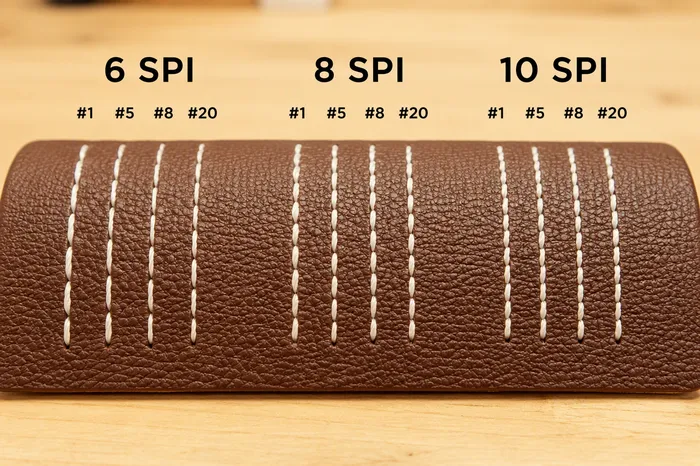
| Dimension | 6 SPI | 8 SPI | 10 SPI |
|---|---|---|---|
| Stitches per inch | 6 stitches | 8 stitches | 10 stitches |
| Relative stitch count | 1.00 | 1.33 | 1.67 |
| Pure sewing time | 100% | Approx. 133% | Approx. 167% |
| Overall labor time increase (including setup, thread changes, trimming, QC) | 100% | Approx. 120–135% | Approx. 140–170% |
| Thread consumption | 100% | Approx. 125–145% | Approx. 150–180% |
| Relative overall cost | 1.0 | Approx. 1.2–1.4× | Approx. 1.4–1.7× |
| Equipment requirements | Standard flatbed / walking-foot machine | Precision feed, fine needle and thread | High-precision feed, fine needle and thread, skilled operator |
| Needle / thread breakage risk | Low | Low–Medium | Medium |
| Dimension | 6 SPI | 8 SPI | 10 SPI |
|---|---|---|---|
| Visual style | Long, coarse stitches; rugged, vintage, strongly handcrafted | Even, refined, balanced; more polished than 6 SPI but not as dense as 10 SPI | Fine, dense, high-end; almost embroidery-like, but may appear delicate |
| Strength & durability | High single-stitch strength, but wide spacing is prone to snagging | Good balance of strength and aesthetics | Best balance: dense enough for security without weakening the leather |
| Applicable leather thickness | Thick leather (1.8–2.5 mm) | Medium-to-thick leather (1.5–2.0 mm) | Medium leather (1.2–1.8 mm) |
| Common applications | Work bags, vintage leather goods, saddlery | Mid-to-high-end handbags, leather goods, wallets | High-end handbags, luxury bags, wallets |
| Hand vs. machine | Hand-stitched or coarse-thread machine sewing | Mainly machine-sewn; can also be hand-stitched | Mainly precision machine sewing; hand-stitching is rare |
| Industry assessment | Durable but not refined enough | Practical and refined; suitable for most premium goods | Mainstream standard for luxury brands |
| Brand | Common SPI Reference | Stitching Method | Key Stitching Features / Notes | Craftsmanship Positioning |
|---|---|---|---|---|
| Hermès | 6–12 SPI (hand saddle stitch usually 6–8; fine styles up to 10–12) | Hand saddle stitch | Saddle Stitch double-needle saddle stitch, obvious handcraft feel; stitch spacing error no more than 0.3 mm, strength is 3–5 times that of machine sewing | High-end handcrafted leather goods |
| Chanel | 9–11 SPI | Mainly machine | Diamond quilting requires high uniformity; classic styles usually 10–12 stitches per inch, counterfeits often fewer than 10 stitches | Fine quilting |
| Louis Vuitton | 7–9 SPI (handle attachments often 5 SPI) | Mainly machine | Straight stitching, even edge stitching; the fixed 5 stitches per inch at handles is a stable authentication feature | Precision machine stitching |
| Dior | 8–10 SPI (special techniques have extremely high stitch counts) | Machine / Hand | Straight lines, curves, and structural seams require stability; Cannage quilting alone requires 18,700 stitches, Book Tote over 1.2 million stitches | Fine structural construction |
| Gucci | 7–9 SPI (some styles 8–10 SPI) | Mainly machine | Even stitching on leather edges and decorative seams; Made in Italy, pursuing absolutely uniform stitches | High-end machine stitching |
| Prada | 8–10 SPI | Mainly machine | Saffiano and other structured leathers require neat stitching; the triangle logo stitching has strict standards (14 stitches and 15 holes on the horizontal side) | Precision machine stitching |
| Bottega Veneta | 8–10 SPI (weaving density 12–15 crossings per inch or 12 stitches per cm) | Mainly hand weaving | High requirements for weaving, leather splicing, and structural stitching; Intrecciato leather weaving is the core craft | Complex leather craftsmanship |
| Saint Laurent | 8–10 SPI | Mainly machine | Fine, straight, consistent margins | Minimalist precision stitching |
| Celine | 8–10 SPI | Mainly machine | Structural lines straight, corners natural | Minimalist high-end |
| Loewe | 8–10 SPI (fine areas up to 12–16 SPI) | Combination of hand and machine | Curves, three-dimensional structures, and leather splicing; pursuing extreme fineness, stitch density is relatively high among luxury brands | Combination of hand and machine |
| Givenchy | 8–10 SPI | Mainly machine | Uses high-strength waxed thread, consistent stitch spacing, straight stitching, lining stitch density no less than 8 stitches per inch | High-end machine stitching |
Gionar (Guangzhou Gionar Leather Products Co., Ltd.) is a leather goods manufacturer based in Guangzhou, China. The company follows specific written standards for its stitching processes, combining appropriate stitch selection, stitch density specifications, thread matching, and a multi-stage quality control system.
Depending on each bag’s design, materials, and structural requirements, Gionar employs a range of hand-stitching and machine-stitching techniques.
Hand-stitching plays a vital role in long-term durability, craftsmanship reputation, and the ability of leather goods to age naturally and gracefully. It is particularly important for areas that cannot be easily machine-stitched, such as hardware attachments and decorative details.
Gionar uses 8–10 stitches per inch (SPI) as its benchmark for stitching density and adheres to this standard throughout production.
Gionar’s general factory standards are as follows:
Stitch length must be matched to thread thickness. Thicker decorative threads require longer stitch lengths, while finer threads call for shorter, more closely spaced stitches to prevent puckering and thread buildup.
For reference, typical stitch density benchmarks across different market segments may include:
| Product Tier / Part | Stitch Density (SPI) | Stitches per cm | Description |
|---|---|---|---|
| High-end custom / European & American brand orders | 8–9 SPI | 3.1–3.5 stitches/cm | Corresponds to mainstream affordable luxury standards; stitch spacing uniformity tolerance ≤ 0.2 mm |
| Own-brand mid-range | 7–8 SPI | 2.8–3.1 stitches/cm | Balances cost and quality; standard for main product lines |
| Entry-level / fast-moving orders | 6–7 SPI | 2.4–2.8 stitches/cm | Basic standard for volume orders; not lower than 5 SPI |
| Load-bearing areas (handle / shoulder strap attachment) | Densified to 8 SPI + double stitching | 3.1+ stitches/cm | Handle-to-body attachment uses double needle + backstitch bar tack reinforcement |
| Corners / curved areas | 7–9 SPI | 2.8–3.5 stitches/cm | Automatic densification at corners to prevent cracking and wrinkling |
| Lining / hidden seams | 6–7 SPI | 2.4–2.8 stitches/cm | Balances production efficiency for non-visible interior areas |
| Stitch Type | Method | Typical Use in Bags |
|---|---|---|
| Running Stitch | Needle alternates over and under fabric, creating evenly spaced dashes | Temporary basting, holding layers before final sewing, decorative accents on simple bags |
| Back Stitch | Needle and thread double back after each pass | Smooth, gap-free straight lines; suitable for seams requiring extra strength |
| Whip Stitch | Simple diagonal sewing technique | Joining two pieces of leather to form a firm, neat seam |
| Slip Stitch | Hidden stitch | Finishing edges and closing openings invisibly |
Gionar selects different types of thread according to the specific requirements of each bag component:
Thread color must match the fabric color to ensure visual consistency and a harmonious appearance. All stitching must be neat, even, and flat.
Gionar also offers antibacterial-coated thread, which creates an antimicrobial zone along the seams to help inhibit pathogens and bacteria that can cause stains and unpleasant odors.
This specialized thread is particularly suitable for medical environments, including operating room beds, hospital furniture, and medical uniforms, as well as outdoor products such as sporting goods, tents, and backpacks. It helps protect materials against bacterial and mold growth.
The yarn features a polyester core combined with antibacterial properties. It delivers excellent sewability and antibacterial protection while maintaining strength and appearance. It has undergone multiple authoritative certification tests, including Japan’s Blue Sign certification.
Edge finishing is one of the most revealing details of quality in luxury bag manufacturing. It directly affects durability, aesthetics, tactile feel, and perceived product value.
Whether achieved through edge painting, burnishing, folding, or binding, a beautifully finished edge reflects exceptional craftsmanship and meticulous attention to detail.
| Technique | Description | Best For | Durability | Aesthetic | Relative Labor / Cost |
|---|---|---|---|---|---|
| Edge Painting (Edge Coat) | Multiple layers of flexible edge paint applied, sanded, and polished | Most high-end leather bags | High | Smooth, uniform, glossy or matte | High |
| Burnishing | Edge is dampened, slicked, waxed, and polished to a natural shine | Vegetable-tanned leather, artisan bags | Medium-High | Natural, warm, organic | Medium-High |
| Edge Dyeing | Edge is dyed to match or contrast the leather | Veg-tan, raw edges | Medium | Natural with color | Medium |
| Edge Folding (Turned Edge) | Edge is skived thin, folded over, glued, and stitched | Thin leather, linings, refined bags | High | Clean, soft, no visible edge | High |
| Edge Binding | A strip of leather or fabric is wrapped around the edge and stitched | Fabric linings, travel bags | High | Decorative, contrasting | Medium-High |
| Piping | A rolled cord covered in leather / fabric is inserted into the seam | Structured bags, decorative edges | High | Defined, architectural | High |
| Raw Edge | Edge is left unfinished or lightly waxed | Casual, rustic, minimalist designs | Low-Medium | Natural, unrefined | Low |
| Edge Sealing / Waxing | Wax or sealant applied to protect and polish the edge | All leather types | Medium | Subtle sheen | Low |
| Creasing | Heated tool presses a decorative line near the edge | High-end leather goods | N/A (decorative) | Refined, formal | Medium |
The edges of a bag are among the areas most susceptible to wear, most frequently touched, and most likely to develop problems.
An industry rule of thumb: edge finishing may account for 15–25% of a bag’s total manufacturing labor cost, yet its contribution to perceived quality may exceed 30%.
Edge painting is one of the most common finishing techniques used in premium leather bags. It creates a smooth, durable, and uniform edge while helping prevent cracking and moisture penetration.
The thickness, width, and color of the finished edges should remain consistent throughout the entire bag. There should be no areas that are noticeably thicker or thinner, or that alternate between glossy and matte finishes unintentionally.
The edge finish should transition naturally and smoothly around corners, without excessive material buildup or wrinkles. Rounded corners should have a consistent radius, while square corners should remain crisp and well-defined.
The edges should feel smooth and pleasant to the touch, without burrs, rough spots, or a grainy texture. Running a finger along the entire edge should reveal no sharp or abrasive areas.
Edge paint must not spill onto the leather surface. No visible joints, loose thread ends, or glue marks should be present.
The edge paint should closely match the leather color, with minimal color variation. If a contrasting color is intentionally used, the color should be consistent and the edge line should remain clean and precise.
The finished edges should have uniform thickness, with deviations not exceeding 0.1 mm. High-end bags often feature beveled edges, in which both sides of the edge are lightly sanded at an angle to create a softer, more comfortable feel.
Scraping the edge gently with a fingernail should not cause the finish to peel or flake off. After 100 bending cycles, the edge finish should remain free of cracks and wrinkles.
The edge finishing should be equally well executed on both the exterior and interior of the bag. Lower-quality bags often have attractive exterior finishes but poorly finished interior edges. High-end craftsmanship maintains consistent quality throughout, including areas that are less visible.
| Checkpoint | What to Look For |
|---|---|
| Smoothness | No bumps, drips, or rough spots |
| Uniformity | Same thickness and color along the entire edge |
| Flexibility | No cracking when bent |
| Adhesion | Edge paint does not peel |
| Cleanliness | No glue residue or paint on the leather surface |
| Stitching | Even distance from edge, consistent SPI |
| Color | Matches spec, no bleeding |
| Durability | Resists rubbing and moisture |
| Bag Material | Recommended Edge Finish | Reason |
|---|---|---|
| Top-grain cowhide (smooth) | Edge painting (6–8 layers) | The most classic and premium leather finishing method. |
| Vegetable-tanned leather | Burnished and wax-sealed edges | Brings out the “ageable” character of vegetable-tanned leather; it gets more beautiful with use. |
| Lambskin / soft leather | Folded edges + thin edge painting | Lambskin is too delicate; pure edge painting cracks easily, while folded edges are more durable. |
| Canvas / nylon | Piping / binding | Fabric has many raw edges; piping gives the cleanest and neatest finish. |
| Raffia / straw woven | Leather piping + inner fabric backing | Prevents straw fibres from unraveling; leather piping enhances the texture and quality. |
| Suede / napped leather | Folded edges + binding | Suede cannot be edge-painted; folded edges are the most suitable option. |
| Crocodile / snake skin | Same-leather piping + inner edge painting | Exotic leathers require the highest-grade finishing. |
| Evening bags / structured hard bags | Metal edge trim | Enhances luxury appeal and protects the corners. |
Edge painting is the mainstream edge treatment method for leather goods and is also the core process of Gionar. It is divided into two grades based on the number of coating layers and the level of refinement:
| Tier | Number of Coats | Process Details | Target Customers | Edge Cost per Bag (USD) |
|---|---|---|---|---|
| Mid-range Mainstream | 4–6 coats | Sanding between each coat with 400–600 grit sandpaper, water-based eco-friendly edge paint (compliant with EU REACH / RoHS), color difference ΔE ≤ 1.5 from leather surface | Mid-range European / American brands, own-brand bestsellers | $0.45 – $1.19 |
| High-end Custom | 6–8 coats | Hand-sanded layer by layer, final wear-resistant topcoat, rounded corner treatment, smooth matte / semi-gloss edge finish | High-end designer brands, limited editions, vegetable-tanned leather collections | $1.49 – $2.98 |
For styles that are not well suited to edge painting, such as canvas-and-leather combinations, casual tote bags, and straw bags with leather trim, Gionar offers binding and piping techniques.
Material options:
Standard manufacturing practices:
Suitable applications:
Process: the leather edge is folded inward twice to conceal the raw edge, then secured with a line of topstitching.
Suitable applications:
Key characteristics: turned edges feel soft and supple, without the firm, sometimes rigid feel of painted edges. However, the folding process adds thickness, making this technique less suitable for structured bags that require a crisp, rigid shape.
This technique is reserved for premium vintage-style orders made from vegetable-tanned leather and is not part of the standard production process.
Process: the leather edges are carefully hand-sanded until smooth. Beeswax or a suitable conditioning oil, such as neatsfoot oil, is then warmed and worked into the leather fibers.
Key characteristics: this technique preserves the leather’s natural character. The edges can develop a richer sheen with use and can often be refreshed through further burnishing. However, the method is suitable only for relatively thick vegetable-tanned leather and requires substantial manual labor.
Hardware components in high-end bags represent a sophisticated combination of materials science, precision engineering, and artisanal craftsmanship. While leather and stitching define a bag’s character, its hardware serves as both the structural framework and the functional core, determining how the bag opens and closes, how much weight it can support, and how well it withstands years of use.
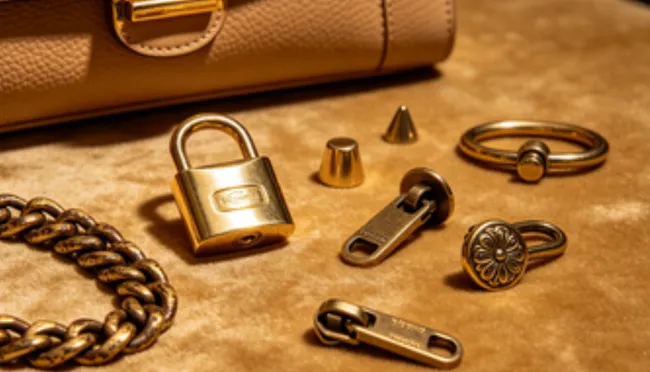
The choice of base material is critical. It directly affects the bag’s durability, overall weight, and the long-term wear and aging characteristics of its hardware components.
| Material | Key Characteristics | Typical Use in Luxury Bags |
|---|---|---|
| Solid Brass | Exceptionally strong, durable, and corrosion-resistant. Develops a rich patina over time. Heavier than other options. | The gold standard for premium hardware. Used by Hermès, Deadly Ponies, and other heritage brands for structural pieces. |
| Stainless Steel | Excellent corrosion resistance, high hardness, and a cooler, more modern appearance. Can be polished or PVD-coated. Lighter than brass. | Increasingly popular for high-end hardware. Used by Hermès and brands like Songmont for its durability and resistance to oxidation. |
| Zinc Alloy (Zamak) | Cost-effective, easy to cast into intricate shapes, and lightweight. However, it is weaker and more prone to corrosion and denting than brass or steel. | The most common base metal in the industry, from mass-market to some mid-luxury bags. Its durability depends heavily on the quality and thickness of its plating. |
Transforming raw metals into functional, aesthetically refined hardware components requires a series of highly specialized manufacturing processes.
Complex shapes can be produced using die-casting technology. For the highest quality, solid brass may also be cast and then meticulously polished to achieve a refined finish.
For example, Hermès collaborates with specialized silversmithing workshops to develop prototypes, with the development of a single new hardware design taking at least one year.
Surface treatment is a critical stage that determines both the durability and visual appeal of hardware components.
This signature technique involves cutting, hammering, and hand-polishing the tip of a nail-shaped hardware component until it forms a smooth, spherical “pearl.” The result is a distinctive surface finish that resembles the appearance of a soldered joint.
The structural design of hardware directly determines its durability, reliability, and user experience.
| Fastening Method | Process | Strength | Features | Application Area |
|---|---|---|---|---|
| Single-foot Rivet | One prong on the back is flattened to secure | ⭐⭐ Loosens easily | Simple and inexpensive | Decorative buckles, small logo plates |
| Double-foot / Four-foot Rivet | 2–4 prongs on the back are bent to secure | ⭐⭐⭐ Fairly secure | Most commonly used | Magnetic clasps, D-rings, bag strap buckles |
| Screw Fixing | Screws tightened from both front and back | ⭐⭐⭐⭐ Very secure | Detachable and repairable | High-end bag handles, shoulder strap buckles |
| Tubular Rivet + Leather Interlayer | Rivet penetrates multiple layers of leather + reinforcement lining | ⭐⭐⭐⭐⭐ Most secure | Permanent fixation, will not loosen | Top-tier bag handle attachment points |
| Glue + Rivet Dual Fastening | Apply glue first, then rivet | ⭐⭐⭐⭐ Secure + sealed | Prevents wobbling and wear on leather | Common practice for mid-to-high-end bags |
| Closure Type | Durability | Experience | Representative Styles |
|---|---|---|---|
| Magnetic Snap | ⭐⭐⭐ Medium (magnets weaken over time) | Convenient, one-handed opening | Tote bags, commuter bags |
| Turn Lock | ⭐⭐⭐⭐ Very durable | Requires two hands, strong sense of ritual | Chanel classic styles, vintage bags |
| Push Lock | ⭐⭐⭐⭐ Durable | Opens with a single press | Motorcycle bags, utility bags |
| Zipper | ⭐⭐⭐⭐⭐ Most durable | Smooth but requires two hands | The vast majority of bags |
| Buckle | ⭐⭐⭐⭐ Extremely durable | Troublesome; more decorative than practical | Belt buckles, vintage bags |
| Test | Standard | What It Measures | Luxury Benchmark |
|---|---|---|---|
| Salt Spray Test | ASTM B117 / GB/T 10125 | Corrosion resistance by simulating exposure to sweat, humidity, and salty air. | 48–72 hours without visible red rust. Failures within months indicate a manufacturing defect. |
| Tensile / Pull Test | GB/T 35777-2017 | The force a component (like a D-ring or strap attachment) can withstand before breaking. | Often requires a minimum pull strength of ≥300N. |
| Hardness Test | ASTM E18 / GB/T 4340.1 | The metal’s resistance to indentation and wear. | Rockwell Hardness (HRB) typically specified in the 70–90 range. |
| Cycle / Fatigue Test | ISO 22776 / Brand-Specific | The number of open/close cycles a clasp or zipper can endure. | Luxury brands often set internal standards exceeding 10,000 cycles. |
| Failure Phenomenon | Cause | Which Bag Tier It Appears In |
|---|---|---|
| Fading / Color Loss | Too-thin coating, poor electroplating process, sweat corrosion | Low-end bags; some mid-range bags also show it after long-term use |
| Hardware Loosening | Poor fastening method (single-foot rivet), no reinforcement lining | Low-end fast-fashion bags; poor-quality influencer-brand bags |
| Zipper Jamming / Sticking | Poor zipper quality, inaccurate installation alignment | Can occur in both mid-range and low-end bags |
| Magnetic Snap Losing Magnetism / Demagnetization | Poor magnet quality, repeated impact | Common in mid-to-low-end bags |
| Scratching | Insufficient coating hardness, no protective layer | All tiers can scratch; high-end ones are more scratch-resistant |
| Breakage / Fracture | Poor zinc alloy material, bubbles and sand holes, structural design flaws | Low-end bags; defective products |
| Rusting | Base material oxidizes after coating is damaged | Low-end hardware made of iron / steel |
Gionar (Guangzhou Gionar Leather Goods Co., Ltd.) is positioned as a mid-to-high-end OEM manufacturer specializing in luxury-style handbags and backpacks. Its hardware engineering follows mid-to-high-end, export-oriented industrial standards. Zinc alloy is the primary material, supplemented by brass. Its electroplating processes are designed to meet the corrosion-resistance requirements of everyday use, while durability testing follows the acceptance criteria specified by European and North American clients.
Positioned in the mid-to-high-end market, Gionar focuses on business briefcases and handbags. Its hardware components mainly consist of functional elements such as clasps, zipper pulls, D-rings, and protective bag feet.
As an export-oriented OEM manufacturer, Gionar’s electroplating specifications are designed to comply with the quality acceptance requirements of European and North American clients.
| Test Item | Standard Requirement (Mid-Range Regular Styles) | Testing Frequency |
|---|---|---|
| Salt Spray Test | 72 hours with no rust spots and no coating peeling | Sampling inspection on every batch upon arrival |
| Coating Abrasion Resistance Test | 200 dry rubs without exposing the base material (500 rubs for high-end styles) | Sampling inspection for every batch |
| Pull Force Test | Load-bearing hardware must withstand ≥30 kg pull without detaching | 5 pieces sampled per batch |
| Zipper Cycle Test | Still smooth after 2,000 repeated open-and-close cycles, with no tooth loss | Sampling inspection for every batch |
| Nickel Release Test | Complies with EU EN 1811 standard (≤0.5 μg/cm²/week) | Third-party testing quarterly |
| Appearance Inspection | No bubbles, no sand holes, clear engraving, no burrs on edges | 100% inspection |
Beyond testing individual components, Gionar also conducts systematic testing on finished bags.
Material consistency and traceability are two indispensable aspects of high-end bag manufacturing. They determine whether a brand can consistently produce products of the same quality and whether issues can be quickly identified, traced, and resolved when problems arise.
Consistency ensures that every product meets the same quality standards. Traceability provides the evidence needed to demonstrate that consistency — and by 2026, regulatory requirements are making such evidence increasingly important.
Material consistency means that bags of the same model produced in different manufacturing batches maintain consistent colors, textures, and performance across leather, hardware, and auxiliary materials. In other words, customers should not receive a second bag that looks or performs noticeably differently from the first.
An industry reality: many small brands fail to scale not because their products are inherently poor, but because quality fluctuates from one production run to another. The initial samples may be impressive, yet the mass-produced goods fall short. One batch may be well made, while the next suffers from cost-cutting and reduced workmanship.
Luxury brands develop comprehensive technical specifications for every material, covering requirements such as:
| Market Segment | Illustrative ΔE Target | Perceptibility |
|---|---|---|
| Top-tier luxury | ΔE ≤ 1.0 | Virtually imperceptible to the human eye |
| High-end brands | ΔE ≤ 1.5 | Difficult for most people to distinguish |
| Mid-range brands | ΔE ≤ 2.0 | Differences may be noticeable to trained observers |
| Low-end or unbranded products | ΔE ≥ 3.0 | Differences may be visible to the average consumer |
These figures are illustrative benchmarks rather than universal industry requirements. Actual acceptance limits depend on the material, color, measurement method, and brand specifications.
Every incoming batch of materials should undergo inspection. Materials that fail to meet acceptance criteria should be rejected or quarantined pending resolution.
How rigorous can IQC be at a luxury brand? The source material cites Hermès as an example of intensive leather inspection, describing manual inspection of every hide and rejection of batches with defect rates exceeding 3%. Such claims should be verified against the brand’s actual documented procedures before being presented as official policy. Nevertheless, meticulous leather selection helps explain why the quality and appearance of finished products can vary significantly even when similar exotic leathers are used.
A retained sample should be kept from every incoming material batch. Suggested sample quantities include:
Each retained sample should be clearly labeled with the batch number, supplier, arrival date, and inspection results. Retention period: keep samples for two to three years after the product is discontinued, where appropriate, to facilitate future traceability and comparison. Color reference management: maintain an approved master color card or reference sample. Colors must be checked against the approved standard before production begins.
Every product model should have a detailed Standard Operating Procedure (SOP) specifying each production step, the materials to be used, and the required process parameters. For example, the SOP may specify a stitch density of 7 SPI, five coats of edge paint, and defined temperature and pressure settings. All relevant parameters should be documented and controlled. Workers should follow standardized procedures rather than relying solely on personal judgment or experience.
After production, finished bags undergo either 100% inspection or sampling inspection, depending on the agreed quality requirements. Each bag must conform to the approved reference sample and applicable quality standards before shipment. Nonconforming products must be reworked and reinspected or rejected and scrapped if they cannot be brought into compliance.
Material traceability means that every finished bag can be traced back to the specific batches of leather, hardware, and auxiliary materials used in its production. Ideally, the records can identify the original supplier, production date, and even the farm of origin for a particular hide.
The core benefits of a traceability system:
Every batch supplied by a material vendor should have the following documentation:
Leather should be traceable to its country or region of origin and, where the supply chain supports it, to a specific farm and livestock batch. For regulated exotic leathers, such as crocodile or ostrich, the relevant CITES documentation and permit or certificate reference numbers should be recorded where applicable. Individual hides may also carry unique identification numbers, depending on the sourcing and traceability system.
Every production run is assigned a manufacturing batch number. Production records should clearly document:
Material batch numbers should be recorded whenever materials are issued to production, ensuring that the materials used can be linked to the resulting products.
Each bag or carton may be assigned a production batch number or serial number, depending on the manufacturer’s tracking system. Luxury brands may emboss production codes on an interior leather label or another discreet location. For example, Hermès uses date-related and artisan-related markings on certain products as part of its identification system. Mid-to-high-end brands often manage products by production batch rather than assigning a unique serial number to every individual bag.
Batch numbers or serial numbers are scanned and recorded during warehouse receiving, inventory movements, and dispatch. This enables the manufacturer or brand to identify which warehouse, distribution channel, or retail store received each shipment, supporting inventory control and targeted recalls.
Consumers may be able to scan a QR code or enter a serial number on the brand’s official website to access available product information. Depending on the brand’s system, the information may include:
For certain exotic-leather products, relevant CITES documentation references may also be available, subject to legal requirements and the brand’s disclosure policy. Not every luxury brand provides consumers with access to all these details. The information available depends on the brand’s traceability infrastructure and disclosure practices.
| Dimension | Low-end White Label | Mid-range Brand | High-end Brand | Top Luxury |
|---|---|---|---|---|
| Material Standards | Verbal agreements only; no written standards | Basic material specification sheets available | Complete technical standard documents, ΔE ≤ 1.5 | Extremely precise standards, ΔE ≤ 1.0 |
| Supplier Lock-in | Frequently switched; buy from whoever is cheapest | Core materials sourced from 2–3 fixed suppliers | Exclusive supply / strategic partnership for core materials | Dedicated suppliers; even build or hold controlling stakes in factories |
| Incoming Inspection | Almost none; materials used directly | Sampling inspection of appearance + basic dimensions | Full performance sampling + 100% appearance inspection | 100% inspection; every hide is checked |
| Color Difference Control | ΔE ≥ 3.0 (visible to the naked eye) | ΔE ≤ 2.0 (basically consistent) | ΔE ≤ 1.5 (very consistent) | ΔE ≤ 1.0 (almost indistinguishable) |
| Batch Sample Retention | No samples retained | Retained for 6 months – 1 year | Retained for 2–3 years | Retained for 5+ years |
| Traceability | None at all; cannot trace the cause when problems arise | Batch-level traceability (know which batch of material) | Batch + supplier traceability | Item-level traceability; full chain verifiable |
| Consumer Verifiability | No | Some brands allow authenticity verification | Batch information verifiable on official website | Full production history + artisan ID verifiable |
| CITES (Exotic Skins) | None; mostly smuggled or counterfeit | Legally imported with certificates | All certified and verifiable | Each item has a unique ID, verifiable on official website |
Gionar’s approach in terms of material consistency and traceability is based on a well-established preventive quality management system, third-party verification, and transparent procurement statements for regulated materials.
| Benefit | Impact |
|---|---|
| Quality assurance | Fewer defects, lower return rates, stronger brand reputation |
| Regulatory compliance | EUDR and DPP requirements make traceability a market-access condition |
| Consumer trust | Verifiable origin and sustainability claims drive purchase decisions |
| Resale value | Documented material provenance supports authentication and premium pricing |
| Supply chain resilience | Batch-level visibility enables rapid response to quality or compliance issues |
| Item | Specific Practice | Description |
|---|---|---|
| Material Specification Sheet (BOM + Technical Requirements) | Establish a BOM list for each product, specifying parameters such as leather grade / thickness, hardware material / plating layers, lining fabric weight, and thread size. | Standards are locked after customer confirmation; bulk production strictly follows the BOM. |
| Supplier Selection | Core materials (leather, hardware, zippers) are sourced from 2–3 long-term cooperative suppliers — all regular suppliers in the Baiyun/Huadu area that have passed environmental testing. | Suppliers are not changed arbitrarily to ensure stable supply. |
| Incoming Quality Control (IQC) | After each batch of materials arrives, perform sampling inspection: color comparison against standard color card, thickness / weight sampling, appearance defect check, and verification of environmental test reports. | Non-conforming batches are returned or exchanged directly and do not enter production. |
| Color Difference Control | Mid-range regular styles: ΔE ≤ 2.0 (ordinary consumers basically cannot see the difference). High-end custom styles: ΔE ≤ 1.5 (only discernible by professionals through comparison). | Judged using a spectrophotometer or standard color card comparison. |
| Grade | Characteristics | Consistency Demand |
|---|---|---|
| Full-Grain | Retains natural grain surface; strongest, most characterful | Panel matching for colour, grain, and stretch within a single bag |
| Top-Grain | Lightly sanded for uniformity; easier to maintain | Consistent finish across production runs |
| Corrected-Grain | Aggressively sanded and re-embossed; uniform, manufactured appearance | Emboss pattern consistency; coating adhesion |
| Split | Lower layer; softer, weaker; used as suede or backing | Not for structural panels |
For each production batch, the factory retains one complete finished sample, together with small reference samples of key materials, including leather, lining fabric, and hardware.
Retention period: at least 12 months, supporting comparisons for future orders and investigations into customer complaints. Each retained sample must be clearly labeled with the following information:
Gionar’s current traceability capability is based on production batches rather than individual units, a common approach among mid-range OEM manufacturers.
Each order batch is assigned a unique production batch number. A typical format combines the year, month, and a sequential identifier, such as 2609001. Production records document the following information:
If a quality issue arises, the production batch number can be used to trace the affected products back to the specific leather batch, supplier, production date, and manufacturing team involved.
| Traceability Stage | Traceable Content |
|---|---|
| Supplier Side | Names of leather / hardware / lining suppliers, material batch numbers, accompanying environmental test reports |
| Production Side | Production batch number, cutting / sewing / edge painting / assembly teams, production start and end dates, inspection records |
| Finished Product Side | Finished product batch number, quantity, shipment date, corresponding customer order number |
| Customer Side | Shipment records can be linked to customer orders; when customer complaints arise, the corresponding batch can be quickly identified |
| Stage | Action |
|---|---|
| 1. Prevent problems | Analyse customer requirements, process key points, difficulties, and change notices before production begins. |
| 2. Find the standard | Reference production orders, sample packages, routine operating standards (stitch length, margin, etc.), and change notifications. |
| 3. Operate according to standard | Train workers through explanation, demonstration, and verification until they meet the standard. |
| 4. Check according to standard | Management performs first-piece inspection; QC checks against standards; downstream staff verify the previous process. |
| 5. Report confirmation | Any abnormality is reported immediately; production continues only after the problem is confirmed and solved. |
The lining of a high-end bag is more than just a functional layer; it reflects craftsmanship, tactile experience, and the brand’s values. A premium lining must strike the right balance between durability, hand feel, weight, colorfastness, and environmental compliance.
Genuine leather, suede, silk, and branded jacquard fabrics remain industry benchmarks. Meanwhile, microfiber and recycled PET offer excellent performance alongside sustainability benefits.
Exceptional craftsmanship — expressed through concealed seams, bound edges, hand-stitched details, and precise color matching — transforms a practical interior into a luxurious experience.
| Material | Characteristics | Pros | Cons | Typical Use | Cost Tier |
|---|---|---|---|---|---|
| Genuine Leather (Lambskin, Calfskin) | Soft, supple, luxurious; develops patina | Ultimate tactile luxury; durable; breathable | Heavy; expensive; requires care | Top luxury handbags, limited editions | Very High |
| Suede / Microfiber Suede | Velvety, soft, matte finish; excellent scratch resistance | Luxurious feel; lightweight; colorfast | Can attract dust; sensitive to moisture | High-end handbags, jewelry pouches | High |
| Silk / Satin | Smooth, glossy, drapes beautifully | Elegant; lightweight; gentle on contents | Prone to snags; less durable | Evening bags, clutch interiors | High |
| Jacquard (Branded) | Woven pattern with logo or monogram | Strong brand identity; durable; refined | Higher cost; limited design flexibility | Luxury brands, signature linings | Medium-High |
| Microfiber | Fine synthetic fiber; soft and durable | Excellent scratch resistance; lightweight; easy to clean | Less breathable than natural fibers | Mid-to-high-end bags, tech bags | Medium |
| rPET / Recycled Polyester | Made from recycled plastic bottles | Eco-friendly; durable; colorfast | Slightly less soft than virgin polyester | Sustainable brands, eco-conscious lines | Medium |
| Organic Cotton | Natural, soft, breathable | Sustainable; skin-friendly; biodegradable | Wrinkles easily; less abrasion-resistant | Artisan bags, eco-luxury brands | Medium |
| Viscose / Rayon | Semi-synthetic; silky feel | Soft, drapes well; affordable | Weak when wet; prone to pilling | Mid-range bags, fashion linings | Low-Medium |
| Polyester Jacquard | Woven polyester with patterns | Durable; colorfast; affordable | Less luxurious feel | Affordable luxury, branded linings | Medium |
| Thin Nylon | Lightweight, strong, water-resistant | Very light; durable; cheap | Can feel cheap; less breathable | Fast fashion, low-end bags | Low |
Luxury standards: genuine leather, suede, silk, and branded jacquard fabrics are among the most commonly used materials for high-end bag linings. Meanwhile, microfiber and recycled polyester (rPET) are increasingly being incorporated into premium collections focused on sustainability.
| Technique | Description | Purpose | Quality Indicators |
|---|---|---|---|
| Precision Cutting | Lining panels cut to exact dimensions with minimal waste | Ensures perfect fit and reduces bulk | Clean edges; no fraying; consistent size |
| Seam Taping / Binding | Raw edges bound with fabric or leather strips | Prevents fraying; adds refinement | Even width; tight stitching; no puckering |
| Hidden Seams (Blind Stitching) | Stitches concealed within the seam | Clean interior; no visible stitching | Invisible from inside; strong bond |
| Edge Folding (Turned Edge) | Lining edges folded and stitched | Soft, clean finish; no raw edges | Smooth fold; consistent width |
| Interior Pockets | Flat, zip, or slip pockets sewn into lining | Organization and functionality | Straight stitching; reinforced stress points |
| Logo Jacquard / Woven Label | Brand logo woven into lining fabric | Brand reinforcement; luxury signal | Sharp detail; colorfast; correctly positioned |
| Embossed Logo Plate | Metal or leather logo plate attached to lining | Premium branding | Secure fastening; no scratches |
| Hand-Stitched Details | Artisan hand-sewing on visible lining areas | Ultimate craftsmanship signal | Even stitches; consistent SPI |
| Lining-to-Shell Attachment | Lining sewn or glued to outer shell | Prevents shifting; adds structure | No wrinkles; secure bond |
| Anti-Mold / Anti-Bacterial Treatment | Applied to lining fabric | Prevents odor and mold in humid climates | Certified treatment; no odor |
| Water-Repellent Coating | PU, Teflon, or silicone applied | Protects contents from spills | Beads water; no discoloration |
| Checkpoint | Standard |
|---|---|
| Colorfastness | Grade 4+ dry / wet rubbing |
| Abrasion Resistance | Martindale ≥ 20,000 cycles (microfiber / suede) |
| Seam Strength | ≥ 20 N/cm |
| Stitch Density | 8–10 SPI for visible seams |
| Color Difference (ΔE) | ≤ 1.5 for high-end; ≤ 1.0 for top luxury |
| Weight | Lining adds ≤ 80 g for medium tote |
| Odor | No chemical smell |
| Environmental Compliance | REACH, RoHS, OEKO-TEX® Standard 100 |
| Pilling Resistance | Grade 4+ |
| Dimensional Stability | Shrinkage ≤ 3% |
| Lining Material | Added Cost per Bag (USD) | Corresponding Product Tier |
|---|---|---|
| Thin Nylon | $0.30 – $0.75 | Fast fashion, low-end white label |
| Polyester Jacquard | $0.75 – $2.25 | Mid-range, affordable luxury |
| Microfiber | $1.50 – $3.75 | Mid-to-high-end, designer brands |
| Suede | $3.00 – $7.50 | High-end artisan brands |
| Genuine Leather Lining | $4.50 – $12.00 | High-end, luxury |
When placing an order with a factory, include the following details in the technical specification package:
Gionar does not rely on a single, fixed lining specification. Instead, it selects from a range of lining materials according to each client’s product positioning, design requirements, and quality expectations. The company emphasizes a balance of quality, durability, brand value, and user experience.
A carefully selected lining does more than protect the contents of a bag. It also enhances structural stability, conceals raw material edges, and elevates the overall unboxing experience.
| Tier | Share | Material Type | Details |
|---|---|---|---|
| Mainstream Standard Tier | ~70% | 230T twill polyester jacquard lining | The most mainstream configuration: abrasion-resistant, wrinkle-resistant, colorfastness ≥ Grade 4. Customizable small logo jacquard available. Compliant with EU REACH / RoHS and California Prop 65; no export compliance risk. Color-matched to the exterior material, with color difference ΔE ≤ 2.5. |
| Mid-to-High-End Upgrade Tier | ~20% | Cotton-polyester blend / microfiber suede facing | Cotton-polyester blend (60% cotton + 40% polyester): skin-friendly and natural, suitable for vegetable-tanned leather and casual-style collections. Microfiber suede: used only for the interior of phone pockets and eyewear pockets; scratch-resistant and shock-absorbing, significantly enhancing the tactile quality. |
| Basic Volume Tier | ~8% | 190T plain-weave polyester lining | Cost-effective configuration, suitable for fast-fashion and promotional low-price orders. |
| Special Function Tier | ~2% | Water-repellent coated / antibacterial functional lining | Optional for functional orders such as outdoor bags and diaper bags; available with water-repellent treatment or silver-ion antibacterial treatment. |
The leather goods manufacturing cluster in Baiyun District, Guangzhou, has developed mature production capabilities. As an export-oriented OEM manufacturer, Gionar is expected to follow the following general industry standards for lining construction:
| Branding Method | Description | Best For |
|---|---|---|
| Woven label | Custom logo woven into a fabric tag | All bag types |
| Leather patch | Debossed or hot-stamped leather label | Premium bags |
| Heat transfer | Printed logo applied with heat | Cost-effective branding |
| Embroidery | Stitched logo directly onto lining or label | High-end, textured look |
| Hot stamping | Gold / silver foil stamping on leather or PU | Luxury branding |
| Jacquard logo | Logo woven into the lining fabric itself | Limited editions, high-end |
| Test / Standard | Purpose | Gionar Requirement |
|---|---|---|
| Colorfastness | Prevents dye transfer to contents | Grade 4+ (dry / wet rubbing) |
| Abrasion resistance | Ensures lining does not wear through | Martindale ≥ 20,000 cycles (varies by material) |
| Tear strength | Prevents ripping at seams and pockets | Meets brand specification |
| Shrinkage | Avoids distortion after cleaning | ≤ 3% (depending on material) |
| pH value | Skin safety | 4.0–7.5 |
| Formaldehyde / azo dyes | Chemical safety | Complies with REACH / OEKO-TEX |
| Seam strength | Prevents seam failure | ≥ 150 N (varies by construction) |
| AQL sampling | Batch acceptance | AQL 1.0–2.5 for major defects |
As a manufacturer serving well-known European and North American brands, Gionar’s bag linings should undergo the following routine inspections and tests to meet export-quality acceptance standards.
| Test Item | Industry Standard | Description |
|---|---|---|
| Colorfastness | Dry rub ≥ Grade 4; wet rub ≥ Grade 3 | Verifies dye adhesion |
| Tear Strength | ≥ 20 N/mm² | Ensures lining durability |
| Shrinkage Rate | ≤ 1.5% | Ensures dimensional stability after washing |
| Bonding Strength | Complies with GB 20400 standard | Verifies adhesion strength between lining and leather |
| Formaldehyde Content | Complies with GB 21550 standard | Ensures no irritating odor |
| Customization Item | Options |
|---|---|
| Material | Polyester, nylon, cotton, rPET, microfiber, satin, jacquard, functional coatings |
| Color | Pantone matching, custom dyeing |
| Logo | Woven label, leather patch, heat transfer, embroidery, hot stamp, jacquard |
| Pocket Layout | Fully customizable |
| MOQ | From 100–500 pieces per style (depending on material and complexity) |
| Sampling Time | 5–7 working days for standard linings; 10–15 days for custom jacquard or special coatings |
| Certifications | OEKO-TEX, GRS, REACH available on request |
Most high-end leather bags fall between 8–10 SPI for machine sewing and 6–8 SPI for hand-stitching. Hermès hand saddle stitch typically runs 6–8 SPI with stitch spacing error no more than 0.3 mm; Chanel averages 9–11 SPI; Louis Vuitton 7–9 SPI with handle attachments often fixed at 5 SPI; and Bottega Veneta, Saint Laurent, Celine, Loewe, and Givenchy generally sit at 8–10 SPI. Higher is not automatically better: density above 10–12 SPI can perforate and weaken the leather.
Edge painting is the standard technique — at least six layers for high-end bags, each layer hand-sanded, with a finished thickness of 0.1–0.2 mm and thickness deviation not exceeding 0.1 mm. The finish should not peel when scraped with a fingernail and should remain free of cracks after 100 bending cycles. Edge finishing may account for 15–25% of total manufacturing labor cost, yet contributes more than 30% of perceived quality. Material matters: burnishing suits vegetable-tanned leather, folded edges suit lambskin and suede, and piping or binding suits canvas, nylon, and raffia.
Solid brass is the premium benchmark — exceptionally strong, corrosion-resistant, heavier, and develops a rich patina — used by Hermès and other heritage brands. Stainless steel offers excellent corrosion resistance and lighter weight. Zinc alloy (Zamak) is the industry’s most common base metal because it is cost-effective and easy to cast into intricate shapes, but it is weaker and more prone to corrosion and denting, so its durability depends heavily on plating quality and thickness. Plating benchmarks include Hermès’ 3-micron layer of 23.5-karat gold, and PVD coating for hard, wear-resistant finishes.
Look at the fastening method and the test records. Single-foot rivets loosen easily; double- or four-foot rivets are fairly secure; screw fixing is very secure and repairable; and a tubular rivet through multiple leather layers plus a reinforcement lining is the most secure option for handle attachment points. Require evidence of testing: a 48–72 hour salt spray test without visible red rust (ASTM B117 / GB/T 10125), minimum pull strength of ≥300N (GB/T 35777-2017), Rockwell hardness in the 70–90 HRB range, and cycle testing exceeding 10,000 open/close cycles.
ΔE is the measured color difference between a sample and the approved standard. Illustrative targets by segment: top-tier luxury ΔE ≤ 1.0 (virtually imperceptible), high-end brands ΔE ≤ 1.5 (difficult for most people to distinguish), mid-range brands ΔE ≤ 2.0 (noticeable to trained observers), and low-end or unbranded products ΔE ≥ 3.0 (visible to the average consumer). These are benchmarks rather than universal requirements — actual acceptance limits depend on the material, color, measurement method, and brand specification.
A working system covers five levels. At supplier level: batch or lot number, production date, and inspection and test reports, with leather traceable to country or region of origin and CITES references recorded for regulated exotic leathers. At factory level: the manufacturing batch number, which material batches were used and in what quantities, the production team or shift, and the production date. At product level: a batch or serial number tied to an interior label. At warehouse level: scan records for receiving, inventory movement, and dispatch. At consumer level: a QR code or serial number lookup on the brand’s website. Gionar operates batch-level traceability with a typical batch format combining year, month, and a sequential identifier, such as 2609001.
Luxury handbag manufacturing relies on a rigorous quality system built around exceptional consistency, precision craftsmanship, and end-to-end quality control. These standards go far beyond conventional leather goods manufacturing and help support the premium positioning and perceived value of luxury brands.
True luxury handbag manufacturing goes beyond functional design. It combines meticulous material selection with precision craftsmanship to deliver products designed for more than a decade of use, while helping preserve their value in the secondary market.
With 20 years of industry experience, Gionar specializes in mid-to-high-end handbag manufacturing and has developed its own manufacturing processes and quality standards for premium, luxury-inspired bags. Its capabilities are designed to meet the quality expectations of contemporary luxury brands in Europe and North America, with the goal of approaching the standards of top-tier luxury products.
Partner with Gionar to bring your vision to life, elevate your product quality, and create lasting value for your brand.

Previous :
What Is Python Leather? Is It Ethical, Legal & Durable? Ultimate GuideNext :

Mobile Website

Inquires Whatsapp