- +86 (0) 20-86655668
- info@gionar.com

English


English
May 12 , 2025
Bag hardware refers to the metal or high-hardness accessories used on the bag, which is the functional core and decorative highlight of the bag. Hardware directly affects the durability and quality of products – high-quality hardware can withstand repeated opening and closing as well as heavy pressure, is corrosion-resistant and smooth without sound, thus extending the lifespan of bags. Inferior hardware is prone to oxidation, cracking or fading, which not only affects the user experience but also lowers the overall grade. How to test the hardwares of bag are durable?
Bag-making hardware refers to the functional and decorative metal or plastic components used in the bag-making process, ensuring the durability, safety and aesthetics of the bags.
The hardware used on bags includes: zippers, D-rings and O-rings, metal feet, copper rivets, handles and straps, etc.
YKK (industry standard) : Rust-proof, smooth sliding teeth.
Additional straps/detachable small bags.
Side release buckle: Used for adjustable shoulder straps (common in backpacks).
Magnetic buckle: Quick to close.
Roller buckle: Used for fine-tuning the belt
Metal feet: Protect the bottom of the bag from wear and tear.
Copper rivets: Reinforce force-bearing points.
Lobster buckle: For detachable shoulder straps.
Adjustable slider: For customizing the length of the watch strap.
Trademark signboards: Usually made of brass or enamel.
Chain: Used as a shoulder strap or embellishment.
Weight: High-quality hardware makes people feel very sturdy.
Engraving: High-end brand laser etching trademark (non-stick).
Movement: Smooth operation (no squeaking sound from zippers/buckles).
The durability of bag hardware depends on the quality of the material, manufacturing standards and usage conditions.
Zipper: The best ones are YKK Excella (Japan)/Riri (Switzerland), which can have a cycle of more than 50,000 back-and-forth pulls.
Buckles and clasps: The more durable one is ITW Nexus (USA), which can withstand a tensile strength of more than 200 pounds.
Rivets and feet: Copper rivets (double ends), capable of withstanding shear forces of over 100 pounds.
Testing the durability of bag hardware requires a combination of standardized laboratory tests and actual on-site evaluations. Here is a professional-level method to ensure that the hardware of your package meets high-performance standards:
Tool: Zipper fatigue tester (such as James Heal 089).
Method: Open and close the zipper 5,000 to 50,000 times (for luxury brands, the test exceeds 50k).
Qualification criteria: No tooth misalignment and the slider function is normal.
Hang a heavy object weighing 10 to 15 kilograms on the zipper for 24 hours.
Check:
The tape is separated from the fabric.
The slider is deformed.
Salt spray test (ASTM B117) : Exposure for more than 48 hours simulates coastal climate.
Freeze-thaw test: Cycle from -20°C to 60°C (5 times) to check the brittleness of the material.
Pull the buckle open with a force gauge until it fails.
Minimum standard:
Side release buckle: 200N (45 pounds).
Magnetic clasp: 15N (3.4 pounds) per magnet.
The force that hooks and buckles can withstand (in N) varies due to factors such as material, size, design and manufacturing process.
For example:
Small plastic hooks and buckles may only be able to withstand a force of several dozen Newtons, approximately ranging from 30 to 50 Newtons.
The load-bearing capacity of ordinary metal hooks and buckles is relatively greater, possibly ranging from 100 to 500N. Medium-sized hooks generally need to be ≥ 500N
Some high-strength gold hook buckles may be able to withstand forces of 1000N or even higher.
However, this is only a rough range. For specific details, please refer to the product description of the hook buckle and other relevant information.
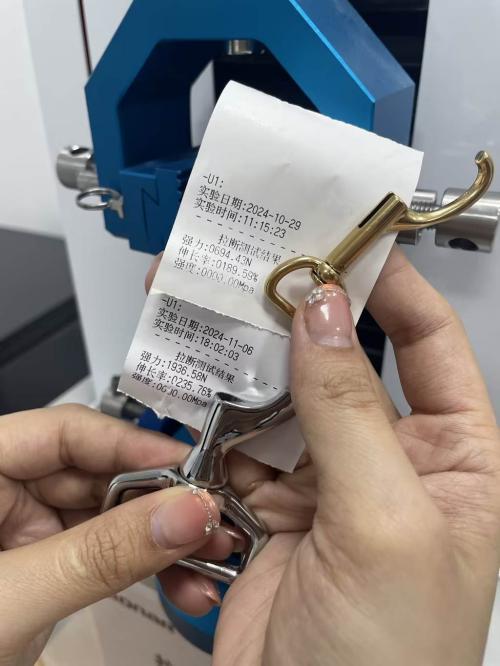
One of the hooks of songmont can withstand a force of 694.43N.
The test for the fastener (large size) specifically designed for hook buckles is 1936.58N
Fidlock buckle: Tested over 10,000 participating magnetic models.
Plastic buckle: Freeze to -10°C, then quickly open/close (check for cracking in cold weather).
Connect to the dynamic load tester and apply:
Static load: 50kg, 1 hour (no deformation).
Impact load: 10kg dropped from a height of 1m (3x).
Apply lateral pressure until the rivets come off.
Acceptable threshold:
Copper rivets: 500N (112 pounds).
Aluminum rivets: 300N (67 pounds).
Rub the belt anchor 100 times with sandpaper (120 grit).
Check:
Surface wear (the PVD coating should remain intact).
Structural cracks.
Soak the hardware products in acetic acid solution with a pH value of 4.5 (simulating sweat) for 72 hours.
Non-conformity mark: Rusting, peeling of the coating (commonly seen in cheap zinc alloys).
Scratch the surface of the coating with a blade, apply tape, and then peel it off.
Good result: No surface treatment removal (compliant with ASTM D3359).
Protecting the hardware in your bag – whether it’s a luxury handbag, travel gear or a daily handbag – requires active care and strategic design choices. The methods for the daily protection of hardware include:
Use paraffin or zipper lubricant (for example, zipper care) monthly to prevent sticking.
Never force the zipper to get stuck – first check if the fabric is stuck.
After contact with sweat, perfume or salt water, wipe with a microfiber cloth.
Apply clear nail polish on the plated surface to prevent peeling (reapply once every quarter).
Stick self-adhesive felt pads on the basic hardware to prevent the desktop from being scratched.
Whether it’s luxury leather, durable nylon or vintage fabric, some general methods or those that require special attention are needed to maintain their appearance, functionality and value.
Stainless steel/chromium: Clean with isopropyl alcohol (to remove fingerprints).
Brass: Polish with Wright’s copper frost (restore luster without wear).
pvd coating: Use mild soap + water (without abrasive cleaners).
For salt water exposure, rinse the hardware with distilled water and then dry it immediately.
Vinegar (acid can corrode paint).
Steel velvet (scratch finish).
Oil-based polish (vacuuming).
Filling: Use acid-free paper or pillowcases to maintain the shape.
Dust-proof bag: Store in the original cotton bag (do not use plastic bags to avoid moisture absorption).
Summer: Wipe off sunscreen/sweat immediately (bleach leather). Avoid direct sunlight to prevent fading.
In winter: Brush off the salt stains with a white vinegar solution (1:3 vinegar/water). Maintain the leather more frequently (cold air will dry out the leather).
Related customized services:
Tags :


Mobile Website

Inquires Whatsapp