- +86 13922774531
- info@gionar.com

English


English
April 27 , 2026
Hardware is an indispensable accessory in bags. In high-end brand bags, hardware components are crucial elements that reflect the brand’s reputation, craftsmanship level, and long-term value.
Most luxury bags use zinc alloy (Zamak) as the main hardware material, while top luxury styles often use solid brass to achieve greater weight and durability.
The hardware accessories used by bag manufacturer Gionar come from the same hardware suppliers as luxury bag brands.
This post will explore the bag hardware materials and suppliers used by luxury bag brands.
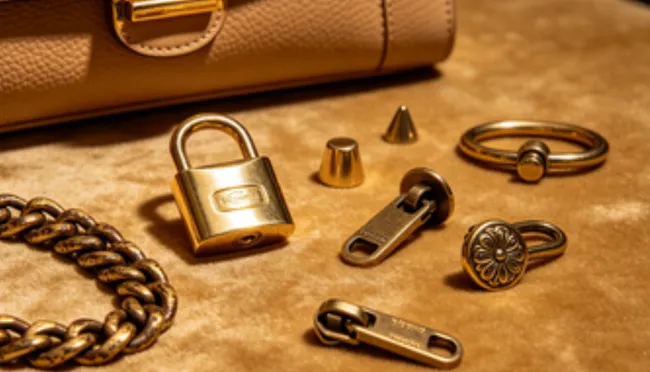
The hardware accessories of a bag refer to the metal components installed on the bag to achieve functional or decorative purposes. These hardware accessories not only can realize functions such as opening and closing, fixation and protection, but also can determine the overall appearance of the bag and the perceived quality it gives. They can be regarded as the “skeleton” and “joints” of the product.
| Hardware Type | Function | Typical Materials |
| Zipper | Opens/closes compartments | Brass, zinc alloy, nickel, stainless steel |
| Slider / puller | Moves along zipper teeth | Zinc alloy, brass, resin |
| Buckle | Adjusts strap length; secures flaps | Zinc alloy, brass, stainless steel |
| Clasp / latch / lock | Closes the bag or flap | Zinc alloy, brass (often plated) |
| D-ring / O-ring | Attaches straps or accessories | Stainless steel, brass, iron |
| Rivet | Reinforces stress points (e.g., handle base) | Brass, copper, zinc alloy |
| Stud / snap button | Fastens flaps or pockets | Brass, stainless steel |
| Feet / bottom studs | Protects bag bottom from wear | Zinc alloy, brass, stainless steel |
| Handle grip / holder | Connects handle to bag body | Zinc alloy, brass |
| Decorative plate / logo plate | Branding and ornamentation | Zinc alloy, brass, copper, stainless steel |
| Strap hook (lobster clasp) | Attaches shoulder straps | Zinc alloy, brass, stainless steel |
| Key holder / leash | Secures keys inside bag | Brass, stainless steel |
| Material | Properties | Common Finishes |
| Brass | Corrosion-resistant, premium feel, easy to plate | Polished, antique, matte, gold, nickel, palladium |
| Zinc alloy | Cost-effective, good for complex shapes (die-cast) | Electroplated, lacquered, painted |
| Stainless steel | Very durable, scratch-resistant, heavy | Brushed, polished, sandblasted |
| Iron / steel | Strong, but prone to rust without coating | Painted, plated (less common in premium bags) |
| Aluminum | Lightweight, modern look | Anodized, brushed |
When ordering custom bags, please provide the following information to the bag manufacturer:
At Gionar, we source hardware from suppliers that are in line with luxury brands (such as YKK, Riri, etc.) and implement strict quality control to ensure that your bags stand out in both functionality and appearance.
Luxury brands are high-end brands that offer products of high quality, exquisite craftsmanship, uniqueness and symbolic value. Their products go far beyond basic functional requirements. They are not merely expensive price tags; they represent a unique value proposition built on tradition, artistry and an aspirational lifestyle, as well as status, heritage, design and superior experiences.
The use of rare and high-quality materials (such as full-grain leather, silk, precious metals).
Careful hand-finishing, which usually requires experienced artisans to complete after years of training.
Strict quality control (for example, the hand-sewing of Hermès bags may take 15 to 20 hours).
Limited production or customized styles.
Strict distribution control (for example, only available in flagship stores, no discount retailers).
Long waiting lists (such as Birkin or Kelly bags).
Achieved through high prices, strict distribution (only a few flagship stores), and limited production. Its goal is desirable but out of reach for the general public.
Deep historical roots (many established in the 19th or 20th centuries).
Iconic designs related to tradition (for example, Chanel 2.55 bag, Louis Vuitton letter logo).
Emphasis on the founders’ vision and tradition.
The price is significantly higher than its actual value – this reflects intangible values (reputation, rarity, emotion).
There are rarely any discounts; maintaining price stability is of utmost importance.
The price directly depends on the brand’s reputation, rather than just the cost. It acts as an entry barrier and reinforces the perception of uniqueness.
Possessing luxury goods can demonstrate success, taste, or belonging to an elite group.
It is usually associated with pursuit, self-reward, or as a gift.
Sold in the brand’s own stores or in selected high-end department stores (such as Harrods, Saks Fifth Avenue).
The in-store experience is immersive, personalized and focuses on service.
Luxury brands strictly control every touch point, from the in-store experience, advertising to after-sales service, to maintain the brand’s mysterious charm.
Although rooted in tradition, luxury brands evolve through the creativity of their creative directors (such as Virgil Abloh of Louis Vuitton and Maria Grazia Chiuri of Dior), reinterpreting classic works for modern audiences.
| Characteristic | What It Means |
| Premium pricing | Prices significantly higher than mass-market alternatives; often 5-50x the cost of production |
| Scarcity & exclusivity | Limited production, controlled distribution, waitlists, or invitation-only access |
| Heritage & craftsmanship | Artisan techniques, generational expertise, meticulous hand-finishing |
| Strong brand identity | Recognizable logos, signature motifs, distinctive design language |
| Emotional value | Purchases driven by desire, aspiration, self-expression—not just need |
| Superior materials | Rare or finest-grade inputs (full-grain leather, precious metals, exotic skins) |
| Brand | Founded | Known For | Key Hardware / Detail |
| Hermès | 1837 (Paris) | Birkin, Kelly bags; hand-stitched craftsmanship | Solid brass hardware, palladium/gold plating, Permabrass |
| Chanel | 1910 (Paris) | Classic Flap, 2.55 bag; quilted leather, chain straps | Gold-plated or palladium metal; interlocking CC logo |
| Louis Vuitton | 1854 (Paris) | Monogram canvas, LV initials, travel trunks | PVD-coated brass hardware; range of finishes |
| Gucci | 1921 (Florence) | GG logo, horsebit detail, bamboo handles | Brass hardware with vintage-style finishes |
| Prada | 1913 (Milan) | Saffiano leather, triangle logo plate | Stainless steel hardware; clean, modern industrial look |
High-end brands (such as Coach, Michael Kors, and Montblanc) offer products of superior quality compared to those in the mass market, but they lack the uniqueness, heritage, and depth of craftsmanship that true luxury possesses.
True luxury is not determined solely by price; rather, it is defined by cultural capital, scarcity, and permanence.
| Dimension | Luxury | Premium | Mass Market |
| Core Driver | Dream & Identity | Quality & Performance | Function & Price |
| Price | Extremely high; cost irrelevant | High; justified by better features | Low; competitive |
| Customer | Buys the brand story & status | Buys the superior product | Buys the utility |
| Example (Bag) | Hermès Birkin | Tumi Alpha 3 Briefcase | Jan Sport Backpack |
| Segment | Price | Quality | Exclusivity | Examples |
| Mass Market | Low | Basic, machine-made | Widely available | Fast fashion brands (ZARA, H&M) |
| Accessible Luxury (Affordable Luxury) | Mid | Good, often mass-produced with better materials | Moderate; widely distributed | Coach, Michael Kors, Tory Burch, Longchamp |
| High Luxury / Premium Luxury | High | Exceptional; handcrafted, superior materials | Limited; selective distribution | Louis Vuitton, Gucci, Prada |
| Ultra Luxury | Very high (often $10k+) | Artisanal; bespoke; heirloom quality | Extremely exclusive; waitlists | Hermès, Chanel (Haute Couture), Loro Piana |
What customers pay for is not just a bag or a logo. They pay for:
Nowadays, luxury has taken on two completely different forms:
When luxury bag brands select hardware components, they take into account factors such as material, surface treatment, durability, weight, and brand characteristics. For high-end bag models, they usually choose a base metal, such as pure copper or stainless steel, and then select a high-quality surface treatment process, such as gold, palladium gold, or ruthenium gold, to match the design style of the bag.
The hardware components of luxury bags are selected through a strict, multi-level process, which prioritizes long-term durability, brand recognition, flawless aesthetics, and the integrity of the supply chain. Each piece of hardware is regarded as an engineering component and must function perfectly for many years while conveying the brand’s DNA.
The texture, weight, and durability of hardware components start from their base materials. High-end hardware is made from solid metals, while lower-quality hardware is typically composed of cast alloys with a thin layer of metal coating.
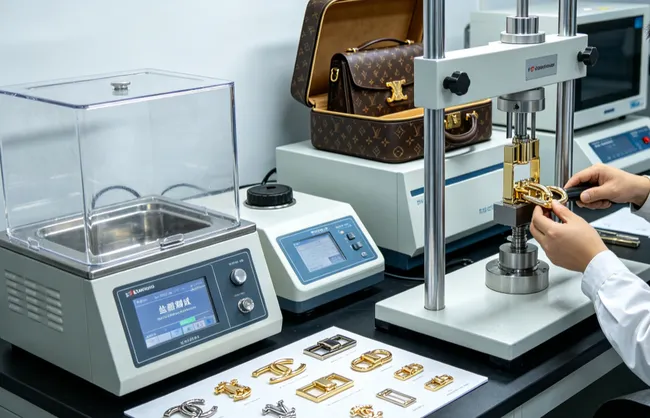
The entire process begins with the base metal, which determines the weight, texture, corrosion resistance and adhesion of the electroplating of the hardware.
| Material | Properties | Best Use | Example Brands |
| Solid Brass | Warm weight, natural corrosion resistance, ages with a rich patina | Heritage collections, high-touch visible hardware (buckles, feet, zippers) | Hermès, Chanel, Goyard |
| 316L Stainless Steel | Extremely strong, scratch-resistant, superior finish durability with PVD | Daily-wear items, travel luggage, belt buckles, high-load components | Loewe, Prada, DeMellier |
| Zinc Alloy (Zamak 5) | Cost-effective, can be cast into complex shapes, lightweight | Decorative hardware, logo plates, interior fittings, seasonal designs | Gucci, Dior |
The material is merely a canvas. The true luxury lies in the meticulous craftsmanship, which encompasses both the processing procedure and precision.
Die casting is used to produce complex shapes (such as ornate logos), using liquid brass.
Numerical control machining is employed to manufacture precise components (such as locking mechanisms), which are machined from solid brass or steel blocks, ensuring a tolerance of ±0.05 millimeters to ensure perfect operation.
Process: Physical Vapor Deposition. Metals such as titanium nitride are evaporated in a vacuum environment and attach to the hardware at the molecular level.
Result: A layer that is extremely hard, scratch-resistant, and uniform. This is the reason why the luxurious hardware in black or matte finish does not crack. It has excellent corrosion resistance, allowing the hardware to pass a 96-240+ hour salt spray test.
Process: Electroplating is carried out using genuine gold, palladium or ruthenium, with several layers deposited, each layer being several micrometers thick.
Result: A deep, rich and warm luster, without the green tint of thin-market gold electroplating or the cheap yellow hue. Over time, it will form a soft luster layer.
| Tier | Supplier Examples | Key Features |
| Top-tier | Riri, Lampo | Ultra-premium zippers and closures with extremely tight tolerances |
| Premium | YKK, Suizhou Haifute, Meiouya | High-volume, reliable components with advanced vacuum plating (PVD) and custom finishing |
| Specialist | Bouclerie Poursin (Paris), Renato Menegatti (Italy) | Artisanal, hand-crafted buckles and clasps for the most exclusive collections |
| Test Type | Purpose | Standard Requirement |
| Salt Spray Test | Simulates exposure to sweat, humidity, and salty air | ≥48 hours without visible corrosion (ASTM B117); luxury houses often demand 72 hours [11†L23-L25] |
| Plating Thickness | Ensures coating will not wear through quickly | Minimum 2–3 μm (microns); 5–8 μm for high-touch parts [11†L22-L24] |
| Adhesion (Cross-Hatch) | Prevents plating from peeling | ASTM D3359, score ≥3A |
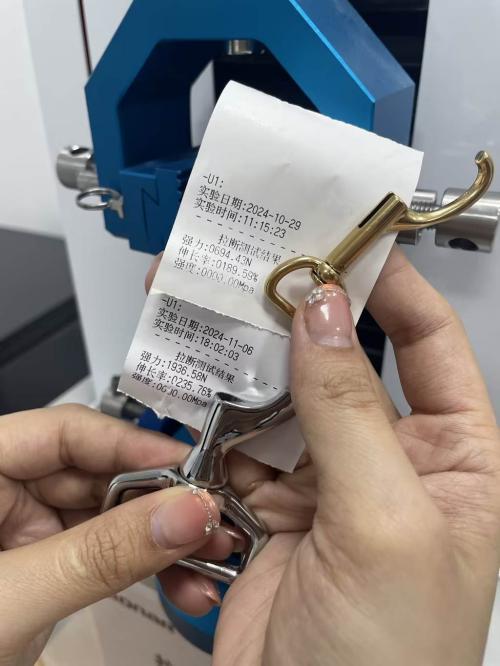
| Pull / Load Test | Verifies D-rings, handles, and strap anchors can bear weight | 150–300 N minimum (varies by component) |
| Nickel Release | Prevents skin allergies (for items in contact with skin) | EN 1811 compliance (EU REACH) |
| Impact / Drop Test | Checks resilience against sudden impacts | Hardware must not crack or deform after drops from defined heights |
Without a rigorous supply chain, even the best specifications are of no use. Luxury brands implement:
| Brand | Hardware Signature | Key Choices |
| Hermès | Solid brass base with 18-karat gold or palladium plating; exclusive “Permabrass” finish for Birkin and Kelly | Multi-stage hand-finishing; PVD for matte special editions; every lock and key is serialized [1†L5-L9] |
| Chanel | Gold-tone or silver-tone plated brass; iconic “CC” turn-lock and chain strap | All hardware is custom-designed; plating must be mirror-smooth and scratch-free [2†L16-L18] |
| Louis Vuitton | Heavy use of PVD coatings on brass; wide range of finishes from polished steel to matte black | Hardware is often engraved with the brand name and model number as an anti-counterfeiting measure |
| Prada | Stainless steel hardware; clean, modern industrial aesthetic | Prioritizes scratch resistance and hypoallergenic properties for long-term daily wear |
The same high-quality hardware manufacturer supplies zippers, clasps and other metal accessories to many well-known luxury handbags. This is not an uncommon occurrence.
The hardware used in Gionar’s bags comes from the same suppliers as those used by luxury brands!
What luxury brands look for? Luxury brands usually prefer to choose custom metal parts that have precise tolerances, high-quality coatings or surface treatment processes, as well as those that meet specific requirements such as nickel-free or low-allergenic treatments. Some suppliers also emphasize internal control, mass production, and full-process technical support from design to manufacturing, which is crucial for consistency at the brand scale.
| Supplier | Known For | Key Clients |
| Riri Group | High-end zippers (the “Rolls-Royce of zippers”), buttons, and other metal components. | Hermès, Louis Vuitton, Prada, Gucci |
| YKK | World’s largest zipper manufacturer, offering a vast range of reliable and high-quality zippers for all markets. | Chanel (zippers), Prada (also uses YKK) |
| Lampo | An Italian zipper manufacturer renowned for its high-quality, durable, and very smooth-running zippers. | Prada (primary zipper supplier), Bottega Veneta, Moncler |
| Suizhou Haifute Hardware Co., Ltd. | Precision metal components (locks, buckles, feet, decorative rings, etc.), using advanced techniques like vacuum coating for enhanced quality and durability. | Louis Vuitton, Ferragamo, Coach, MCM, Michael Kors |
| Meiouya | A comprehensive global manufacturer of decorative buckles and accessories for handbags, footwear, and apparel. | Coach, Michael Kors, Tory Burch, Cole Haan, Kate Spade |
| Brand | Hardware Approach |
| Hermès | Legendary control; reportedly works with select Tuscan foundries and maintains in-house metalwork expertise; palladium and gold plating done to exacting proprietary standards |
| Chanel | Historically used 24k gold-plated hardware (vintage pieces); now uses ruthenium, palladium, and gold-tone finishes; zipper pulls and chain mechanisms are custom-specified |
| Louis Vuitton | Mix of brass and coated metals; some hardware produced in-house or through LVMH-aligned suppliers; trunk heritage influences corner protectors and rivets |
| Bottega Veneta | Favors solid brass with minimal plating—allows natural patina; hardware often intentionally understated |
| Gucci | Uses Italian suppliers for signature hardware (horsebit, bamboo turn-lock, interlocking G); gold-tone finishes are house-specific |
Gionar is a manufacturer specializing in the production of mid-to-high-end leather bags. Choosing the same top-notch hardware supply chain as luxury brands is our core strategy for ensuring high quality, enhancing the sense of luxury, and pursuing outstanding value. We believe that the true value of an excellent bag begins with every meticulously crafted detail.
Hardware components are the “skeleton” and “finishing touch” of luggage, and their quality directly determines the product’s lifespan and user experience. The suppliers chosen by luxury brands are all experts who have reached the industry’s top level in terms of materials, craftsmanship, and quality control.
Hardware components are the “first impression” that gives the bag its luxurious texture.
The supply chain we have established not only ensures quality but also significantly enhances the reliability and efficiency of production.
Among luxury bags, most of the hardware is made of solid brass or 316L stainless steel. It is coated with PVD to achieve excellent durability and undergoes a 48-72 hour salt spray test to ensure corrosion resistance.
Choosing a bag manufacturer like Gionar, which sources hardware from the same suppliers as luxury brands and applies the same strict standards, can enhance the perceived value and durability of the products.
If you are running your own bag business and want to customize luxury bags, please feel free to contact us at any time.


Mobile Website

Inquires Whatsapp