- +86 13922774531
- info@gionar.com

English


English
February 4 , 2026
Suede leather is a type of real leather that is formed by polishing the inner layer (the suede layer) of the leather. It features a fine velvet surface. It possesses the quality of high-end leather materials, giving items a retro, luxurious or laid-back style. Its elegant texture still makes it a classic material, and thus it is favored by fashion brands.
Suede leather is mainly used in items such as high-end shoes, handbags, jackets and home decorations.
This post will explore the characteristics of suede leather and the advantages and disadvantages of manufacturing bags with it.
Suede leather (velvet-like leather) is a type of real leather processed through special techniques. Its most notable feature is having a soft, fine, matte velvet-like surface.
Suede leather is a high-end type of genuine leather, favored for its softness, velvety texture, and matte appearance – this effect is achieved by carefully grinding or polishing the inner layers (the flesh side) of animal leather (usually cowhide, sheepskin, or goatskin), thereby creating a dense, short, and fluffy layer of fur on the surface. It is a unique variant of genuine leather, different from nubuck (which is buffed from the outer grain side of cowhide and more durable) and smooth full-grain leather (untreated outer hide with a natural grain).
| Type | Description | Characteristics |
| Full-Grain Suede | Made from the top layer of the hide | Most durable, retains natural grain patterns |
| Top-Grain Suede | Made from the second layer of the hide | Softer than full-grain, less durable |
| Split Suede | Made from the lower layers of the hide | Least durable, more affordable |
It can also be classified by the type of animal hide:
Seats, steering wheels, instrument panels: Enhancing the refined feeling of the driving experience.
Jewelry, keychains, notebook covers: Exploring creative design.
| Material | Source | Surface | Durability | Water Resistance |
| Suede | Inner hide (split) | Napped, fuzzy | Low–Medium | Very low |
| Nubuck | Outer hide (top grain) | Sanded smooth-nap | High | Low (but tougher than suede) |
| Smooth Leather | Outer hide | Glossy/smooth | High | Medium–High |
| Ultrasuede® | Synthetic (microfiber) | Soft, suede-like | High | High (stain/water-resistant) |
Fun Fact: The word “suede” comes from the French gants de Suède (“gloves from Sweden”), as Swedish tanners were famous in the 18th century for producing ultra-soft gloves from reindeer hide.
Understanding these differences can help make informed decisions when purchasing and maintaining suede leather products.
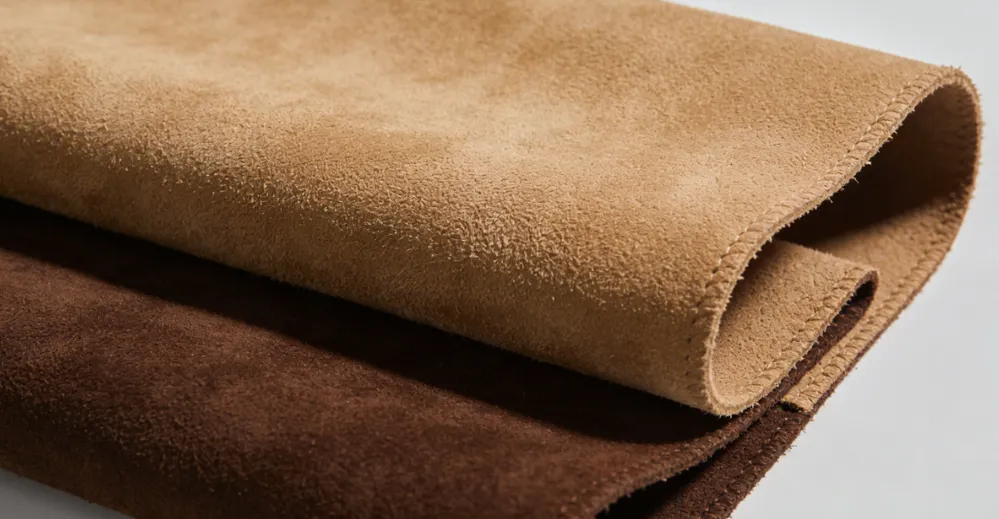
Suede leather is a type of real leather. Its essence is a material obtained through special processing of animal leather.
The international leather industry has clear definition standards for “real leather”, mainly based on three core elements: material source (must come from animal skin), fiber structure (retaining the natural collagen fiber network), and tanning process (through chemical or plant tanning treatment).
Suede leather fully complies with these three standards:
It is worth noting that the definition of real leather does not include the condition of “whether the surface is smooth”. Smooth leather (full grain leather), suede (nubuck), and suede are different manifestations of real leather, with the only difference being the surface treatment process. Among them, nubuck is the polishing of the surface layer (outer layer) to form short and dense hairs, while suede is the polishing of the inner layer (meat layer) to form longer hairs. However, both are real leather. It’s like the same piece of fabric, the front is smooth, and the back is furry, but they are all cotton.
In short: natural suede = real leather; faux suede = not leather.
| Feature | Real Suede Leather | Faux Suede (Synthetic) |
| Material | Animal hide (inner split) | Polyester, polyurethane |
| Texture | Natural, slightly irregular nap | Uniform, consistent feel |
| Water Reaction | Absorbs water, darkens | Repels water |
| Durability | Less durable, stains easily | More stain- and water-resistant |
| Breathability | High | Low |
| Eco-Impact | Biodegradable (but animal-based) | Not biodegradable (plastic-based) |
Based on the above analysis, when consumers purchase suede leather products, they can confirm whether it is real leather through the following methods:
Suede leather is made through a specific processing technique, which transforms the inner layer of animal skin into a soft and fuzzy material – unlike smooth leather (which is made using the outer grain layer of the hide).
Firstly, use untreated animal skins (durable mink fur usually uses cowhide; softer and more luxurious mink fur uses lamb or goat hide). Firstly, clean the skin to remove dirt, blood and impurities. Then, use a layering machine to cut the skin horizontally into two or more layers: the thicker, denser outer texture layer (for full-grain/face-grain smooth leather) and the thinner, more fibrous inner layer – this is the basic material of mink fur.
The pre-treatment is carried out layer by layer to prepare for tanning:
Leather tanning is a crucial step that transforms perishable raw skin into durable leather. For sable skin, chrome tanning is the most common method (fast, cost-effective, and capable of producing soft and elastic sable skin): the split animal skin is immersed in a chromium sulfate solution for several hours, which binds with the animal skin fibers, preventing decay and giving the leather a soft texture. Some high-end sable skins use vegetable tanning (slower, more environmentally friendly) to achieve a more natural touch, but this practice is not common.
This step determines the velvety texture of the suede. The tanned split layers are dried to the ideal moisture level and then fixed onto a rotating drum or platform. Fine sandpaper or a grinding roller is used to repeatedly rub the flesh side (the inner surface) of the animal skin, gently scraping the surface to form a dense, short and uniform velvet-like pile of fibers (the soft, velvety-like strands we are referring to). The direction and pressure of the polishing are precisely controlled to avoid damaging the fragile fibers.
Finally, the finished suede leather is inspected to check for any flaws (such as uneven fur, holes, and stains). The quality is graded accordingly – high-quality suede has uniform and dense fur with almost no flaws and is used for high-end bags, shoes, and jackets; lower-grade suede is used for smaller accessories or decorations.
Key difference: Nubuck leather is made by a similar polishing process on the outer grain layer of cowhide (the outer layer of cowhide). It has a more durable material compared to suede (suede uses the inner layer with multiple layers). In contrast, faux suede is an artificial material – made from interwoven polyester/nylon fibers. These fibers are polished to simulate the texture of suede, and no animal skin is used throughout the production process.
The regular lifespan of suede leather is 3 to 8 years. The exact duration depends on the usage frequency, maintenance methods, and quality grade.
Under normal use (such as 2-3 times per week) and with regular professional maintenance, high-quality top-grain suede shoes or handbags can maintain good condition for more than 5 years; frequent daily use without maintenance may result in obvious wear and tear within 2-3 years. It should be emphasized that due to the surface fuzz structure of suede, its durability is slightly lower than that of smooth leather, and the lifespan varies greatly from individual to individual.
| Factor | Level of Impact | Details |
| Frequency of Use | ⭐⭐⭐⭐⭐ | Daily use vs. occasional use can result in a 2–3 times difference in lifespan. |
| Care & Maintenance | ⭐⭐⭐⭐⭐ | Regular professional care can extend the lifespan by more than 50%. |
| Quality Grade | ⭐⭐⭐⭐ | Full-grain suede vs. split suede can differ by 30–50% in durability. |
| Environment | ⭐⭐⭐ | Damp, dusty, or humid conditions accelerate aging. |
| Usage Habits | ⭐⭐ | Improper use (e.g., wearing in rain) can cause immediate damage. |
| Product Type | Normal Lifespan | With Good Care | Notes |
| Suede Shoes | 2–4 years | 3–6 years | Sole and heel wear are the main limiting factors. |
| Suede Handbags | 3–5 years | 5–8 years | Handles and corners wear first, but overall more durable. |
| Suede Clothing | 3–5 years | 4–7 years | Seams, elbows, etc., are prone to wear. |
| Suede Accessories | 4–6 years | 6–10 years | Lower intensity of use extends lifespan. |
Note: The above period is the “normal usage” duration, not the complete scrapped time. The suede products may experience color fading, flattened fur, and local wear and tear in the later stage, but they can still be used; it’s just that their appearance quality will decline.
To maximize the lifespan of leather products, the following measures are crucial:
| Do’s | Don’ts |
| Apply protector spray every 2–3 months | Wear in rain or snow without protection |
| Use a suede brush after each wear | Scrub with water or household cleaners |
| Store with cedar shoe trees or tissue stuffing | Keep in plastic bags (traps moisture) |
| Rotate usage (e.g., alternate shoes/bags) | Overload suede bags—they stretch easily |
Suede products do not suddenly become unusable; they gradually deteriorate. The following situations indicate that replacement may be necessary:
However, in most cases, suede products can extend their service life through professional refurbishment (such as re-coloring, re-filling the down), at a cost of approximately 30-50% of the price of a new item.
Synthetic faux suede (microfiber suede) is more durable than genuine suede (lasting for 5 – 10 years with daily use) – it is water-resistant/stain-resistant, does not wear easily, and requires the least amount of maintenance, making it an ideal choice for those who like the texture of suede but want low maintenance costs.
The actual lifespan of suede leather products varies between 3 – 8 years, depending on your usage habits and maintenance efforts. High-quality products with meticulous maintenance can approach the upper limit, while poor maintenance may cause rapid aging.
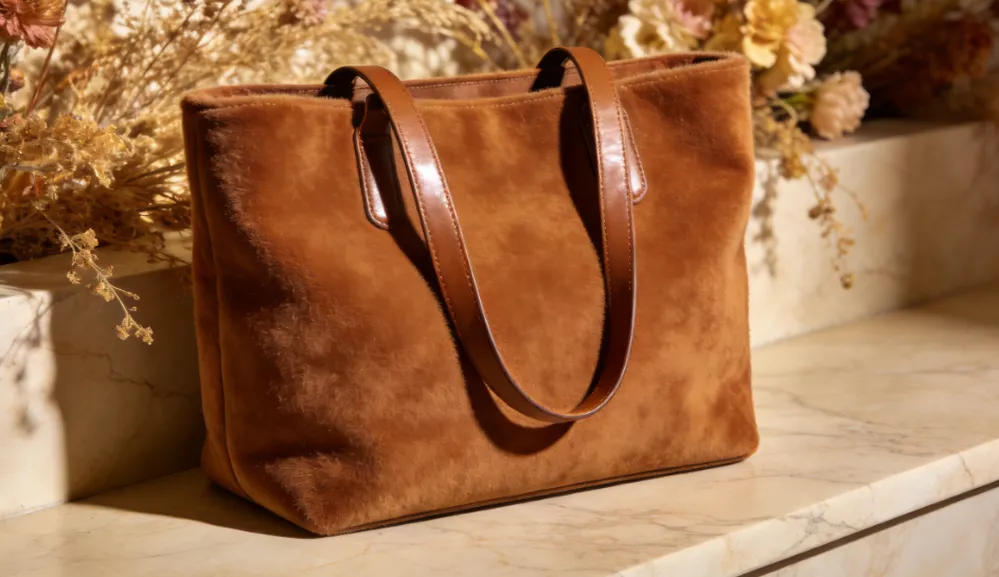
Yes, suede leather is suitable for making bags and is a very classic and popular material in bag design. However, it is not suitable for everyone or all usage scenarios. Whether it is “good” or not entirely depends on your specific needs and preferences.
In simple terms, if you are seeking a unique aesthetic, high-quality texture, and are willing to take good care of it, a suede leather bag is an excellent choice; if you need a “durably made” commuter bag that can withstand sun and rain and be used casually, then it might not be the most practical option.
| Feature Dimension | Rating | Explanation |
| Durability | ★★★☆☆ (Below Average) | Prone to abrasion, especially at edges. Lifespan depends heavily on usage intensity. |
| Aesthetics & Texture | ★★★★★ (Excellent) | Matte nap, soft touch, creates unique retro, luxurious, or casual styles. |
| Care Difficulty | ★☆☆☆☆ (High) | Requires waterproofing/stain-proofing; cleaning and maintenance steps are complex, requiring specialized tools and products. |
| Seasonal Suitability | More suitable for Fall/Winter | The material itself feels warm and visually pairs well with autumn/winter clothing. |
| Brand Adoption | Very Widespread | Used extensively by high-end luxury brands and designer labels, recognized as a fashionable material. |
| Ideal For | Not Ideal For |
| ✔️ Evening or special-occasion bags | ✖️ Everyday work totes |
| ✔️ Seasonal (spring/summer) accessories | ✖️ Commuter or school backpacks |
| ✔️ Fashion-forward, low-use statement pieces | ✖️ Travel duffels or gym bags |
| ✔️ Interior linings or accent panels (combined with smooth leather) | ✖️ Environments with dust, sand, or moisture |
Recommended for suede:
Less suitable for suede:
If you like suede but want it to be more durable:
Suede leather is a fashionable and high-quality material for bags, but it is not suitable for heavy-duty daily-use bags – its soft, velvety texture adds a delicate and warm aesthetic to the bags.
Suede leather is highly suitable for lightweight, casual or semi-luxurious bag styles (such as tote bags with suede decorations, small crossbody bags, and evening bags), and is also an important choice for budget luxury brands like Longchamp (used for the decorative elements of Le Pliage) and Coach.
If you are running your own bag business and want to customize a bulk of suede leather bags, please feel free to contact Gionar to discuss the specific details.


Mobile Website

Inquires Whatsapp