- +86 13922774531
- info@gionar.com

English


English
April 14 , 2026
As consumers may not be familiar with the concept of stitch length, for entrepreneurs running a bag business, stitch length is a question that needs to be considered during the design process of bags. Because stitch length is a crucial factor in measuring the craftsmanship level of bags, it directly determines the strength, durability, and appearance texture of the bags.
Stitch length refers to the distance between two consecutive stitches during sewing. It is usually expressed in millimeters (mm) or stitches per inch (SPI), and is one of the most fundamental and critical quality parameters in bag manufacturing.
The appropriate stitch length needs to be considered based on multiple factors, including the positioning of the bag, material properties, and thickness.
This article will explore the significance and standard parameters of stitch length in bag manufacturing.
In the fields of sewing and bag manufacturing, the stitching line (which is the loop or chain formed by the needle and the thread) is the basic unit of sewing. It refers to a basic unit formed by the sewing thread after the needle passes through the material (such as leather, fabric). When multiple consecutive stitch lines are combined together, they form a seam.
In simple terms, each time a needle goes down, from the upper thread passing through the material to intertwining with the lower thread, the formed loop knot is a stitch. It is a fundamental component that determines the strength, durability, appearance and functionality of bags.
| Element | Description |
| Stitch length / SPI | The number of stitches per inch or per centimeter, determining seam density and strength |
| Stitch type | Different ways of interlacing thread, such as lockstitch, chainstitch, etc. |
| Thread tension | The balance between upper and lower threads, affecting seam smoothness |
| Thread material | Nylon, polyester, cotton, etc. – different materials affect strength and appearance |
| Needle Type | Material / Structural Characteristics | Applicable Fabrics / Scenarios | Advantages |
| Leather Needle | Sharp point (triangular/cone-shaped), thicker needle shaft | Various leathers (cowhide, sheepskin, crocodile, etc.), PVC, and other hard materials | Strong penetration, prevents tearing of material; suitable for thicker threads like Saffiano thread, thick waxed thread |
| Ball Point Needle | Rounded point, thinner needle shaft | Knit fabrics, canvas, velvet, and other soft / elastic fabrics | Reduces snagging and pilling; suitable for silk thread, fine nylon thread, etc. |
| Triangular Needle | Triangular point, larger eye | Thick material joining (leather + canvas, multi-layer fabrics), edge reinforcement | Enhances thread grip; suitable for sewing stress points with thick thread (6+ plies) |
| Hand Sewing Needle | Long, slender shaft, sharp point | Hand-sewn details (e.g., edge finishing, hardware attachment, decorative stitching) | High flexibility; suitable for fine operations with hand waxed thread, silk thread, etc. |
| Stitch Type (ISO Code) | Diagram | Key Feature | Best Use in Bags |
| Lockstitch (301) | – | Most common. Thread interlaces in the middle of the fabric. Neat on both sides. | General construction. Zippers, seams, lining. The industry standard. |
| Chainstitch (401) | > | Single thread loops into itself. Strong but can unravel if thread breaks. | Decorative topstitching, some internal seams. Cheaper but riskier than lockstitch. |
| Safety Stitch (516) | = | Two needles + looper. Creates a seam and an overedge finish in one pass. Very strong. | Heavy-duty backpacks, luggage shells. Prevents fraying and adds strength. |
| Overlock / Serger (504) | / | Wraps the fabric edge. Prevents fraying. | Finishing raw edges of fabric inside the bag (lining, dividers). |
| Bartack (Special) | [ ] | A dense, reinforced block of stitching. | Stress points – strap attachments, buckle anchors, handles. |
| Stitch Name | Process Characteristics | Applicable Parts / Functions | Example Brands & Bag Models |
| Straight Stitch | Linear continuous stitching, uniform stitch length | Main body panel joining, lining stitching (e.g., leather to fabric) | ZARA basic styles, Coach tote bag body |
| Overlock Stitch | Thread wraps the fabric edge, forming an “overlocked” appearance | Edge binding for canvas and knitted fabrics (prevents fraying), e.g., edges of sports backpacks, canvas totes | Lululemon sports bags, H&M canvas bags |
| Backstitch | Each stitch steps back half a stitch, forming a tight straight line, similar to machine stitching effect | Stress points (handle-to-body attachment, zipper edges) | Hermès Birkin handles, Chanel Classic Flap zipper edges |
| Blind Stitch | Thread hidden between fabric layers, almost invisible on the surface | Edge finishing for high-end bags (e.g., leather bag edge trimming), decorative paneling (pursuing “seamless” texture) | Hermès Kelly bag edges, Loewe Puzzle bag paneling |
| Herringbone Stitch | Herringbone crossed stitches, good elasticity | Straps, foldable areas (e.g., foldable bags, waist bag closures) | Tory Burch Kira straps, Song (Songmont) foldable bags |
| Double Chain Stitch | Two threads interwoven into a chain, strong toughness, can be unraveled | Reinforcement of leather bag shapes (e.g., silhouette of structured bags), vintage-style decoration | Gucci Jackie 1961 bag silhouette, handmade vintage messenger bags |
| Brand | Common Needle Types | Core Stitch Methods | Corresponding Bag Models & Process Details |
| Hermès | Thick leather needle, hand sewing needle | Backstitch, blind stitch | – Kelly bag: Body sewn with thick leather needle + 6-ply waxed thread using backstitch (10-12 stitches per inch); edges finished with blind stitch for “seamless” edge binding. – Crocodile Birkin: Triangular needle + 6-ply waxed thread to enhance grip on stiff leather. |
| Chanel | Medium leather needle, ball point needle | Straight stitch, backstitch | – Classic Flap: Quilted pattern sewn with medium leather needle + 3-ply waxed thread using straight stitch (8-10 SPI); hardware attachment reinforced with hand sewing needle + backstitch. – Boy Chanel: Edge binding using ball point needle + overlock stitch for lambskin edges. |
| Gucci | Ball point needle, hand sewing needle | Herringbone stitch, blind stitch | – Jackie 1961: Strap sewn with herringbone stitch (silk thread + ball point needle) for elasticity; lining uses blind stitch to hide thread marks. – Horsebit bag: Decorative stitching done with hand sewing needle + silk thread using backstitch to highlight luster. |
| Song (Songmont) | Medium leather needle, triangular needle | Straight stitch, herringbone stitch | – Underarm bag: Body uses straight stitch (8 SPI) to maintain structured shape; strap uses herringbone stitch (nylon thread + triangular needle) for frequent shoulder wear. |
| ZARA | Ball point needle, standard machine needle | Straight stitch, overlock stitch | – Basic tote bag: Machine straight stitch (6-7 SPI) + overlock stitch for canvas edges to reduce cost. |
When inspecting samples at the exhibition booth, you can use this quick checklist to assess the factory’s attention to details:
| Inspection Item | Method |
| Stitch length uniformity | Measure the number of stitches over 10 cm and calculate SPI |
| Stitch straightness | Visually check that stitches follow the intended line |
| Skipped or broken stitches | Turn the bag over and inspect, especially at corners |
| Back tacking at start/end | Check that thread ends are locked by back tacking to prevent unraveling |
| Needle hole damage | On materials like leather, check if holes are too large or cause cracking |
Stitch length refers to the distance between two adjacent needle holes during sewing, the distance between one stitch and the next, or more intuitively, it is the density of needles per unit length of the sewing thread. It is usually measured in millimeters (mm) on sewing machines. It directly determines the strength, appearance, and stress condition of the sewing thread, and is one of the core parameters for evaluating sewing quality.
When purchasing and inspecting luggage, checking the stitch length can quickly determine the production process level of the factory and directly affect the durability and appearance of the bag.
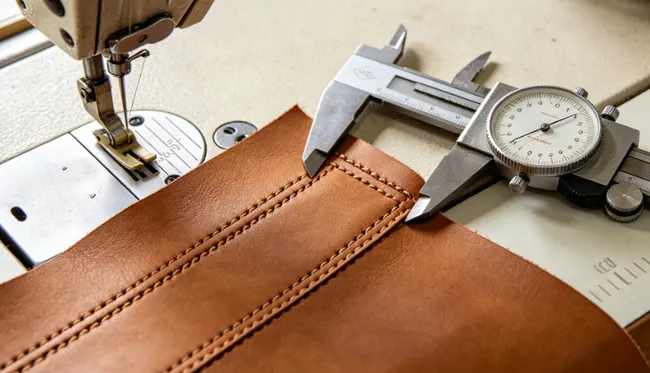
For ordinary sewing threads, approximately 2.5 millimeters is usually the common standard size.
In bag manufacturing, stitch length directly affects the strength and appearance of the sewing line:
| Length | Best For |
| 1.5–2mm (15-16 SPI) | Fine fabrics (silk, chiffon), top stitching details, reinforcement at seams |
| 2.5mm (10-12 SPI) | Standard setting – Most woven fabrics (cotton, linen, denim) |
| 3–4mm (6-8 SPI) | Basting/temporary stitches, heavy fabrics (canvas, leather), quilting |
| 4mm+ | Gathering, decorative topstitching, heavy-duty materials |
| Type | Typical SPI | Strength & Durability | Production Efficiency | Best Use Cases |
| Long Stitch | 4–6 SPI | Low(prone to breaking, unraveling) | High (saves thread, time) | Temporary seams, low-value promotional items, linings |
| Standard Stitch | 8–10 SPI | High(industry standard strength) | Medium | General backpacks, tote bags, standard luggage |
| Short/Dense Stitch | 12–14 SPI | Very High (tear-resistant, waterproof) | Low (consumes thread, time) | Heavy-duty outdoor packs, waterproof bags, stress points |
| Feature | Sewing Stitch Length | Knitting Stitch Length |
| Primary Definition | Distance between needle penetrations (spacing). | Total length of yarn in one loop. |
| What it Controls | Seam strength, speed of sewing, thread consumption. | Fabric density, elasticity, weight, and porosity. |
| Measurement | Distance (mm or stitches per inch). | Yarn Length (mm). |
| Key Impact | Affects how well two pieces of fabric hold together. | Affects the fundamental structure and “hand feel” of the fabric itself. |
Summary in One Sentence: Stitch Length is the “pixel density” of sewing. 8 SPI is the passing line, 10 SPI is the quality line, and 6 SPI is the risk line. As a buyer, controlling the stitch length is controlling the bottom line of the product’s lifespan.
The “standard stitch length” for luggage does not have a globally uniform value. It varies depending on factors such as product type, materials used, stressed areas, and brand positioning.
| Product / Process Type | Typical Stitch Length Range | Notes & Sources |
| Handbag body (standard) | 7–8 SPI | Common industry standard |
| Handbag body (fine workmanship) | 8–10 SPI | Suitable for high quality backpacks, cosmetic bags, and some business handbags |
| Handbag body (luxury hand stitching) | 12–16 SPI | Common on top tier luxury handbags and small leather goods, reflecting the highest level of craftsmanship |
| Stress points (e.g., handles, straps) | 8–10 SPI | Denser stitch length increases strength at load bearing areas |
| Lining, binding, hidden seams | 6–7 SPI | These areas have less impact on appearance; slightly wider stitch length balances cost |
| Small leather goods (e.g., labels, wallets) | 9–10 SPI | Smaller products usually require denser stitches for a more refined look |
| Non-woven / eco-shopping bags | 4–5 SPI | Too dense a stitch can tear the material along the needle holes; a special case |
| Decorative heavy thread / specific threads | Stitch length matched to thread thickness | Stitch length must be adjusted according to thread diameter (as illustrated in the table) |
During the inspection process, in addition to checking the numerical values, the following points are more important than simply looking at a single number:
Therefore, as the purchasing party, when communicating with the bag supplier, in addition to referring to the above range, it is more important to clarify the product positioning and propose specific requirements for different components. When communicating with the bag factory, you should clearly state the stitch length standard (such as “the exposed surface requires 8 SPI, the stressed points are encrypted to 10 SPI”), and require strict implementation in the samples before production and in the batch production to ensure that the process meets the standards.
In the manufacturing of bags, choosing the appropriate stitch length is crucial for ensuring the strength, appearance and durability of the bags.
Stitch length refers to the number of sewing needles per inch (approximately 2.54 cm). The more needles, the denser the sewing thread (for example, 10 needles per inch is denser than 6 needles per inch).
When installing a zipper, use a short stitch length (2-2.5 millimeters) to ensure a secure connection between the zipper and the fabric. This is particularly important for frequently opened and closed zippers.
| Factor | Influence | Explanation |
| Material type | Greatest impact | Soft/thin materials need shorter stitches; thick/hard materials need longer stitches |
| Stress points | Strength requirement | Load bearing areas (handles, straps) need shorter (denser) stitches |
| Product positioning | Aesthetic quality | Luxury bags require shorter, more uniform stitches |
| Thread thickness | Matching | Thick thread → longer stitch; thin thread → shorter stitch |
| Machine type | Capability limits | Different sewing machines have different stitch length ranges |
| Material Type | Recommended Stitch Length (mm) | Approx. SPI | Reason |
| Thin nylon/polyester (70D-210D) | 2.5 – 3.0 | 8 – 10 | Prevents needle holes from causing puckering or tearing |
| Medium canvas/oxford (600D-1000D) | 3.0 – 3.5 | 7 – 8 | Balances strength and production efficiency |
| Heavy canvas/Cordura (1000D+) | 3.5 – 4.0 | 6 – 7 | Avoids damaging fibers with overly dense stitches |
| Soft PU / synthetic leather | 3.0 – 3.5 | 7 – 8 | Prevents cracking at needle holes |
| Thin leather (0.8-1.2mm) | 3.5 – 4.0 | 6 – 7 | Avoids tearing leather due to dense needle holes |
| Medium leather (1.2-2.0mm) | 4.0 – 5.0 | 5 – 6 | Standard stitch length for leather |
| Thick leather / multi layer composite | 5.0 – 6.0 | 4 – 5 | Longer stitches reduce damage to leather |
| Mesh / spacer mesh | 3.0 – 4.0 | 6 – 8 | Moderate density suitable for open structure |
| Stretch fabric (Lycra, etc.) | 2.5 – 3.0 (with stretch thread) | 8 – 10 | Dense stitches prevent seam slippage; use elastic thread |
| Area | Recommended Stitch Length (mm) | SPI | Explanation |
| Main body seams (non stress) | 3.5 – 4.0 | 6 – 7 | Standard density, efficient |
| Main body seams (stress areas like bottom) | 3.0 – 3.5 | 7 – 8 | Denser for higher strength |
| Handles, straps, webbing | 2.5 – 3.0 | 8 – 10 | Critical stress points; must be densest |
| Zipper attachment | 3.0 – 3.5 | 7 – 8 | Uniform and secure |
| Binding / edge finishing | 3.0 – 3.5 | 7 – 8 | Ensures neat edges |
| Lining / interlining | 3.5 – 4.5 | 5 – 7 | Can be slightly longer to save cost |
| Decorative topstitching | Depends on design | — | Usually same as or slightly longer than body stitches to highlight lines |
| Product Positioning | Recommended Stitch Length (mm) | SPI | Additional Requirements |
| Fast fashion / budget bags | 3.5 – 4.5 | 5 – 7 | Uniform only; minor variations allowed |
| Mid-range brands | 3.0 – 3.5 | 7 – 8 | Consistent, no skipped or loose stitches |
| High-end / accessible luxury | 2.8 – 3.2 | 8 – 9 | Very uniform; straight stitching; perfect top/bottom threads |
| Top-tier luxury | 2.5 – 3.0 (hand stitching can be 12-16 SPI) | 8 – 10+ | Extremely high SPI; hand- or specialized machine work; ultra-fine finish |
| Thread Specification (Tex / number) | Recommended Stitch Length (mm) | SPI | Explanation |
| Very fine thread (Tex 20-30) | 2.0 – 2.5 | 10 – 12 | For ultra thin fabrics or fine decorative stitching |
| Common thread (Tex 40-60) | 3.0 – 3.5 | 7 – 8 | Most universal combination |
| Thick thread (Tex 70-100) | 3.5 – 4.5 | 5 – 7 | Thick thread needs longer stitch length to avoid thread bunching |
| Very thick decorative thread (Tex 120+) | 5.0 – 7.0 | 4 – 5 | For outdoor bags, workwear styles |
Matching principle: The length of the stitching line should be at least 3 to 4 times the diameter of the thread, so that the knot can lie flat within the material.
| Machine Type | Typical Stitch Length Range | Notes |
| Standard lockstitch machine | 0 – 5 mm | Most factories’ standard; max about 5 mm |
| Heavy duty lockstitch | 0 – 7 mm | Wider range, suitable for thick leather |
| Computerized pattern seamer | Programmable, high precision | Can set different stitch lengths for different sections |
| Chainstitch / overlock | Usually fixed or limited adjustment | Follow machine specifications |
Note: Each machine has minimum and maximum stitch length limits. Exceeding them may cause needle breakage or skipped stitches.
| Scenario | Recommended Stitch Length (mm) | SPI |
| Thin nylon / backpack body | 3.0 | 8 |
| Heavy canvas / tote bag | 3.5 | 7 |
| Thin leather / handbag | 4.0 | 6 |
| Thick leather / briefcase | 5.0 | 5 |
| Handles / straps (any material) | 2.5 – 3.0 | 8 – 10 |
| Lining / interlining | 4.0 | 6 |
| Brand / Positioning | Stitch Length (stitches per inch) | Rationale |
| ZARA (Fast Fashion) | 6-7 SPI | Focuses on “rapid iteration + affordable price”. Basic stitching meets short-term use requirements, reduces manufacturing costs, and aligns with the value-for-money positioning of fast-moving consumer goods. |
| Huadu Cheap Bags | 6-7 SPI | Same logic as fast fashion: low cost is the core. Stitch length does not need to be too dense; it only needs to fulfill basic seaming function. |
| Song (Songmont) | 8 SPI | Mid-to-high-end positioning emphasizes a balance between design and quality. 8 SPI is denser than fast fashion, enhancing detail refinement while balancing durability and cost. |
| Tory Burch (Accessible Luxury) | 8-10 SPI | Accessible luxury brands need to convey “sophistication”. A density of 8-10 SPI makes stitching more uniform and delicate, suitable for various materials (leather, canvas, etc.), meeting the expectation of “premium feel” among accessible luxury consumers. |
| Hermès (Top-tier Luxury) | 10-12 SPI | The essence of top-tier handcraftsmanship is “extreme durability + perfect details”. A high density of 10-12 SPI allows the thread to fit tightly with the leather (especially firm leather), preventing deformation or seam opening over long-term use. Moreover, controlling the uniformity of stitch length (with minimal error) during hand-sewing is itself a craft benchmark, embodying the “handcrafted value of luxury goods”. |
The stitch length of Gionar’s bag factory is 7.5 stitches, which is classified as “medium density”. It lies between fast-moving consumer goods (6-7 stitches) and mid-to-high-end (8 stitches +), suitable for products that balance cost and basic quality – being more durable than purely low-priced bags and saving more time than mid-to-high-end brands, meeting the demand positioning of the mass market.
The stitch length is “a direct reflection of product positioning”. For low-priced / fast-moving consumer goods, a sparse stitch length is used to control costs. For mid-to-high-end / luxury products, a dense stitch length is employed to enhance quality and craftsmanship value. Specific cases and factory conditions must conform to the logic of this industry and represent a very precise observation.
The stitch length at the Gionar’s bag factory is in line with the bag-making techniques of mid-to-high-end brands. If you are planning to create your own luxury bags and need to customize a large number of luxury bags, please feel free to contact Gionar to discuss the details.

Previous :
Next :

Mobile Website

Inquires Whatsapp