- +86 13922774531
- info@gionar.com

English


English
October 10 , 2026
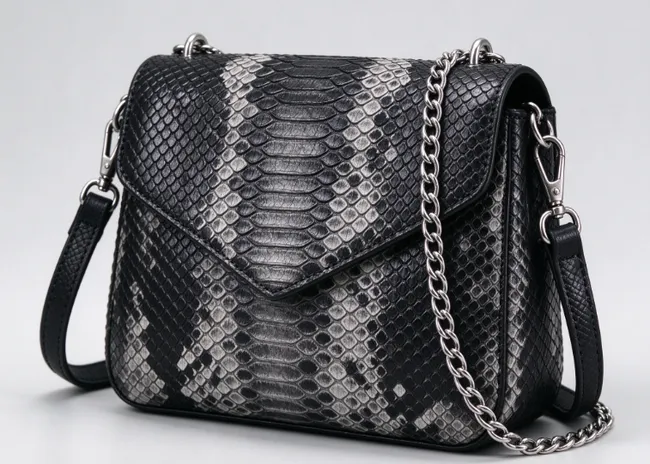
Python leather is a rare exotic leather sourced from pythons, distinguished by its natural diamond-shaped or reticulated scale pattern, soft supple hand feel, and large continuous hide panels. It is commonly used to craft handbags, wallets, belts, footwear, and other luxury goods. Compared to standard cowhide, python leather is lighter, thinner, and more flexible, with a pronounced natural grain that lends it high decorative value in the fashion and luxury industry.
Python leather offers strong tear resistance and excellent wrinkle-resistant flexibility, making it well suited for handbag face panels. However, it has low abrasion resistance and scratches easily. The scales are typically adhered to the hide and can lift or peel off when exposed to moisture, high heat, or improper care. For this reason, python leather is sensitive to water and heat, with an expected service life of roughly 5 to 10 years.
While its farming and slaughter practices draw frequent criticism from animal-welfare organizations, a number of luxury brands continue to use python leather in their collections today. This guide covers how python leather is made, where it performs best, whether it is ethical, and exactly where it is legal — including the strict rules in California and India.
Python leather is a category of exotic leather derived from snakes of the Pythonidae family. It is almost exclusively sourced from farmed reticulated pythons or Burmese pythons to comply with international wildlife trade regulations, and is used to produce handbags, wallets, footwear, belts, watch straps, and other high-end goods.
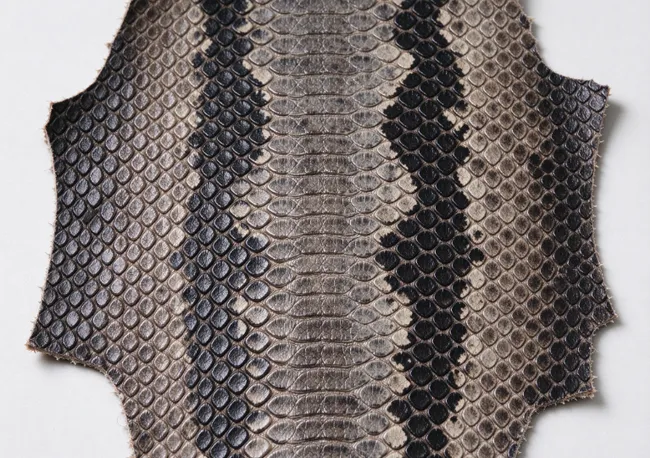
| Feature | Description |
|---|---|
| Appearance | Natural scales form a unique diamond/net pattern; every hide is one of a kind and highly recognizable |
| Hand feel | Soft, elastic, yet with good strength |
| Size advantage | Pythons are large (some species can reach 6.5 meters long and 60 cm wide), providing large, flawless panels suitable for big bag bodies |
| Scale structure | Scales are flat and close-fitting; they usually need to be glued down. The surface is smooth but easily scratched |
| Colour treatment | Natural patterns can be preserved (white background with dark brown markings), or the skin can be bleached and re-dyed, often finished to a matte Nappa effect |
Python leather is widely used across a variety of fields, including fashion apparel, small leather goods and accessories, ethnic musical instruments, and home décor. Its core value lies in the fact that the diamond-shaped scale patterns of each hide are unique and impossible to replicate, creating a distinctive visual appeal that combines a sense of wildness with luxury. At the same time, python leather is lightweight, soft, and supple, with excellent drape and flexibility.
| Category | Application Features | Representative Brands |
|---|---|---|
| Evening Bags / Clutches | Python skin’s “highlight moment” — the scale pattern is most striking when displayed over a large area; often paired with metal chains or crystal clasps | Chanel, Dior, Saint Laurent |
| Shoulder Bags / Crossbody Bags | Mostly small to medium sizes; commonly used for flap bags and box-style bags | Celine, Chloé, Gucci |
| Tote Bags | Rarely made entirely of python skin; mostly spliced designs (python skin + cowhide / fabric) | Valentino, designer brands |
| Mini Bags / Flap Bags | Small-area material usage; cost-controllable; the easiest entry point | Various luxury brands’ small accessory lines |
| Category | Application Features | Price Range (USD) |
|---|---|---|
| Wallets / Long Wallets | Medium-sized item that best showcases the complete scale pattern | $224 – $1,193 |
| Cardholders / Coin Purses | Entry-level python leather items, ideal for first-time buyers | $75 – $298 |
| Belts | A staple for men; python-pattern belts are understated yet textured | $149 – $746 |
| Watch Straps | Pairs with high-end watches; the fastest-growing application in recent years | $119 – $447 |
| Phone Cases | Emerging category; small material usage; affordable price | $45 – $224 |
| Keychains / Charms | Brand gifts and accessories; made from leftover materials | $30 – $119 |
| Application | Recommended Leather Part | Cutting Points | Main Risks |
|---|---|---|---|
| Evening Bag | Belly (large and uniform scales) | Symmetrical cutting along the centerline to display complete scale pattern | Easily crushed; requires stuffing for storage |
| High Heels | Belly + Back | Cut along the scale direction, avoiding flex zones | Scales lifting at creases |
| Belt | Whole hide, belly is best | Cut in long strips following the direction | Sensitive to water; sweat stains cause discoloration |
| Wallet | Belly / Back | Pattern-matching cut | Cracks easily at folds |
| Erhu (Chinese two-stringed instrument) | Mid-belly section | Tension control during skin mounting | Highest legal compliance risk |
| Watch Strap | Leftover pieces / Back | Small size, avoid defects | Easily damaged by sweat soaking |
Python leather is regarded as a luxurious exotic leather and is favored by many high-end and luxury fashion brands.
| Leather | Look | Feel | Weakest Against | Verdict |
|---|---|---|---|---|
| Python | Diamond scales, iridescent | Soft, light, drapey | Folding, crushing, water | Best for soft statement pieces |
| Crocodile | Raised tile scales | Firm, structured | Drying, cracking | Best for structured luxury |
| Ostrich | Quill-follicle bumps | Soft, light | Oil stains | Best all-round exotic |
| Lizard | Fine small scales | Thin, crisp | Delicate, tiny skins | Best for small goods |
| Cowhide | Plain or printed | Varies | General wear | Best daily workhorse |
| You are… | Assessment |
|---|---|
| A collector or evening-wear buyer | ✅ Excellent — buy a documented, un-restored piece and store it properly |
| An everyday commuter | ❌ Avoid — you’ll destroy it within a year |
| A brand considering python | ⚠️ Only with the full permit + label chain, and only on small soft pieces |
| Someone wanting the python look | 💡 Choose high-quality embossed leather or printed fabric — same visual impact, no legal burden, no maintenance nightmare |
| A reseller in China | 🚨 No label = no business, full stop |
Whether python leather is ethical does not have a simple “yes” or “no” answer. It is a complex and highly debated issue involving animal welfare, environmental sustainability, legal compliance, and supply-chain transparency.
Investigations published by animal-welfare organizations such as PETA have documented severe animal-welfare concerns in parts of the python-leather industry. In some farms in Indonesia and Vietnam, pythons have reportedly been subjected to extremely painful practices, including skinning while still alive, as well as blunt-force trauma, puncturing, and inflation.
Supporters of regulated python-leather production, however, argue that legal and sustainable harvesting is fundamentally different from poaching. They point out that, when proper procedures are followed, slaughter can be carried out in accordance with animal-welfare standards. They also argue that legal trade can provide economic incentives for local communities to protect python populations and their habitats.
The traditional view is that the python-skin trade may place pressure on wild populations. However, more recent research has presented a more nuanced picture.
International trade in python skins is regulated under the Convention on International Trade in Endangered Species of Wild Fauna and Flora (CITES). Legal international trade generally requires the appropriate CITES documentation to establish the species, origin, and legality of the shipment. However, legal does not necessarily mean ethical. CITES primarily focuses on the conservation of species and the sustainability of international trade; it does not comprehensively regulate the welfare of individual animals.
Certain jurisdictions impose additional restrictions. For example, California has historically maintained particularly strict restrictions on the commercial sale of python skins and products, while some countries have suspended or restricted exports for conservation reasons.
Luxury brands are increasingly taking different approaches to the use of python leather.
The legality of python leather depends entirely on the country or jurisdiction involved, the species, the source of the leather, and the intended use, such as commercial sale versus personal use. There is no single global ban on python leather. However, international trade is strictly regulated.
International trade in python skins is primarily regulated under CITES. Many commercially traded python species, including reticulated pythons and Burmese pythons, are listed under CITES Appendix II. This generally means that international commercial trade requires the appropriate permits or certificates from the relevant authorities and that the trade must comply with applicable conservation requirements.
In general, several conditions need to be satisfied simultaneously:
Python leather may be illegal when, for example:
| Situation | Why It Is Illegal |
|---|---|
| No CITES Permit | Trade in Appendix II species without a permit is illegal. |
| Document Mismatch | The permit does not match the goods, quantity, or species. |
| Wild-Sourced Skin | Not sourced from a licensed breeding farm; violates source rules. |
| Personal Carry / Mail Without a Permit | Smuggling — even if it is only a single item. |
| Domestic Sale in China Without Special Marking | Violates the Wildlife Protection Law of the People’s Republic of China. |
| False Declaration of Goods | Both customs fraud and an endangered-species violation. |
Yes. California law restricts the commercial importation, sale, and possession for sale of python skins and python-skin products. California has maintained particularly strict restrictions on the commercial trade of certain exotic animal skins for decades.
The restrictions are set out in California Penal Code Section 653o, which prohibits the commercial importation into California, possession with intent to sell, and sale of the skins or parts of certain listed animals, including python. The statutory list also includes a number of other species, such as polar bears, leopards, tigers, zebras, whales, and sea turtles.
The key distinction is between commercial activity and personal possession.
Therefore, for brands, retailers, manufacturers, and distributors, python leather presents a significant compliance issue when the product is intended for commercial sale or importation into California.
| Subdivision | Species covered | Effective |
|---|---|---|
| (a) | polar bear, leopard, ocelot, tiger, cheetah, jaguar, sable antelope, wolf, zebra, whale, cobra, python, sea turtle, colobus monkey, kangaroo, vicuna, sea otter, feral horse, dolphin/porpoise, Spanish lynx, elephant | Since 1970 |
| (b) | crocodile, alligator | Jan 1, 2020 (AB 1260) |
| (c) | iguana, skink, caiman, hippopotamus, Teju/Ring/Nile lizard | Jan 1, 2022 |
Violations of the relevant provision may constitute a misdemeanor. Potential penalties may include:
It is important to distinguish commercial activity from personal possession and use. The restrictions primarily target commercial activities. Lawfully owned python-leather products intended for an individual’s personal use — such as a pair of python boots or a handbag legally purchased in another state and brought into California for personal use — are not necessarily prohibited solely because they are python products. The core restrictions concern commercial importation, possession with intent to sell, and sale within California.
In practical terms:
| Activity | Legal in California? |
|---|---|
| Selling python bags/shoes/belts in a CA store | ❌ Illegal |
| Importing python goods into CA for resale | ❌ Illegal |
| Possessing python inventory with intent to sell | ❌ Illegal |
| Offering online for shipment to a CA address | ❌ Illegal (Amazon explicitly prohibits it) |
| Owning a python bag you bought legally elsewhere | ✅ Generally legal |
| Wearing/carrying a python product in California | ✅ Legal |
| Passing through CA with python goods in transit | ✅ Generally legal |
| Gifting a python item (non-commercial) | ✅ Legal |
| Repairing a customer’s python item commercially | ⚠️ Legal grey zone — risky |
This law is not merely a paper restriction; it is actively enforced in practice. In a recent case, in July 2026, the San Luis Obispo Police Department seized 85 pairs of python-skin boots from a western-wear store during a search. The boots were valued at approximately USD 400–600 per pair. The seized boots were subsequently turned over to the California Department of Fish and Wildlife (CDFW) for further investigation. The CDFW has also confirmed that the sale of python-skin products is prohibited in California.
No. Python leather is subject to strict legal restrictions in India, and commercial trade in python skins is generally prohibited. India has one of the world’s longest-standing and most stringent wildlife-protection regimes. Unlike California, where the restriction is imposed at the state level, India’s restrictions are based on the national Wild Life (Protection) Act, 1972.
Indian law imposes strict restrictions on pythons and python-derived products, covering commercial trade, possession, transportation, import, and export. These restrictions form part of India’s nationwide wildlife-protection framework. The Indian rock python (Python molurus) is classified as a highly protected species under India’s wildlife legislation. India introduced comprehensive restrictions on the commercial trade in python skins decades ago, with the trade having been prohibited since the 1970s.
The Wild Life (Protection) Act, 1972 is the cornerstone of India’s legal framework for protecting pythons and other wild animals. Under India’s wildlife-protection framework, protected python species are subject to the highest levels of legal protection. The Indian rock python (Python molurus), as well as other protected python species, are covered by the Act’s species schedules. Species receiving the highest level of protection are subject to stringent restrictions on hunting, capture, possession, transport, and trade, except where specifically permitted by law.
For businesses dealing in exotic leather, this means that python leather cannot be treated as ordinary leather goods in India. Commercial possession, domestic trade, import, export, or other transactions involving python leather may be prohibited or require specific authorization and documentation under applicable wildlife and customs regulations.
| Item | Status in India |
|---|---|
| Indian python (Python molurus) | Schedule I, Wild Life (Protection) Act, 1972 — highest protection |
| Protection level | Same tier as tiger, leopard, elephant, pangolin |
| Hunting | Prohibited throughout India |
| Trade / commerce in skins | Prohibited — “animal article” explicitly covers articles made from any part of a wild animal |
| Offence character | Cognizable and non-bailable |
| Snake skin trade | Ended in 1976; all snake species brought under WLPA protection from 1980 |
| Requirement | Reality |
|---|---|
| CITES export + import permits | Required, but only the starting point |
| Management Authority approval | Must be obtained under Chapter VB |
| Foreign Trade Policy | Wildlife products are treated as restricted/prohibited for import; requires DGFT licensing plus MoEFCC clearance |
| Domestic prohibition | Even with a permit, commercial trade in Schedule I articles remains barred |
| Documentation mismatch risk | Species, quantity and HS code must align exactly with permits |
The Indian rock python (Python molurus) is also listed in CITES Appendix I, which means that commercial international trade is generally prohibited. The species is protected in India, and the capture of wild individuals is prohibited. Commercial trade in specimens of the species is likewise not permitted, except in very limited circumstances allowed under CITES.
In 2025, the Indian government further tightened its export controls, explicitly prohibiting the export of reptile skins, whether processed or unprocessed. The restrictions extend to clothing, accessories, and other products made from animals protected under India’s Wild Life (Protection) Act or listed under CITES.
Violations involving Schedule I species under India’s wildlife-protection legislation constitute serious criminal offenses and may be non-bailable. Potential penalties include imprisonment of a minimum of 3 years, which may extend to 7 years, and a fine of a minimum of INR 25,000 (approximately USD 300), which may extend to INR 100,000 (approximately USD 1,200).
| Item | Detail |
|---|---|
| Nature of offence | Cognizable and non-bailable for Schedule I offences |
| Imprisonment | Up to 7 years (penalties sharply enhanced by the 2022 Amendment) |
| Fine | Substantial — running into lakhs of rupees |
| Scope | Covers hunting, possession, transfer, and trade/commerce in trophies and animal articles |
| Confiscation | Seized goods and the means of transport are liable to forfeiture |
As in California, an important distinction under Indian law is between personal use and commercial trade. Lawfully owned python-leather products intended solely for personal use — such as personal belongings brought into India from abroad — may not automatically constitute a criminal offense simply because they contain python leather. However, customs authorities impose strict controls on wildlife products entering the country, and undeclared or improperly documented python-leather products may be detained or seized. Indian customs authorities also pay close attention to imported reptile-skin products, even when they are described or labeled simply as “leather,” because wildlife products may be misdeclared or presented as ordinary leather goods.
Despite India’s strict legal restrictions, illegal trade in python skins continues to occur. Recent enforcement cases include an incident in September 2024, when the Forest Department in Manipur reportedly seized python skins and other python-derived items — including heads, gallbladders, and eyes — from a vehicle. The suspected individuals were arrested in connection with the case. The Wildlife Protection Society of India (WPSI) has also reported multiple cases involving the smuggling of python skins, including cases involving skins imported from countries such as Italy, Singapore, and Malaysia.
These enforcement cases illustrate that India’s restrictions on python products are not merely theoretical: wildlife authorities and customs agencies actively monitor and investigate the illegal trade and movement of python skins and other reptile-derived products.
| Agency | Role |
|---|---|
| Customs | Airport/port interdiction; AI-based X-ray scanning and biometric identification deployed at key checkpoints |
| Wildlife Crime Control Bureau (WCCB) | Investigation and prosecution |
| WPSI (Wildlife Protection Society of India) | Monitoring and intelligence |
| State Forest / Wildlife Departments | Licensing, seizures, prosecution |
| Option | Status | Note |
|---|---|---|
| Embossed calf leather (python print) | ✅ Legal | India’s leather industry developed this specifically after the 1976 ban |
| PU / PVC python-embossed | ✅ Legal | Common in handbags, belts, footwear |
| Printed fabric | ✅ Legal | Underlying material must be accurately declared |
| Anaconda skin (imported) | ⚠️ Still regulated | Not Schedule I domestically, but import rules and CITES still apply |
| “Faux python” with accurate labelling | ✅ Legal | Labelling must not mislead consumers into believing it is real python |
| Jurisdiction | Python leather status |
|---|---|
| India | ❌ Effectively prohibited nationwide — Indian python is Schedule I; snake skin trade banned since 1976; no commercial import channel |
| China | ⚠️ Legal only with provincial approval + 中国野生动物管理专用标识 |
| California | ❌ Banned for import-for-commerce, possession-with-intent-to-sell, and sale (§653o) |
| New York / most US states | ✅ Legal to sell |
| US federal | Legal with CITES permits |
| EU | ✅ Legal with CITES permits |
| Question | Answer |
|---|---|
| Is python leather legal in India? | ❌ Effectively illegal |
| Which law governs? | Wild Life (Protection) Act, 1972 |
| Protection tier for Indian python? | Schedule I — highest, same as tiger and elephant |
| When was snake skin trade banned? | 1976; all snakes protected from 1980 |
| Can I import python leather with CITES permits? | ❌ No practical legal channel; import of wildlife products is restricted |
| Is possessing a python bag an offence? | ⚠️ Possession and transfer of Schedule I articles are covered; commercial dealings clearly prohibited |
| Is the offence bailable? | ❌ Non-bailable and cognizable |
| Penalty | Up to 7 years’ imprisonment plus fines in lakhs (enhanced by the 2022 Amendment) |
| What about python-print leather? | ✅ Legal, provided it is accurately labelled as imitation |
| Enforced in 2026? | ✅ Yes — multi-agency enforcement with AI scanning; seizures include imported reptile skins |
Python leather is moderately to highly durable, but it requires careful handling and maintenance. It is not primarily known for being exceptionally tough or hard-wearing. Instead, its key value lies in its unique natural scale pattern, softness, flexibility, and distinctive texture.
The durability of python leather depends heavily on factors such as the tanning process, finishing treatments, quality of the hide, and how the product is used and maintained. For this reason, its performance should not be compared directly with conventional leathers such as cowhide, which are generally designed for greater resistance to heavy wear and abrasion.
| Dimension | Performance & Notes |
|---|---|
| Tear strength | Relatively high. Python skin has a strong fiber structure and excellent tear and tensile resistance, especially suitable for flexible handbag panels. |
| Abrasion resistance | Medium-low. This is the main weakness. Its surface scales are smooth and fine, so it is very prone to scratches; abrasion resistance is inferior to traditional leathers like cowhide. |
| Flexibility & wrinkle resistance | Excellent. Very soft and elastic, almost does not crease, ideal for soft-structured bags or those that need frequent bending. |
| Scale stability | Medium. Natural scales usually require additional gluing after tanning to secure them. Over time or with improper care, scales may lift — a unique aging phenomenon of python leather. |
| Estimated lifespan | 5–10 years. With careful maintenance and non-daily heavy use, python leather products can last 5 to 10 years; some well-cared-for footwear can even last 10–15 years or more. |
Python leather is not a uniform material. It consists of two layers with distinct structural properties, and nearly all durability-related issues depend on which layer is subjected to stress.
| Layer | Composition | Properties | Durability |
|---|---|---|---|
| Scale layer (outer) | Hard keratin, overlapping plates | Hard, abrasion-resistant, slightly translucent edges, iridescent sheen | ⭐⭐⭐⭐ Excellent — resists scratching and surface rubbing |
| Scale hinge / dermis (between scales) | Thinner, softer collagen tissue | Flexible, allows the skin to bend | ⭐⭐ The weak point — the hinge is where stress concentrates and where failure begins |
The durability of python leather is not fixed. Several factors can significantly affect its performance and lifespan:
| Material | Abrasion/Scratch Resistance | Tear Resistance | Flexibility | Weather Resistance | Typical Lifespan |
|---|---|---|---|---|---|
| Python leather | Low-Medium | High | Excellent | Poor (water/heat sensitive) | 5–10 years |
| Cowhide (full-grain) | Very high | Very high | Good | Good | 15–20+ years |
| Lambskin | Low | Low | Excellent | Poor | 3–5 years |
| Crocodile leather | Medium-High | High | Medium | Medium | 10+ years |
| Durability dimension | Python | Cowhide | Crocodile | Assessment |
|---|---|---|---|---|
| Abrasion resistance | ⭐⭐⭐⭐ Good (keratin scales) | ⭐⭐⭐⭐⭐ Excellent | ⭐⭐⭐⭐⭐ Excellent | Scales resist surface rubbing well |
| Tensile strength | ⭐⭐⭐ Moderate | ⭐⭐⭐⭐ High | ⭐⭐⭐⭐ High | Thin skin, generally around 1mm or less |
| Tear resistance | ⭐⭐⭐ Moderate | ⭐⭐⭐⭐ Good | ⭐⭐⭐⭐ Good | Scale edges can be caught and torn |
| Resistance to folding | ⭐ Poor | ⭐⭐⭐⭐⭐ Excellent | ⭐⭐⭐ Moderate | The critical weakness |
| Water resistance | ⭐ Poor | ⭐⭐⭐ Moderate | ⭐⭐ Poor | No water repellency; damage is permanent |
| Scratch visibility | ⭐⭐⭐⭐ Good | ⭐⭐⭐ Moderate | ⭐⭐⭐ Moderate | Natural pattern masks light scratches |
| Patina development | ⭐⭐⭐⭐ Good | ⭐⭐⭐⭐⭐ Excellent | ⭐⭐⭐ Good | Scales polish and deepen with careful use |
| Repairability | ⭐ Very poor | ⭐⭐⭐⭐ Good | ⭐⭐ Poor | Scale lift and water damage can’t be restored |
| Product | Realistic lifespan | What usually fails first |
|---|---|---|
| Watch strap | 1–3 years | Sweat and constant flexing at the lug; straps are consumables |
| High heels | 2–5 years | The crease zone across the toe box — scales lift first here |
| Belt | 3–8 years | Buckle abrasion, plus perspiration and flex at the wear point |
| Wallet / card case | 5–10+ years | Fold line; a well-stored wallet can outlast its owner |
| Evening bag / clutch | 10–20+ years | Nothing, if stuffed and stored flat — minimal handling |
| Daily-use handbag | 1–3 years before visible ageing | Handles, flap edges, base corners |
| Statement jacket | Decades if rarely worn | Shoulders and elbows if worn often |
| Small pouch / key ring | 3–7 years | Constant pocket friction |
Proper care and maintenance are among the most important factors in determining the lifespan of python-leather products.
| Do | Don’t |
|---|---|
| Dust with a soft brush or microfibre cloth | Never use water or soap — dries, stiffens, discolours irreversibly |
| Wipe along the direction of scale growth | Never wipe against the scales |
| Stuff with acid-free tissue to hold shape | Never store flat/collapsed or stacked under weight |
| Store in the dust bag (never a plastic bag) | Keep away from plastic — traps moisture |
| Keep at roughly 18–24°C, 40–60% humidity | Avoid bathrooms, windows, AC vents, radiators |
| Rotate with other bags to limit handling | Don’t overload — stress widens stitch holes |
| Professional care once or twice a year | Avoid heavy refurbishing — it cuts resale value 10–30% |
| Keep away from perfume, alcohol, solvents | Don’t let it get rained on |
| If you want it for… | Durability verdict |
|---|---|
| Evening bag, clutch | ✅ Excellent — decades, minimal handling |
| Wallet, card case | ✅ Very good — 5–10+ years |
| Watch strap, belt | ⚠️ Acceptable — but treat straps as consumables |
| Occasional statement heels | ⚠️ Moderate — crease zone is the weak spot |
| Statement jacket (rarely worn) | ✅ Excellent |
| Daily commuter bag | ❌ Poor — expect visible ageing within 1–3 years |
| Travel or luggage | ❌ Poor — pressure, humidity, rough handling |
| Humid climate, careless storage | ❌ Fails fast and permanently |
| Long-term investment/resale | ✅ Good — if original, un-restored, and documented |
Python leather is an exotic leather made from the skins of pythons of the Pythonidae family, valued for its natural diamond-shaped or reticulated scale pattern, soft drape, and large continuous panels. It is expensive because the raw material is scarce and the hides are graded strictly: only uniform, scar-free belly panels are suitable for high-end products. In addition, CITES documentation and compliance add sourcing, processing, and paperwork costs, and the tanning process is more demanding than for ordinary cowhide.
Moderately to highly durable, but with clear limits. Tear strength is relatively high and flexibility is excellent — it almost never creases. However, abrasion resistance is medium-low, and the material is highly sensitive to water, heat, and humidity, which can cause scales to lift permanently. Its typical lifespan is 5–10 years, though an evening bag or clutch that is properly stuffed and stored flat can last 10–20+ years, while a daily-use handbag may show visible ageing within 1–3 years.
It is not recommended. Python leather is not designed for heavy daily use. Repeated friction, folding, and load-bearing accelerate damage to the scales and finish, particularly at handles, flap edges, and base corners. It performs far better in clutches, evening bags, wallets, watch straps, and other occasionally used pieces. For an everyday commuter bag, full-grain cowhide is a more suitable material.
Commercial activity is not. California Penal Code Section 653o prohibits the commercial importation into California, possession with intent to sell, and sale of python skins and python-skin products, with penalties that may include a fine of USD 1,000 to USD 5,000, up to 6 months in county jail, or both, assessed per violation. Personal use is treated differently: lawfully purchased items that you own and wear or carry for personal use, or bring through the state in transit, are generally not prohibited.
No — commercial trade is effectively prohibited nationwide. The Indian rock python (Python molurus) is listed under Schedule I of the Wild Life (Protection) Act, 1972, the highest protection tier, on the same level as the tiger and elephant. Snake skin trade has been banned since 1976, all snake species came under protection from 1980, and in 2025 India further tightened export controls by prohibiting the export of reptile skins. Offences are cognizable and non-bailable, with imprisonment of 3 to 7 years. Python-print embossed leather and PU/PVC imitations remain legal, provided the labelling clearly declares them as imitation.
Condition the leather regularly with a reptile-specific conditioner such as Saphir Reptan or Bickmore Exotic, applying a small amount monthly or every few months. Keep it away from water, heat, and perfume: if it gets wet, blot immediately and air-dry in a cool, ventilated area — never with direct heat. Clean by dusting along the direction of scale growth with a soft brush or microfibre cloth. For storage, stuff the piece with acid-free tissue to hold its shape, place it in a dust bag (never plastic), and keep it at roughly 18–24°C and 40–60% humidity. Rotate it with other bags, avoid overloading, and arrange professional care once or twice a year.
Python leather is exceptionally beautiful but relatively delicate. It is best suited to lower-frequency-use products such as clutches and evening bags, rather than as the primary material for everyday commuter bags. When sourcing python leather, brands must also verify the CITES documentation and ensure compliance with all applicable regulations in the destination market.
Python leather features a dense, interwoven fiber structure with good tear resistance, while remaining lightweight, soft, and supple with excellent drape. Its ability to take on rich, saturated colors through dyeing further enhances its distinctive appeal, creating a look that is both wild and refined.
For high-end leather-goods brands considering python leather for bag production, ensuring legal and traceable sourcing from the outset is essential. When properly sourced and handled, python leather can add a distinctive sense of luxury and exclusivity to a product, making it a compelling material choice for limited editions, statement pieces, and premium collections.
If you are looking to develop a bespoke luxury bag collection, we would be delighted to work with you and bring your brand’s vision to life.

Previous :
Bag Lining Materials: How to Choose the Right One for Your BrandNext :


Mobile Website

Inquires Whatsapp