- +86 13922774531
- info@gionar.com

English


English
August 11 , 2026
How to find a reliable bag manufacturing factory? When choosing a bag factory, what qualification certificates should be reviewed?
The qualification certificates that a bag factory can have include: ISO 900, ISO 14001, ISO 45001, SMETA, BSCI, WRAP, SA8000, GRS, RCS, OEKO-TEX® STANDARD 100, FSC, etc.
When looking for a bag factory, certification qualifications are the core basis for screening high-quality suppliers. ISO 9001 is the basic quality management system certification, reflecting the standardization of production; SEDEX (SMETA) and SA8000 focus on auditing labor rights and working conditions, and are mandatory entry conditions for European and American brand manufacturers.
This post will explore the qualification certificates of bag factories and help you make informed judgments about manufacturers when looking for bag suppliers.
“Factory Certificate” is a broad term that refers to different documents in various industries and contexts. In simple terms, it is a document issued by the product manufacturer to prove that the product, production process, or the factory itself complies with specific standards or requirements.
Depending on the purpose, factory certificates can be classified into the following categories:
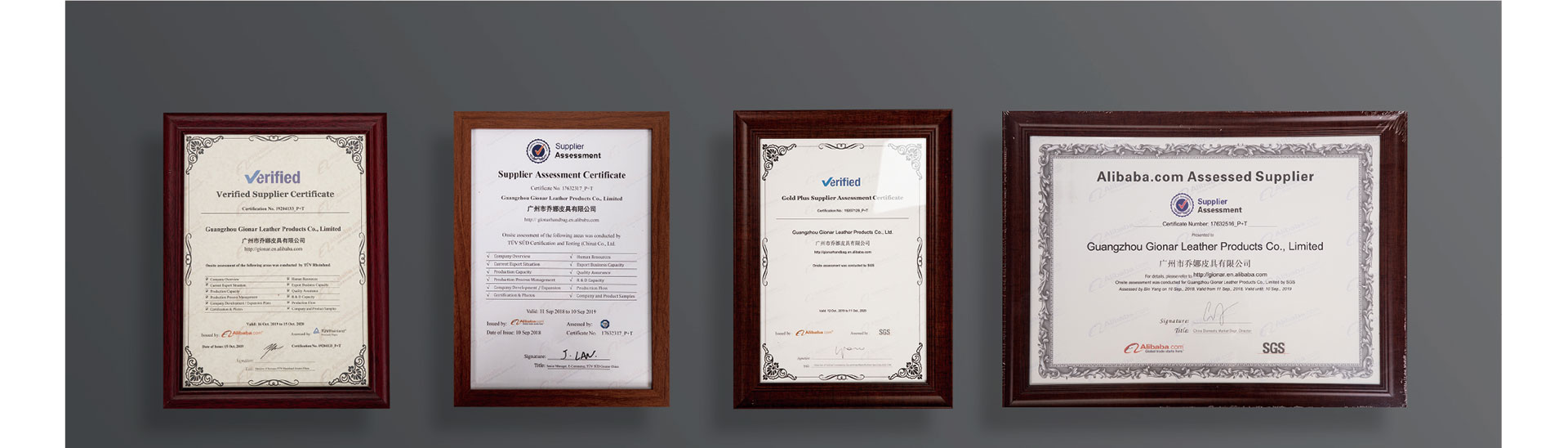
These certificates prove that the factory’s management system, production capacity or social responsibility has reached certain standards, serving as the “identity and strength proof” of the factory.
Obtaining these certifications indicates that the factory has standardized management and is an important basis for brand owners to find reliable partners.
These certificates are specific to certain product batches and prove that their quality meets the agreed standards, serving as the “certificates of conformity” for the products.
These certificates are designed for specific scenarios or industries, such as international trade or the electronics industry.
| Type | Purpose | Common Applications |
| MTC (Mill Test Certificate) | Verifies chemical composition and mechanical properties of metal materials | Export of steel, aluminum, copper to EU/US; required for customs clearance |
| CCC Certificate | China’s mandatory product safety certification | Electrical appliances, automotive parts, toys sold in China |
| ISO 9001 | Confirms implementation of a quality management system | Global supply chain requirements across industries |
| ISO 14001 | Validates environmental management practices | Green manufacturing, export compliance, ESG reporting |
| Factory Audit Report | Third-party assessment of production capability, labor practices, safety | Required by global brands (e.g., Walmart, Apple) before supplier onboarding |
| Certificate of Manufacture | Proves product was produced by the named manufacturer | Used for warranty claims, import documentation, authenticity verification |
| Green Factory Certification | Recognizes energy efficiency, waste reduction, and low-carbon production | Government incentives, sustainable branding, B2B procurement |
| Smart Factory Certification | Validates digitalization, automation, and AI-driven production systems | National-level innovation grants, Industry 4.0 recognition |
| Issue | Reality |
| Certificate ≠ current condition | Audits are periodic; conditions may change between inspections |
| Scope limitations | A certificate covers specific products, processes, or facility sections |
| Fake certificates | Counterfeit documents exist; verify with issuing body |
| Minimum standards | Many certificates set baseline, not excellence |
Many certificates set baseline, not excellence
Bag manufacturers obtain certifications, and the core value lies in building trust, ensuring quality and compliance. In short, bag manufacturers possess more certification certificates. These not only prove their strength but are also crucial in winning orders, guaranteeing quality, and entering the international market in the fiercely competitive market environment.
For brand owners and purchasers, especially international brands, choosing a manufacturer is a high-risk decision. Certification is an objective standard for them to evaluate the capabilities of suppliers.
Certification plays the role of a trust signal in a highly competitive market:
78% of EU consumers stated that they are more willing to purchase bags with visible sustainability or safety certifications.
On Tmall and JD, products labeled with OEKO-TEX or GRS tags have a conversion rate that is 2.3 times higher than those without certification.
Certification is not just a piece of paper; it drives the establishment and optimization of the factory’s internal quality control system.
In the fierce market competition, certification is a powerful tool for manufacturers to distinguish themselves from their competitors.
International retailers and platforms have strict certification requirements for suppliers:
Real case: Feedback from a compliance officer of a Canadian retail chain – “A supplier with ISO 9001 certification is considered sufficient, but when the Vancouver customs detained goods due to the lack of OEKO-TEX documents, we had $180,000 worth of goods in hand.” ISO 9001 is a system certification, not a product chemical compliance certification. Confusing the two is the most common and expensive compliance failure in bag imports.
Bag products involve textiles, dyes, printing, PVC coatings, hardware, etc., with many restricted chemical substances:
GRS (Global Recycled Standard): Verifies the source traceability, chemical management, environment and social responsibility of rPET, recycled nylon, etc., a minimum 20% recycled content is required to claim recycled, and ≥50% can use the GRS trademark.
GRS + OEKO-TEX combination can simultaneously cover “recycled content + chemical safety”, which is the complete requirement of most sustainable textile buyers If a brand claims to “use recycled materials” but fails to provide a GRS transaction certificate, it will face both regulatory and reputational risks.
ISO 9001 provides a structured quality management framework from raw material procurement to cutting, sewing, and final inspection. Over 1 million certificates have been issued globally.
The result is fewer defects, less waste, and a quality system that major retailers truly trust.
The cost for small and medium-sized factories to obtain certification is approximately $3,000 – $8,000, with a cycle of 4 – 6 months, and annual supervision audits are required.
ISO 14001 manages wastewater, emissions, energy consumption, and chemical waste.
For brands serving European or public sector customers, ISO 14001 is evolving from a “nice to have” to a baseline expectation.
Integrating with ISO 9001 certification can save 20 – 30% of audit costs.
⚠️ “One certificate solves everything” is the most common fatal illusion –
Laboratory testing of fabric samples for OEKO-TEX/GRS usually takes 4–6 weeks. If you ask “Does this fabric have OEKO-TEX?” in the 9th week, the entire production cycle will be ruined. The certification status must be locked as a contract clause in the purchase order.
The SOP of reliable buyers is:
| Scenario | Consequence |
| Small or uncertified factory | Limited to low-margin, unregulated markets |
| Failed audit | Loss of major client; production halt |
| Non-compliant materials | Customs seizure; fines; brand damage |
| Labor violations exposed | Consumer boycotts; legal action; contract cancellations |
An internationally competitive bag factory usually holds certifications covering various aspects such as quality management, social responsibility, environmental management and product safety.
This type of certification demonstrates that the production process and quality management level of the factory have reached international standards.
This type of certification focuses on the labor rights, working conditions, and business ethics of factories. It is an important prerequisite for cooperation between international brands and large retailers (such as Walmart and Disney).
Reflects the factory’s commitment to environmental protection and sustainable development.
Ensure that the products do not contain harmful substances and comply with the regulatory requirements of specific markets.
| Audit Standard | Issuing Body | Audit Focus | Key Audit Modules |
| ISO 9001 | International Organization for Standardization | Quality Management System | Document control, process mapping, non-conformance handling, internal audits, corrective actions |
| ISO 14001 | ISO | Environmental Management | Waste disposal logs, chemical storage protocols, energy/water usage tracking, emissions monitoring |
| BSCI | Amfori | Social Compliance | Working hours, wage records, child/forced labor screening, health & safety inspections |
| SMETA (4-Pillar) | Sedex | Ethical Supply Chain | Labor rights, health & safety, environment, business ethics — verified via shared audit reports |
| OEKO-TEX® STeP | Hohenstein Institute | Sustainable Production | Chemical management (REACH compliance), wastewater treatment, energy efficiency, worker training, traceability systems |
| GRS (Global Recycled Standard) | Textile Exchange | Material Integrity | Chain-of-custody documentation, recycled content verification, chemical restrictions, social & environmental criteria |
Third-party auditing institutions (such as SGS, Intertek, BV, TÜV) will use these standards as a “checklist” during on-site audits. If any of the modules fail to meet the requirements, the audit may fail – even if the product has passed laboratory tests.
| Standard | Regulatory Body | Audit Scope | Enforcement Mechanism |
| GB 18401-2002 | SAMR (State Administration for Market Regulation) | Textile safety (formaldehyde, azo dyes, pH) | Mandatory for domestic sales; verified via factory sampling + lab testing |
| GB 20400-2006 | SAMR | Leather/fur material safety (chromium, formaldehyde) | Audited during export inspection; requires test reports from CNAS-accredited labs |
| GB/T 41002-2022 | SAMR | Children’s bags (since 2024) | SCCP, phthalates, small parts — audited via batch sampling and factory process review |
| CCC (China Compulsory Certification) | SAMR | Only applies to specific electrical components in bags (e.g., built-in lights, chargers) | Rarely applicable to standard bags; audit triggered only if electrical elements are present |
The domestic inspection is conducted by certified institutions that have been accredited by CNAS. Exporters must simultaneously meet both Chinese standards and the requirements of international buyers – dual compliance is mandatory.
| Auditor | Common Audit Tools | Unique Focus |
| SGS | Customized checklist templates, digital audit apps, blockchain traceability pilots | Strong in chemical compliance (REACH, CPSIA) and food-contact material audits |
| Intertek | “Luggage Testing Protocol” (ASTM/EN/ISTA), dynamic load testing logs | Emphasizes physical durability: wheel fatigue, zipper cycles, drop tests |
| BV (Bureau Veritas) | SMETA + ISO hybrid audit format, worker interview protocols | High scrutiny on wage payment records and overtime documentation |
| TÜV Rheinland | STeP-aligned audits, carbon footprint calculators | Deep expertise in EU environmental regulations and circular economy metrics |
| QIMA | Mobile audit app with photo/video evidence capture | Popular with Amazon, Walmart; focuses on real-time compliance snapshots |
Auditing is not a one-time event. Most buyers need to undergo re-audits and surprise inspections every year.
OEKO-TEX® STeP is the only certification system for auditing protocols specifically designed for textile and leather manufacturing facilities (including bag manufacturers) worldwide.
Its auditing structure is characterized by its modular and quantitative features:
| Module | Audit Criteria | Scoring System |
| Chemical Management | Inventory of all chemicals used; SDS compliance; banned substance screening | 0–5 scale per chemical category |
| Environmental Performance | Water consumption per unit, wastewater pH/TOC levels, air emissions | Measured against industry benchmarks |
| Social Responsibility | Worker contracts, grievance mechanisms, training records | Verified via anonymous worker interviews |
| Quality Management | Documented QC procedures, batch traceability, non-conformance logs | Must align with ISO 9001 principles |
| Health & Safety | PPE provision, machine guarding, fire exits, first-aid access | Mandatory pass on all safety items |
| Energy & Resource Efficiency | kWh per bag produced, recycling rate of scrap material | Requires continuous improvement plan |
| Certification | Auditor Requirements | Audit Scope | Certification Process |
| ISO 9001 | ISO-accredited certification bodies | Quality management systems, production processes, quality records | Document review, on-site audit, certification valid for 3 years |
| CE Marking | EU notified bodies | Compliance with EU directives, product safety testing, technical documentation | Self-assessment, third-party testing, Declaration of Conformity |
| CPSIA Compliance | CPSC-accredited testing laboratories | Lead/phthalate content limits, product safety testing, tracking labeling | Testing, Certificate of Compliance (CPC), labeling requirements |
| SA8000 | SA8000-accredited certification bodies | Labor practices, working conditions, employee rights | Document review, on-site audit, corrective actions, certification valid for 3 years |
| BSCI Audit | BSCI-approved auditing firms | Compliance with BSCI Code of Conduct, labor practices, environmental practices | Self-assessment, on-site audit, corrective action plan, reporting to BSCI |
| SEDEX Audit | SEDEX-approved auditing firms | Compliance with SEDEX Code of Conduct, labor practices, environmental practices | Registration, on-site audit, reporting to SEDEX, corrective actions |
| ISO 14001 | ISO-accredited certification bodies | Environmental management systems, waste management, energy consumption | Document review, on-site audit, certification valid for 3 years |
| OEKO-TEX® Standard 100 | OEKO-TEX® -accredited testing institutes | Testing for harmful substances, human-ecological requirements | Testing, certification valid for 1 year with annual re-testing |
| FSC Audit | FSC-accredited certification bodies | Sustainable sourcing of paper and wood, traceability | Document review, on-site audit, certification valid for 5 years |
| Disney FAMA Audit | Disney-approved auditing firms | Compliance with Disney’s Code of Conduct, product safety | Application, audit, corrective actions, FAMA issuance |
| Walmart Ethical Sourcing Audit | Walmart-approved auditing firms | Compliance with Walmart’s Ethical Sourcing Standards, product safety | Registration, audit, corrective action plan, Walmart approval |
Verifying the certificates of bag manufacturers is a crucial step in ensuring product quality and supply chain security. A complete verification process should not merely rely on the certificate documents themselves; rather, it should also involve checking against official databases and conducting in-depth reviews of the details.
After obtaining the certificate documents, the first thing to do is not to query the database, but to carefully read the certificate itself and check the most obvious information.
After completing the initial inspection, the next step is to conduct online verification using the official database.
Management system certification (such as ISO 9001, ISO 14001): Use the global database IAF CertSearch of the International Accreditation Forum. IAF is the global authority in the field of management system certification. You can enter the company name or certificate number on this website to verify the validity and status of the certificate. This is the most authoritative and convenient way to verify such certificates.
Social responsibility audit (such as BSCI, SMETA): BSCI and SMETA are more accurately referred to as “audits” rather than “certifications”. Therefore, there is no global public database like ISO for querying. The correct approach is to require the factory to provide a complete audit report. The report should include detailed information such as the audit date and the signature of the auditor. For BSCI, you can also ask the factory to log in to its official data platform for a query.
Product and material certification (such as GRS, OEKO-TEX):
After the online verification is confirmed to be correct, a deeper review is required to ensure that the certificate is not just a formality.
| Certification Type | Verification Method | Key Steps |
| ISO Certifications | Online verification via ISO Survey database | Enter certification number, check validity period, verify manufacturer details |
| SA8000 | Online verification via SAI website | Search for the manufacturer’s name, check certification status and scope |
| BSCI | Online verification via BSCI website | Search for the manufacturer’s name, view audit reports and compliance status |
| OEKO-TEX庐 | Online verification via OEKO-TEX庐 tool | Enter certification number, check validity period, verify product scope |
| FSC | Online verification via FSC website | Enter certification number, check validity period, verify chain of custody |
| CE Marking | Verify technical documentation and test reports | Review Declaration of Conformity, check test reports for compliance with EU standards |
| CPSIA Compliance | Review Certificate of Compliance (CPC) | Check CPC for lead and phthalate content limits, verify test reports |
No matter which type of certificate is being verified, any of the following situations should immediately raise a red flag:
❌ The company name on the certificate does not fully match the business license (the most common fraud method)
❌ The manufacturer refuses to share real-time data on the amfori / Sedex / Textile Exchange platform with you
❌ Only sending static PDF scans and refusing to provide DBID / Sedex ID / certificate registration number
❌ The certificate is “permanently valid” – the validity period of OEKO-TEX is 1 year, GRS is 1 year, and ISO 9001 requires annual review. Any claim of “permanent validity” is a fake certificate
❌ The numbering format does not comply with the rules (OEKO-TEX is XXXXXX-XX-XXXX; GRS TC is [CB]-[Standard]-[number])
❌ The certificate issuance date is later than the product delivery date
❌ Unreported subcontracting – the factory presents a clean report, but the actual order is produced in an unvetted subcontracting shed
❌ The certification body is not on the officially recognized list (OEKO-TEX 17 member institutions, Textile Exchange authorized GRS certification bodies CU/SGS/Intertek/CTI/TÜV/BV, etc.) – ⚠️ Some brands (such as Marks & Spencer, Adidas, Nike, GAP) clearly only recognize GRS certificates issued by Control Union – Before placing an order, confirm whether your client has specific requirements for the certification body.
If you are looking for a reliable bag manufacturer, there are many bag factories all over the world. However, to find a high-quality leather bag factory that has complete export certifications, you need to do a thorough screening.
| Company Name | Key Certifications | Key Information |
| Guangzhou Gionar Leather Products Co., Ltd. | ISO9001, BSCI, REACH, ROHS | Established in 2006; 251–500 employees; monthly capacity of 280,000 pieces. Products include handbags, wallets, backpacks, etc. |
| HACHANGBAG | BSCI, ISO 9001:2015, SGS audit; compliant with REACH, Azo, Low Cadmium, Prop 65 | Vietnam based factory with 3,900 m²; monthly capacity of 70,000 pieces. Advantageous for leveraging Vietnam’s tariff benefits (EVFTA/CPTPP). |
| Hongdebag | ISO9001, BSCI, GRS | Professional OEM/ODM manufacturer with a wide product range. |
| Amie Leather | BSCI, ISO 9001 | Established in 2003; factory over 10,000 m²; monthly capacity of 200,000 pieces. |
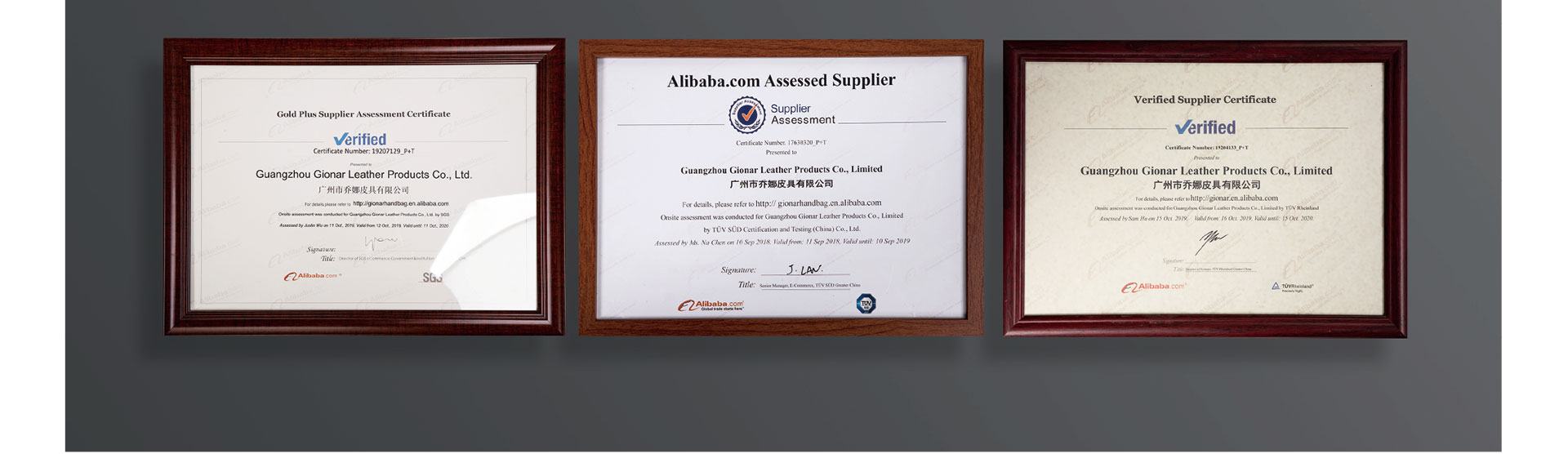
Gionar holds several international certifications, which are crucial for its global export capabilities:
Gionar is a OEM/ODM leather goods manufacturer with over 20 years of industry experience, integrating design, research and development, as well as production and manufacturing. With a 15,000-square-meter factory, over 300 professional employees, 6 production lines, and multiple international certifications such as ISO9001, BSCI, and REACH, Gionar provides one-stop custom leather goods solutions for global brand clients, ranging from design and sample production to mass production and delivery. Its products are exported to major markets such as North America, Europe, and Oceania.
When looking for bag factories, certification is the “first filter” and “threshold” for screening factories, but it is by no means the only evaluation criterion, nor is it a “guarantee” for quality.
International brands usually prefer bag factories that have ISO system certification, social responsibility audits, and environmental material certifications, because these certifications can comprehensively prove that the enterprise has a high level in quality control, compliant production, sustainable development, and supply chain management, thereby enhancing international market competitiveness and customer trust.
Our factory holds these necessary qualification certificates. If you are seeking a reliable bag manufacturer, please feel free to contact us.



Mobile Website

Inquires Whatsapp