- +86 13922774531
- info@gionar.com

English


English
August 18 , 2026
Ostrich leather is one of the most luxurious and durable exotic leathers in the world, made from the skin of the ostrich — the largest bird on the planet. It is highly regarded for its unique natural texture and outstanding properties, held in high regard alongside crocodile skin and python skin at the very top of the leather goods industry.
What truly sets ostrich leather apart is its perfect balance of softness, toughness and lightness: it is unusually soft for its strength, yet exceptionally tear-resistant and significantly lighter than cowhide or crocodile of similar thickness.
Top global luxury brands — Hermès, Prada, Bottega Veneta and Saint Laurent — all use ostrich leather for their most luxurious handbags, wallets and accessories. This guide covers what ostrich leather is, how it is made, why it is so expensive, how durable it really is, and whether it is the right material for making bags.
Ostrich leather is a high-end exotic leather made from the skin of the ostrich, the largest bird in the world. It is widely regarded as one of the most durable, luxurious and distinctive leathers available on the market, favored for its unique texture, flexibility and outstanding strength.
Ostrich leather comes in various grades and is mainly used in high-end luxury products such as handbags, wallets, belts, shoes and watch straps from brands like Hermès, Prada, Chanel, Gucci and Louis Vuitton.
Professional tip: Ostrich leather is an excellent material for manufacturing high-end bags — a fact confirmed by its position at the top of the luxury leather goods industry.
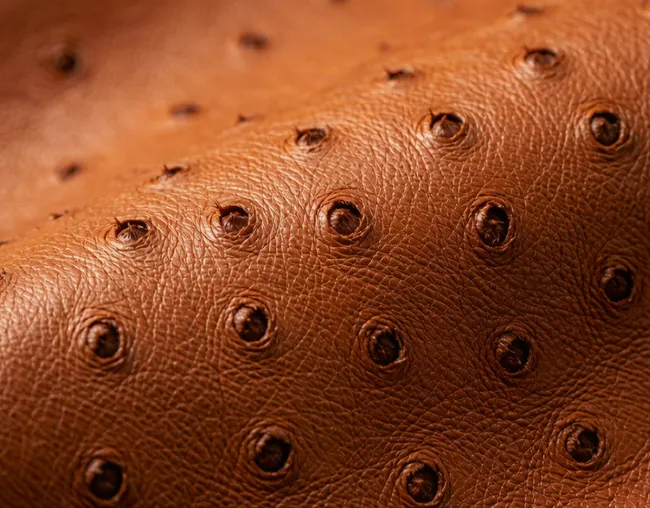
The characteristics below define why ostrich leather behaves so differently from cowhide and other exotics:
| Feature | Description |
| Unique “Quill” Pattern | The most distinctive feature is the raised bump-and-pit texture, created by the feather follicles (quill sockets) on the skin. These bumps are completely natural and vary in size and pattern — no two ostrich leather pieces are exactly alike. |
| Soft & Supple | Ostrich leather is unusually soft and pliable for its strength, making it comfortable for items that need to flex (like shoes and watch straps). It does not require breaking in. |
| Exceptionally Durable | Despite its softness, ostrich leather is tough, tear-resistant, and has one of the highest tensile strengths among all leathers. It is also naturally resistant to cracking and drying out. |
| Lightweight | It is significantly lighter than cowhide or crocodile leather of similar thickness, making it ideal for large bags or travel accessories. |
| Luxurious Finish | It absorbs dyes exceptionally well, producing rich, deep, and uniform colors — available in almost any color, from classic blacks and browns to vibrant reds and pinks. |
| Longevity | With proper care, ostrich leather products can last for decades, developing a beautiful patina while retaining their structure. |
Unique in the world: the pores of each skin are distributed in a natural random pattern, with no repetition, giving each item collection-level uniqueness.
| Performance Dimension | Ostrich Leather | Cowhide (Comparison) | Crocodile Leather (Comparison) |
| Weight | Extremely light (30%+ lighter than crocodile of same thickness) | Medium | Heavier |
| Breathability | ★★★★★ (40% higher than cowhide) | ★★★ | ★★ |
| Flexibility | Excellent — bends without cracking | Good | Relatively stiff |
| Abrasion Resistance (Martindale 5,000 cycles) | Weight loss only 0.8g | Weight loss 1.5g | Weight loss approx. 1.5g (similar to cowhide)* |
| Cold Resistance (–30°C) | Contains natural glycerin — does not crack | Becomes stiff | Prone to cracking |
| Dye Absorption | Absorbs dyes evenly — rich, saturated color | Medium | Excellent |
| Property | Ostrich Leather | Comparison |
| Thickness (tanned) | 1–2 mm (up to 2.5 mm) | Similar to calfskin |
| Usable area per hide | ~15–16 sq ft avg | Much less than calf (ostrich yields only 1–2 sq m of usable hide per bird) |
| Tensile strength | 101–249 N/mm² | Comparable to cowhide |
| Tear resistance | 55–75 N/mm | Higher than cowhide |
| Fiber structure | Fine collagen bundles in horizontal weave | Less coarse than bovine |
| Natural oil content | High | Self-lubricating, crack-resistant |
These protrusions are not decorative structures but the empty feather follicles left after processing the leather. The specific biological principle is as follows:
Not all leather areas have the characteristic protrusions:
The larger and more prominent feather-like spikes indicate an adult bird, which is generally considered more attractive.
The production of ostrich leather is a meticulous journey from the farm to the luxury workshop, integrating meticulous breeding, rigorous craftsmanship, and exquisite chemical technology. It usually requires over 30 processes and takes 1 to 4 weeks to complete.
The quality of ostrich leather is determined during the breeding stage. Ostriches are typically slaughtered at 9 to 14 months of age, when their skin is most mature and their quill follicles are fullest. The breeding process has a significant impact on the leather:
After slaughtering, a skilled worker independently completes the skin removal (to avoid inconsistent cutting damage caused by multiple operations), and the skin removal room is maintained at a temperature of 14–16°C.
The freshly removed raw leather is highly prone to spoilage and must be immediately treated with preservation:
After the raw leather arrives at the tannery, it is first graded. The core value of ostrich leather lies in the “Diamond/Crown” area on the back — the region with the densest feather follicles. This area is divided into four quadrants and each defect is evaluated one by one.
| Grade | Description | Price per Whole Skin |
| A+ / A | Diamond area — virtually flawless | $400 – $600+ |
| B | One quadrant with minor defects | $250 – $400 |
| C | Two quadrants with defects | $200 – $250 |
| D – E | Multiple defects | $150 – $200 |
The purpose of this stage is to restore the flexibility of the dried salted hide and prepare it for tanning:
After squeezing and finishing the blue wet hide, it enters the second stage:
This stage completes the leather, which is called “Crust Leather”.
This is the final finishing stage that directly determines the appearance and feel of the finished leather:
Warning: Ostrich hide is typically chrome-tanned rather than vegetable-tanned: the delicate fiber structure of ostrich hide is too sensitive to the harsh process of vegetable tanning, which may damage the three-dimensional structure of the hair follicles.
Yes, ostrich leather is extremely expensive. It is regarded as one of the most expensive leathers in the world and is mainly used for making high-end handbags, shoes, and accessories. The high price is reflected throughout every stage from raw material to finished product.
The price of ostrich leather varies depending on its grade, location, and market conditions. Here is a rough price range to give you a better idea:
There are approximately 600,000 ostrich skins worldwide, with South Africa accounting for nearly half (250,000+). Ostrich farming requires vast land and specific climate conditions, and the production capacity is far lower than that of cattle and sheep. The usable area of a single sheet is only 12–15 sq ft, while that of cowhide is approximately 22–24 sq ft.
The strong demand from luxury brands creates an imbalance in supply and demand that drives up prices.
The distinctive quill bumps formed by the feathers on the ostrich’s back are only densely distributed in the “Crown Area”, accounting for about 1/3 of the entire skin.
“Full quill” products must be cut only from the Crown Area — making a handbag may require 2 whole sheets to obtain a suitable full quill panel. Outside the Crown Area (abdomen, legs, wings) the bumps gradually disappear, and ostrich leg skin has no bumps at all, but rather a scaly texture.
Low material utilization + high waste rate = a significant increase in the material cost per handbag.
From raw leather to finished product, it goes through three stages: raw → crust → finishing, with a total of 36 steps.
Key challenges: melanin pigment deposits in the dermis (corium) layer rather than the epidermis, requiring specialized bleaching; the bump structure is fragile, and each step of liming/re-tanning/fat-liquoring must be precisely controlled, otherwise the hair follicles will collapse and flatten. The grease must penetrate into the internal structure of the hair follicle — if the process is not done properly, the leather will become brittle.
European (especially Italian) tanned ostrich leather is regarded as the gold standard and is more expensive.
Ostrich leather naturally contains grease, which makes it resistant to cracking, flexible, and durable. Industry tests show that its tensile strength and tear resistance are comparable to or even exceed those of full-grain calf leather, and its overall durability is approximately 3–4 times that of cowhide.
It becomes softer with use, forms a rich patina, and has a lifespan of several decades.
Products made with ostrich leather by top brands such as Hermès, LV, Gucci, and Prada can push the final price up to $15,000–$25,000+. The cost for European manufacturers to purchase premium ostrich leather has risen from $20/sq ft to $42/sq ft.
| Product Category | Price Range (USD) | Material Grade | Market Characteristics |
| Ostrich Raw Hide (Material) | $193 – $303 / sqm | Grade 1 “Full Quill” area | Only 1/3 of each skin is usable as top-grade material; high raw material cost |
| Ostrich Leather Wallet | $414 – $1,103 | Grade 2 or partial Quill | Mostly niche handmade brands or custom-made products |
| Luxury Brand Handbag (Entry) | $9,379 – $12,690 | Prada Galleria Ostrich – Medium | Official retail pricing; includes brand premium and manual labor |
| Luxury Brand Handbag (High-End) | $16,552 – $20,690 | Prada Double Baguette or diamond-studded limited edition | High material matching difficulty; yield rate below 40% |
| Hermès Birkin 25cm | $31,297 – $48,276+ | Full Quill + Palladium hardware | Significant premium on the secondhand market; rare pieces can double in price |
| Ostrich Leather Jacket | $1,655 – $6,897+ | Full Quill, hand-stitched | Requires precise pattern matching; over 20 hours of labor per piece |
| Leather Type | Raw Material Cost per Sqm (USD) | Finished Bag Price Range (USD) | Relative Value Multiple |
| Ostrich Leather | $193 – $303 | $9,379 – $48,276+ | 8–10× cowhide |
| Crocodile Leather | $345 – $552 | $13,793 – $110,345+ | Comparable to ostrich; some rare patterns command higher prices |
| Cowhide (Full-Grain) | $21 – $41 | $690 – $2,759 | Baseline (1×) |
| Ostrich-Pattern PU | $1 – $6 | $69 – $276 | Only 1/50 – 1/100 of genuine ostrich |
Professional tip: For manufacturers, the most cost-efficient route is buying by area: Grade A wholesale runs $30–40 per square foot, but a “full quill” bag panel must come from the crown area — budget for roughly 2 whole sheets per handbag.
Yes, ostrich leather is extremely durable and is hailed as one of the strongest leathers in the world. Its durability lies in the fact that it combines extraordinary flexibility, excellent tear resistance, and natural weather resistance, achieving an excellent balance. Unlike durability achieved through “hardness” (such as crocodile leather), ostrich leather achieves it through “flexibility”.
| Performance Dimension | Ostrich Leather Performance | Comparison Notes |
| Tear Strength | Extremely High | The collagen fibers in ostrich leather have a three-dimensional woven structure rather than a parallel arrangement, making it extremely resistant to tearing. Its tensile strength is often compared at 3–5 times that of cowhide. |
| Flexibility | Excellent | Does not crack even at –30°C. Its flexibility allows it to withstand repeated bending without damage, making it ideal for footwear and watch straps. |
| Abrasion Resistance | Superior | In Martindale abrasion tests, after 5,000 cycles, ostrich leather shows a weight loss of only 0.8g — outperforming standard cowhide (approx. 1.5g). |
| Water Resistance | Good | The leather is rich in natural oils, providing inherent water resistance and protection against everyday spills and stains. |
| Ageing Resistance | Outstanding | Does not harden or crack with age like some leathers. Instead, it develops a beautiful patina over time, becoming more lustrous with use. |
| Leather Type | Expected Daily Lifespan | Overall Durability | Aging Aesthetics |
| Ostrich leather | 20–30 years | ★★★★★ (3–4× cowhide) | ★★★★★ Gets better with age |
| Crocodile leather | 30+ years | ★★★★★ | ★★★★ Stable |
| Caviar leather | 15–25 years | ★★★★★ | ★★★ Slow change |
| Waxed leather | 10–20 years | ★★★★ | ★★★★★ Patina aesthetic |
| Full-grain cowhide | 15–20 years | ★★★★ | ★★★★ |
| Lambskin | 3–7 years | ★★ | ★★★ Develops patina |
Although ostrich leather has outstanding durability, there are clear usage boundaries. Excessive wear and tear will lead to a decline in its performance. Be cautious to avoid:
Yes, ostrich leather is an excellent material for making high-end bags. It is widely regarded in the luxury goods industry as one of the top choices for making handbags, wallets and accessories. The reason why it is so suitable for making bags is that it combines unique aesthetics, outstanding durability and extraordinary lightness.
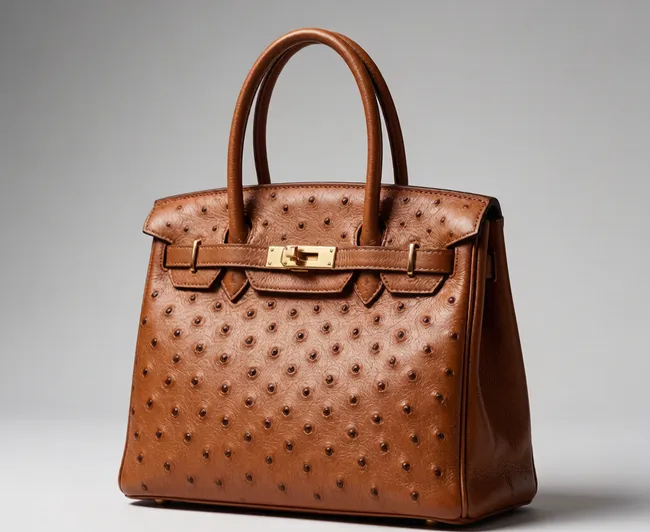
| Advantage | Significance for Bags |
| Iconic “Quill Bump” Texture | The raised quill bumps on the surface are naturally formed and impossible to replicate artificially. This gives each bag a one-of-a-kind appearance, making it more recognizable and luxurious than ordinary leather. |
| Exceptional Durability | Ostrich leather is highly resistant to tearing and abrasion. This means your bag can withstand years of daily use without showing significant edge wear or structural damage — ideal for long-term handbag investment. |
| Lightweight & Soft | Ostrich leather is over 30% lighter than crocodile leather, and it feels soft to the touch. As a bag, this translates to less self-weight, greater comfort during use, and a natural drape that conforms to the body without stiffness. |
| Flexible & Crack-Resistant | Ostrich leather contains natural glycerin, which prevents it from hardening or cracking even in dry or cold environments. For bags, this means flaps, folds, and handles — areas subject to repeated bending — remain intact over time. |
| Excellent Color Absorption | Ostrich leather absorbs dyes evenly and richly, producing vivid, long-lasting colors. This gives brands a wide design palette — from classic black and brown to bright reds, pinks, and blues — all rendered with exceptional depth. |
| Consideration | Explanation |
| Softness Requires Care | Although tough, ostrich leather has a relatively soft surface and is not as scratch-resistant as crocodile or hard-grain cowhide. However, minor scratches tend to fade over time as they blend with the leather’s natural oils. |
| Grade Determines Quality | For bag-making, it is essential to select Grade A or B “Full Quill” hides to retain the signature texture. Lower grades have more visible defects that may compromise the appearance. |
| Very High Cost | Premium ostrich leather costs approximately CNY 1,400–2,200 per square meter, and luxury brand finished bags can range from CNY 68,000 to over CNY 350,000. This positions ostrich leather bags firmly in the ultra-luxury segment. |
| Brand | Product Line | Usage Area | Material Grade | Market Positioning |
| Hermès | Birkin 25cm, Kelly 28cm | Full-body Quill + Palladium hardware | Grade 1 “Full Quill” | Premium exceeds 50% on the secondhand market; auction prices often exceed ~$48,300 USD |
| Prada | Galleria, Double Baguette | Diamond-shaped Quill area primarily | Grade 1 to Grade 2 | Priced at ~$9,400 – $20,700 USD; well-maintained pieces retain high resale value |
| Bottega Veneta | The Pouch, Cassette | Partial Quill splicing | Grade 2 | Emphasizes “understated luxury”; the texture is subtly integrated into the design |
| Saint Laurent | Loulou, Sac de Jour | Full-grain embossed Quill | Grade 1 | Combines modern tailoring with classic texture; a top choice for younger high-end clientele |
| Bag Type | Why Ostrich Works | Best For |
| Totes | Lightweight yet resilient; open design shows off quill texture | Shopping, work, weekend |
| Shoulder bags | Flexible structure drapes comfortably; durable straps | Daily commuting, travel |
| Handbags | Soft structure maintains form; heirloom durability | Professional, luxury collectors |
| Clutches | Exquisite texture elevates evening wear | Formal events, galas |
| Wallets | Compact but extremely durable; retains value | Everyday carry, gifting |
| Property | Ostrich | Cowhide | Lambskin | Alligator |
| Softness | ★★★★★ | ★★★ | ★★★★★ | ★★ |
| Durability | ★★★★★ | ★★★★ | ★★ | ★★★★★ |
| Weight | ★★★★★ (lightest) | ★★★ | ★★★★ | ★★ (heaviest) |
| Scratch Resistance | ★★★★★ | ★★★ | ★ | ★★★★ |
| Water Resistance | ★★ | ★★★ | ★★ | ★★★★ |
| Cost (per sq ft / raw hide) | $$$$$ (highest) | $$ (lowest) | $$$ | $$$$$ (highest) |
| Type | Description | Best For |
| Full Quill | Dense, uniform raised bumps from the crown (back). Most prized and expensive. | Luxury handbags, statement pieces |
| Partial Quill | Fewer, less prominent quills. More subtle texture. | Refined, understated designs |
| Smooth Ostrich | No quill marks. Soft with fine grain. | Wallets, belts, minimalist styles |
| Ostrich Leg | Reptilian scale pattern. Very durable. | Accents, trim, watch straps |
Professional tip: For bag-making, always select Grade A or B “Full Quill” hides to retain the signature texture — lower grades carry visible defects. If budget is a constraint, Partial Quill or Smooth ostrich deliver the material’s durability at a lower cost.
Five factors combine: rarity (only ~600,000 skins worldwide, nearly half from South Africa), small usable area (12–15 sq ft per skin), the crown area being only 1/3 of the skin, a complex 36-step tanning process, and the brand premium from houses like Hermès, LV, Gucci and Prada.
Look for the tiny pore at the top of each quill bump — the opening through which the feather stem emerged. Genuine follicles are random, vary in size, and never repeat; embossed imitations lack the pore entirely.
Highly water-resistant but not fully waterproof. Its natural oils protect against everyday spills and stains, and light rain or damp environments cause no damage — especially with a protective coating. Prolonged exposure to water vapor should be avoided.
It is a trade-off, not a winner. Ostrich is 30%+ lighter, softer, more flexible and crack-resistant; crocodile is heavier, stiffer and more scratch-resistant. Ostrich suits large, comfortable, everyday-luxury pieces; crocodile suits formal, structured designs.
With proper care, 20–30 years of daily use. It softens with use instead of hardening, forms a rich patina, and its overall durability is roughly 3–4 times that of cowhide.
Hermès (Birkin 25cm, Kelly 28cm), Prada (Galleria, Double Baguette), Bottega Veneta (The Pouch, Cassette) and Saint Laurent (Loulou, Sac de Jour) all use it for their flagship bags.
Ostrich leather is a rare type of leather made from the skin of African ostriches (Struthio camelus). It is renowned worldwide for its distinctive quill bump texture.
It is one of the top natural leathers used in making bags, widely applied in high-end handbags, wallets, shoes, belts, watch straps, and other luxury items. Especially in handbag production, it combines durability, softness, and unique texture, which can reflect the sophistication and individuality of the product.
If you are creating your own high-end bag brand and want to customize a bulk of luxury bags made of ostrich leather, please feel free to contact us.


Mobile Website

Inquires Whatsapp