- +86 13922774531
- info@gionar.com

English


English
May 7 , 2026
Crocodile leather is the top material among luxury leathers, and is hailed as “the platinum of leather”. It is noting that crocodile embossed leather is not the genuine crocodile leather; instead, it is a synthetic leather material that is pressed with a mold under high heat and pressure onto the surface of base materials such as cowhide, sheepskin, or PU leather to create an artificial pattern resembling the scales of a crocodile.
Crocodile leather is the top choice for bag materials. The materials commonly used for high-end luxury bags are alligator skin, porosus skin.
Many luxury brands often use crocodile leather to manufacture their bags, such as Hermès’ iconic Birkin and Kelly bags, which are made of crocodile leather and possess extremely strong investment and collection value.
This post will explore the characteristics of genuine crocodile leather and its suitability for making bags.
Crocodile leather is one of the rarest and most expensive leathers in the world. It is made from processed crocodile skins and is characterized by its unique natural texture, extremely high durability, and unparalleled luxuriousness, serving as a symbol of top-quality handbags and accessories. It is often used to make high-end luxury items such as handbags, shoes, belts, and watch straps.
Crocodile leather is not a single product but rather a complete value system composed of different types of crocodile skins from various species, parts, and origins.
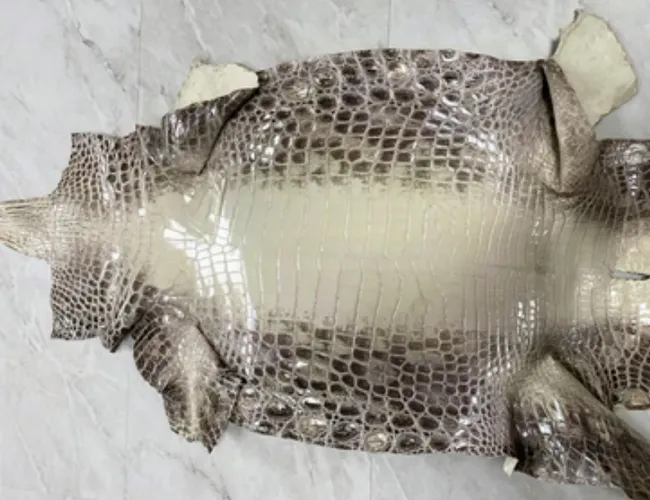
The genuine crocodile leather is almost entirely sourced from regulated farms, which not only guarantees the quality but is also a necessary condition for complying with the Convention on International Trade in Endangered Species of Wild Fauna and Flora (CITES).
| Type | Nickname | Scale Pattern | Feel & Processing | Grade & Status |
| Saltwater Crocodile | Porosus | Fine, even scales with distinct pores (hair follicles) in the center of each scale. | Best hand feel; taken from the belly of young crocodiles; extremely soft and luxurious. | Top grade – rarest and most expensive; the first choice for Hermès Birkin and other ultimate handbags. |
| Nile Crocodile | Niloticus | Rectangular scale pattern covering a wide area; also has pores in the center. | Larger size, soft, easy to dye; suitable for large bags. | High-end – second only to Porosus; widely used by leading luxury brands. |
| Alligator | Alligator | No pores (the most obvious difference from true crocodiles); fine, irregular grain. | Very soft, excellent touch; limited in size, often used for medium/small bags and accessories. | High-end – another classic choice for top brands. |
| Caiman | Caiman | Heavy calcification of scales; rough surface; relatively small hide. | Hard, lacks suppleness; difficult to process; often used for belts or boots; very rare in top-tier handbags. | Low-grade – cheap; not ideal for high-end bags. |
| Grade | Species | Characteristics |
| Top Tier | Porosus (Saltwater/Bay Crocodile) | The most expensive and rarest. Known for having the most uniform, rectangular scales and visible small pores (air holes) in the scales. It has the softest texture. |
| Second Tier | Crocodile (Nile Crocodile) | Highly prized, especially by brands like Hermès. The belly scales are square and dense with visible pores, transitioning to round scales on the sides. It is slightly less uniform than Porosus. |
| Third Tier | Alligator (Mississippi Alligator) | Famous for its “hornback” texture. The key difference is that Alligator skin does not have visible pores. The scales are often more raised and rugged, giving it a bold, masculine look. |
| Entry Tier | Caiman | Often considered lower quality. The skin contains bony deposits (osteoderms) that make it stiff and prone to cracking. It is much cheaper and lacks the softness of the others. |
Even within the same species, the value of the leather can vary depending on the source location:
When purchasing or identifying, the following terms determine quality and price:
| Comparison | Crocodile Embossed Leather | Genuine Crocodile Leather |
| Source | Cowhide, PU, etc. – artificially embossed | Real crocodile hide from farmed crocodiles |
| Texture | Repetitive, regular, mechanical | Natural, irregular, each hide is unique |
| Pores | No natural pores (some fakes may dot them artificially) | Saltwater and Nile crocodiles have distinct pores (hair follicles) at the centre of each scale |
| Feel | Flat, lacks the three-dimensionality and softness of real crocodile | Scales are naturally raised; tactile, soft and elastic |
| Durability | Depends on base material; cowhide embossed is fairly durable; PU embossed ages quickly | Extremely high; can last decades with proper care |
| Cost | Low to medium (cowhide embossed: tens to hundreds of yuan per square foot; PU even cheaper) | Extremely high (thousands to tens of thousands of yuan per square foot) |
| Ethics & Legal | No animal welfare concerns; no CITES certificate required | Regulated by CITES; requires proof of legal origin |
| Best for | Mid-to-low priced bags, footwear, belts, accessories | Top-tier luxury, limited editions, investment-grade handbags |
It is a commonly used material by high-end brands such as Hermès, Louis Vuitton and Gucci, and is used for making:
| Brand | Iconic Crocodile Pieces |
| Hermès | Birkin, Kelly in Porosus and Niloticus; $50,000–$300,000+ |
| Louis Vuitton | Capucines, exotic limited editions |
| Prada | Galleria, top-handle bags |
| Bottega Veneta | Knot clutch, Cabat |
| Item | Price Range |
| Caiman belt | $200–$500 |
| Alligator wallet | $500–$2,000 |
| Nile crocodile handbag | $5,000–$30,000 |
| Porosus Birkin 30 | $50,000–$300,000+ (depending on color/hardware) |
The production of crocodile leather is a strict and multi-stage process, starting from the raw skin obtained from crocodiles raised on farms, to the final processing into the smooth and shiny leather used on top-quality luggage, including standardized tanning, trimming, and treatment steps. Only crocodile skins that have been raised and certified by the Convention on International Trade in Endangered Species of Wild Fauna and Flora can be used in commercial products.
The production of crocodile leather is a meticulous transformation process from a farm to an art piece. This usually requires an expert to spend about a week and go through dozens of procedures.
After leaving the livestock farm, raw leather needs to undergo salting to dehydrate and preserve it. In the tannery, “soaking” is the first step. Craftsmen will immerse the salted crocodile skin in a drum filled with water, salt, and special chemicals for several hours to wash away excess salt, dirt, and impurities, making the stiff raw skin become moist and soft again, preparing it for the subsequent processing.
This is the crucial preparation stage that determines the texture and cleanliness of the leather. It involves multiple meticulous mechanical and chemical processes:
This stage of chemical treatment endows the leather with core physical properties such as durability and softness.
This is the final stage that determines the ultimate visual appeal and protective properties of crocodile leather:
Whether crocodile leather is “ethical” is one of the most contentious issues in the fashion industry. There is no simple answer to this question, as it is intertwined with deep concerns about animal welfare, complex impacts on ecological balance, and the widespread moral dilemmas in modern animal husbandry.
Regarding the ethical issue of crocodile leather, it entirely depends on which set of value systems you stand on: whether you support “sustainable utilization” of resource conservationism, or insist on “animals should not die for luxury goods” of animal rightsism.
| Arguments Against (Animal Welfare & Ethics) | Arguments For (Conservation & Sustainable Use) |
| Captive conditions can be extremely cruel, severely violating natural behaviors. | Legally traded crocodile leather is strictly regulated under CITES, ensuring traceability. |
| Slaughter methods can be brutal, causing immense suffering. | Effectively combats illegal poaching and protects wild populations. |
| Farming may cause environmental pollution and disease risks. | Creates economic value for communities that depend on wildlife resources, indirectly promoting species protection. |
| Many high-performance, animal-friendly alternatives exist today. | Crocodile leather is exceptionally durable, and a well-made bag’s lifetime footprint may be lower than repeatedly buying cheap synthetics. |
The controversy over the ethics of crocodile leather mainly focuses on the following three aspects:
Modern crocodile farms often keep crocodiles in captivity for life in small and filthy spaces. Reports describe that their living environment is “dirty cement ponds and narrow wire cages”. Here, they cannot exhibit their complex behaviors in the wild, such as enjoying the company of family members, communicating and playing. What is even more heartbreaking is that their lifespan is shortened from up to 70 years in the wild to only about 3 years due to this cruel treatment.
To maintain the integrity and beauty of a single skin, some farms use slaughtering methods that can be described as torture. Video surveys show that workers brutally chop at the crocodiles’ backs and then forcefully insert metal rods into their spines to paralyze them. Animal protection organizations like PETA claim that there is evidence suggesting that these operations are carried out when the crocodiles are still conscious. Even a few farms use methods like electric shocks, but their humane nature is highly controversial.
The large-scale crocodile farming industry also brings undeniable environmental and health risks:
The core logic of the crocodile leather trade is to incentivize the protection of their habitats and populations by giving crocodiles economic value.
Opposing animal cruelty and environmental damage is a simple morality, but we cannot ignore the environmental issues of crocodile leather substitutes themselves. Most synthetic leathers (often promoted as “vegan leather”) are made from non-biodegradable plastics such as PVC, and their production process causes pollution.
Supporters argue that regulated crocodile farming is an important means of protecting the species and has a positive impact on the species as a whole.
This industry also provides significant economic benefits to developing countries, as crocodiles are native species in these countries.
This is the biggest pain point. Crocodiles are territorial animals with a long lifespan (up to 70 years).
Crocodile leather is legally permitted, but its trade is strictly regulated by extremely rigorous and complex international and national legal systems, and it is not a commodity that can be bought and sold at will. To trade in crocodile leather, one must ensure that it complies with specific laws aimed at protecting endangered species.
The reason for such strict regulations is that all crocodiles are listed in the Appendices of the Convention on International Trade in Endangered Species of Wild Fauna and Flora (CITES). This means that their international trade is closely monitored to prevent illegal hunting that threatens the survival of the species.
It must be clear that even if the CITES regulations are followed, the domestic laws of various countries may impose stricter restrictions or even prohibit the trade of certain species.
Legal basis: Enforce the Endangered Species Act (ESA) and CITES.
Key regulations:
Importing crocodile leather from sustainable sources as per CITES regulations is legal.
Import requires a license from the U.S. Fish and Wildlife Service (USFWS).
Specific species bans: For instance, trade in freshwater Siamese crocodiles from Thailand, Vietnam, or Cambodia is prohibited, even with a CITES certificate.
Special note: Some states (such as California) attempted to introduce stricter bans, but ultimately the courts ruled that such state laws must be subordinate to the federal Endangered Species Act.
| State | Regulation Status | Key Details |
| California | Strictly Banned | California has some of the toughest laws. The sale and import of crocodile products are generally prohibited, regardless of federal permits. |
| New York | Restricted | New York City banned the sale of crocodile skins in 2022. While you might be able to own one, selling them within the city is illegal. |
| Hawaii | Banned | Strict laws prohibit the import and sale of these products to protect local ecosystems. |
| Other States | Generally Legal | In states like Texas or Florida, trade is legal provided you have the correct CITES documentation. |
Legal basis: Follows CITES regulations.
Special provisions:
Tourists can carry up to 1-2 pieces of crocodile leather products for personal use without obtaining a CITES certificate.
Important prohibition: As mentioned above, the trade of freshwater Siamese crocodiles is prohibited.
Legal basis: Complies with CITES regulations and has domestic laws.
Law enforcement cases: There have been multiple cases where passengers were detained by customs for carrying crocodile leather products (such as belts) without declaration, which violated both CITES regulations and domestic customs laws.
✅ Yes: The product’s source is legal and the trade process is sustainable, so it can be trusted.
❌ No: There are significant legal risks, and it is not recommended to purchase.
✅ No: Trade is permitted, but a CITES certificate is required.
❌ Yes (such as the freshwater Siamese crocodile): Trade is prohibited regardless of whether a certificate is available or not.
✅ Yes: Some countries or regions allow duty-free carrying, but it is necessary to verify the customs regulations in advance.
❌ No: It is necessary to follow the standard import and export procedures and obtain a CITES certificate.
| Scenario | Status | Consequence |
| Farmed crocodile with full CITES permitsand traceability | ✅ Legal | The standard for luxury brands (Hermès, LV, etc.). |
| Wild-caught crocodile (poached) | ❌ Illegal | Violates CITES; severe penalties. |
| No CITES documentation (even if farmed) | ❌ Illegal | Goods will be seized at customs; risk of criminal charges. |
Crocodile leather is an excellent material for making top-quality, durable and highly symbolic bags. However, it is not suitable for all types of bags. Both its advantages and disadvantages are equally significant, and the choice depends entirely on the brand positioning and the purpose of the product.
| Dimension | Performance | Explanation |
| Durability | Extremely high | High tear strength; with proper care, can last for decades and may even appreciate in value over time |
| Aesthetic value | Unique | Distinctive scale pattern + natural luster; each hide has its own texture, offering high recognisability |
| Scarcity | Very high | Strictly regulated by CITES at the source, limited supply, high production cost |
| Processing difficulty | Very high | Cutting, stitching, and edge finishing require specialised artisans; small factories cannot handle it |
| Maintenance requirements | High | Sensitive to water, oil, and direct sunlight; daily use requires extra care |
| Cost & price | Extremely expensive | Raw materials + processing + brand markup; a single bag often costs tens of thousands to hundreds of thousands of US dollars |
| Ethical controversy | Present | Animal welfare, farming conditions, slaughter methods – a source of consumer and brand boycotts |
| Legal compliance | Strict | Cross-border trade requires a CITES certificate; otherwise, the item may be seized by customs |
| Type | Characteristics | Best For |
| Porosus (Saltwater) | The most expensive. Features small, uniform scales with visibe pores (dots) in the center. Softest texture. | The most exclusive, high-end handbags. |
| Nile Crocodile | Very popular. Features rectangular scales with visible pores. Slightly more “rugged” look than Porosus. | Luxury handbags and accessories. |
| Alligator (American) | No visible pores (solid scales). The texture is often more raied and “bumpy.” | Structured bags, briefcases, and men’s accessories. |
| Material | Durability | Cost | Weight | Best For |
| Crocodile (belly) | Excellent | Very high | Light-medium | Investment bags, evening bags |
| Alligator | Excellent | Very high | Medium | US luxury market, softer hand |
| Calfskin (box) | Very good | High | Light | Everyday structured bags |
| Lambskin | Moderate | High | Very light | Soft, draped designs |
| Python | Moderate | High | Light | Fashion-forward, textured looks |
| Cactus/Apple leather | Moderate | Moderate | Light | Sustainable fashion, short-lifecycle bags |
Not as soft and elastic as calfskin; not suitable for making soft, loose casual bag styles.
If not cared for properly, it is prone to drying out, cracking or fading. Regular maintenance is necessary to avoid direct sunlight, heavy rain and strong chemicals.
Animal protection organizations (such as PETA) have long targeted crocodile leather as a key object of boycott. Brands that use crocodile leather may face public opinion turmoil.
| Concern | Impact on Bag Making |
| Extreme cost | A single medium handbag requires 2–4 belly skins; raw material alone can cost $5,000–$15,000 before labor |
| Limited yield | Only the belly and partial tail are usable for premium bags; significant wastage |
| Weight | Hornback (back cut) and larger scales can make bags noticeably heavier than calf leather |
| Care requirements | Cannot use standard leather conditioners; requires professional exotic leather spa services |
| Ethical/legal complexity | CITES documentation required for every skin; sourcing transparency is essential |
| Stiffness in some cuts | Tail and back cuts are less supple; limited to specific design applications |
| Bag Style | Suitability | Reasoning |
| Structured top-handle bags | Excellent | Rigidity supports shape; belly cut is smooth and symmetrical |
| Clutches & evening bags | Excellent | Small scale allows flawless panels; maximum visual impact |
| Briefcases & document holders | Very good | Durability meets professional luxury positioning |
| Crossbody bags | Good | Moderate size works well; hardware integration is stable |
| Tote bags | Moderate | Requires multiple skins (cost prohibitive); weight can become an issue |
| Soft hobo/slouch bags | Poor | Natural rigidity fights the relaxed silhouette; wasteful use of expensive material |
Crocodile leather is a material designed for top luxury products, embodying rarity, craftsmanship and status symbols. Choosing it means accepting its high cost and delicate nature, while ensuring the legal origin. For brands and consumers who pursue “timeless masterpieces”, it remains the ultimate choice that cannot be replaced.
Crocodile leather is suitable for making ultra-luxurious clutch bags, iconic handbags, limited editions and small accessories. It is not suitable for daily commuting bags or those requiring durability and water resistance for sports use.
If you want to establish a luxury bag brand and are looking for a high-end bag manufacturer, please feel free to contact us.


Mobile Website

Inquires Whatsapp