- +86 13922774531
- info@gionar.com

English


English
September 2 , 2026
Record length, width, height and shoulder-strap drop — with the empty bag in its natural shape on a flat surface.
The key to measuring a handbag is to record its length, width, height, and shoulder strap drop, with the empty bag in its natural shape on a flat surface.
The handbag size is the core standardized parameter in the design, production and consumption of handbags. The industry commonly adopts the three-dimensional system of “length/width × height × depth”. The mainstream categories are small (18–25cm), medium (25–32cm), and large (over 33cm). The medium size is the ideal size for daily commutes.
Small bags can hold wallets and mobile phones; medium-sized bags are suitable for daily commutes; large bags are suitable for office work, shopping or traveling. Accurate size affects the fit (body proportions), comfort (length of shoulder straps), convenience of daily use (whether it can accommodate laptops, water bottles, etc.), and compliance with airline luggage regulations — incorrect sizes can cause customer disappointment.
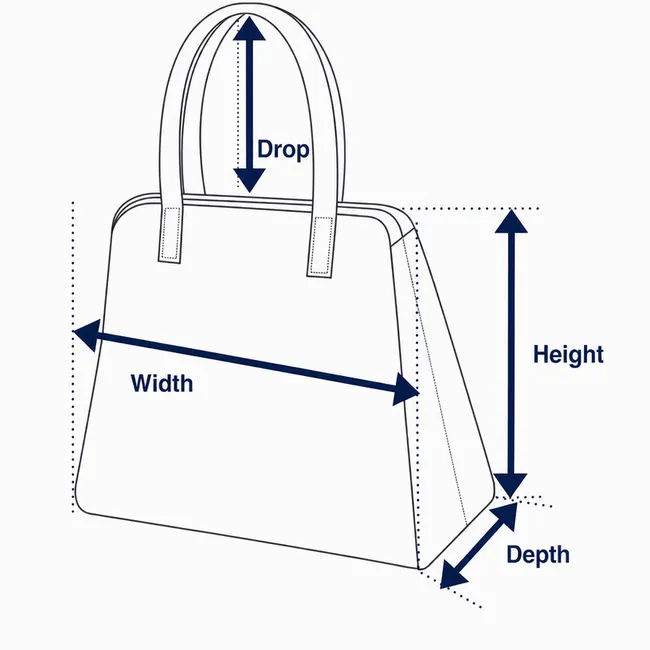
The size of a handbag is usually the standard measurement that describes the physical size of the bag. It typically includes three main parameters: length (width), height, and depth (or side). These dimensions determine the capacity of the bag, its wearing effect, and the applicable scenarios. The size is usually listed in inches or centimeters, and is crucial for understanding the capacity, fit, and whether it is suitable for carrying laptops, tablets, or items that meet airline baggage requirements. Whether you are purchasing, designing, or manufacturing bags, understanding the handbag size is of utmost importance.
| Measurement | Description | What It Affects |
|---|---|---|
| Length (L) / Width | The horizontal measurement across the widest part of the bag from left to right. | Determines how wide the bag is — affects whether it fits under an airplane seat or into a locker. |
| Height (H) | The vertical measurement from the bottom of the bag to the top (excluding the handle or strap). | Defines how tall the bag is — affects whether it can hold taller items like water bottles or folders. |
| Depth (D) / Gusset | The measurement from the front to the back of the bag at its thickest point. | Indicates how much the bag expands — directly affects capacity. A deeper bag holds more but may feel bulky. |
| Size Category | Typical Height | Typical Width | Typical Depth | Best For |
|---|---|---|---|---|
| Mini / Nano | 4–7 in (10–18 cm) | 5–8 in (13–20 cm) | 2–3 in (5–8 cm) | Phone + cards only; evening/party |
| Small | 7–9 in (18–23 cm) | 8–11 in (20–28 cm) | 3–4 in (8–10 cm) | Daily essentials; crossbody/clutch |
| Medium | 9–11 in (23–28 cm) | 11–13 in (28–33 cm) | 4–5 in (10–13 cm) | Most versatile; work + casual |
| Large | 11–14 in (28–36 cm) | 13–16 in (33–41 cm) | 5–7 in (13–18 cm) | Tote; laptop; travel |
| Extra Large / Oversized | 14+ in (36+ cm) | 16+ in (41+ cm) | 7+ in (18+ cm) | Weekender; diaper bag; carry-on |
| Bag Type | Typical Length | Typical Height | Typical Depth | Typical Capacity (L) |
|---|---|---|---|---|
| Clutch / Wristlet | 20 – 30 cm | 12 – 18 cm | 4 – 6 cm | 1 – 3 L |
| Crossbody / Shoulder Bag | 22 – 30 cm | 15 – 22 cm | 6 – 10 cm | 4 – 10 L |
| Tote Bag | 30 – 45 cm | 25 – 40 cm | 10 – 20 cm | 15 – 35 L |
| Backpack (Daily) | 25 – 35 cm | 40 – 50 cm | 15 – 25 cm | 20 – 30 L |
| Weekender / Duffel | 45 – 60 cm | 30 – 40 cm | 25 – 35 cm | 35 – 70 L |
Note: These are general estimates. The actual size may vary depending on the brand, design and material.
| Brand | Collection | Size Code | Width × Height × Depth (cm) | Suitable Scenario | Recommended Height |
|---|---|---|---|---|---|
| Hermès | Birkin | 25 | 25 × 20 × 13 | Evening events, refined outings | 150–165 cm |
| Hermès | Birkin | 30 | 30 × 22 × 16 | All-purpose commute | 160–170 cm |
| Hermès | Birkin | 35 | 35 × 25 × 18 | Business travel | 165 cm+ |
| Hermès | Birkin | 40 | 40 × 28 × 20 | Long-haul travel | 175 cm+ |
| Chanel | 2.55 Reissue | 225 | 24 × 16 × 8 | Daily commute, parties | 160–170 cm |
| Chanel | 2.55 Reissue | 226 | 28 × 20 × 9 | High-capacity commute | 165 cm+ |
| Chanel | 2.55 Reissue | 227 | 31.5 × 23 × 10 | Statement oversized bag | 170 cm+ |
| Prada | Galleria | Medium | 33 × 24 × 14 | Office commute | 162–170 cm |
| Prada | Galleria | Large | 39 × 42 × 18 | Business travel / tall frames | 168 cm+ |
| Louis Vuitton | Neverfull | MM | 47 × 28 × 14 | Everyday all-purpose | 155–175 cm |
| Louis Vuitton | Neverfull | GM | 55 × 32 × 19 | Travel / mommy bag | 165 cm+ |
| Gucci | Dionysus | Super Mini | 16.5 × 10 × 4 | Accessory / evening | 155–170 cm |
| Gucci | Dionysus | Small | 24 × 16 × 10 | Crossbody daily | 160–175 cm |
There is no single “standard” size for handbags, as there are various styles of handbags that are suitable for different purposes. However, the most common handbag sizes generally fall within a range that balances daily use, comfort, and capacity. For most brands, the medium-sized handbag (approximately 25–35 centimeters wide, 15–25 centimeters high, and 8–15 centimeters deep) is regarded as the “daily standard”.
| Bag Type | Width × Height × Depth (inches) | Width × Height × Depth (cm) | Typical Capacity |
|---|---|---|---|
| Clutch | 8 × 5 × 2 | 20 × 13 × 5 | Phone, cards, lipstick |
| Wristlet | 7 × 4 × 1 | 18 × 10 × 2.5 | Phone, cards, keys |
| Small Crossbody | 8 × 6 × 3 | 20 × 15 × 7.6 | Phone, wallet, small items |
| Medium Crossbody | 10 × 8 × 4 | 25 × 20 × 10 | Daily essentials + small tablet |
| Shoulder Bag | 12 × 10 × 5 | 30 × 25 × 13 | Wallet, phone, cosmetics, small book |
| Satchel | 14 × 11 × 6 | 36 × 28 × 15 | Laptop, documents, daily items |
| Small Tote | 14 × 12 × 6 | 36 × 30 × 15 | Groceries, gym gear, daily items |
| Large Tote | 18 × 14 × 7 | 46 × 36 × 18 | Laptop, folders, multiple items |
| Hobo Bag | 14 × 13 × 5 | 36 × 33 × 13 | Everyday essentials, relaxed style |
| Bag Type | Typical Width (cm) | Typical Height (cm) | Typical Depth (cm) | Best For |
|---|---|---|---|---|
| Small Crossbody | 18–22 | 13–18 | 4–8 | Minimalist daily, evenings |
| Medium Crossbody / Shoulder | 22–28 | 15–22 | 6–10 | Everyday essentials |
| Standard Tote | 30–40 | 25–35 | 10–15 | Work, shopping, travel |
| Medium Satchel / Top-Handle | 25–33 | 18–25 | 10–14 | Office, daily carry |
| Large Tote / Weekender | 40–55 | 30–45 | 15–25 | Travel, heavy loads |
Most common everyday handbag size: 30–35 cm (L) × 20–25 cm (H) × 10–15 cm (D) — this fits a small laptop or tablet, wallet, phone, makeup pouch, and water bottle.
| Brand & Model | Size Code | Dimensions (L×H×D cm) | Category |
|---|---|---|---|
| LV Neverfull | MM | 47 × 28 × 14 | Large Tote |
| Prada Galleria | Medium | 33 × 24 × 14 | Medium Satchel |
| Chanel 2.55 | 226 | 28 × 20 × 9 | Medium Flap |
| Hermès Birkin | 30 | 30 × 22 × 16 | Medium Tote |
| Gucci Dionysus | Small | 24 × 16 × 10 | Small Crossbody |
| Factor | Why It Matters |
|---|---|
| Daily essentials | Must fit a phone, wallet, keys, makeup, and small water bottle at minimum. |
| Electronics | Increasingly, standard bags include a padded sleeve for a 13-inch laptop or tablet. This often requires a minimum width of 28–30 cm. |
| Carry-on compliance | Many airlines allow bags up to 55×40×20 cm as carry-on, but this is for luggage, not handbags. For personal items under the seat, the limit is closer to 40×30×15 cm. |
| Body frame | A bag that looks “standard” on a 170 cm person may look oversized on a 155 cm person — and vice versa. |
| Regional preference | Asian markets tend to prefer smaller, compact bags (22–28 cm width), while Western markets favor larger totes (35–45 cm width) for multipurpose daily use. |
Most handbag size labels indicate: Length (Width) × Height × Depth (centimeters). For example: 30 × 22 × 15 centimeters. This means the dimensions of this bag are:
Quick checklist:
Accurate measurement of handbags requires tools with multiple functions, which can both accommodate rigid structural components and deal with soft and easily deformed leather bodies, thereby providing consistent and repeatable results for product development, quality control, and e-commerce specifications.
| Tool | Primary Use | Why It’s Essential |
|---|---|---|
| Flexible Fiberglass Tape Measure (150 cm) | Measuring curved surfaces, handle drops, strap lengths, and bag girth (circumference). | Unlike cloth tapes, fiberglass tapes do not stretch over time, ensuring consistent readings across samples and batches. |
| Hard-Edge Metal Ruler (30 cm & 60 cm) | Measuring straight edges, flat base panels, and high-accuracy flat surfaces. | Provides a stiff, straight reference line that won’t bend, especially useful for structured bags like satchels and briefcases. |
| Digital Caliper (0–150 mm, 0.01 mm precision) | Measuring material thickness (leather, lining, foam), zipper width, seam allowance, and hardware diameter. | Essential for verifying material specs and ensuring that hardware matches technical drawings. |
| Clear Plastic Grid Ruler | Measuring small patterns, zipper teeth spacing, logo dimensions, and stitch density. | Transparent design allows you to see the fabric underneath — ideal for pattern verification and sample review. |
| L-Shaped Right-Angle Ruler / T-Square | Verifying squareness of bag bases, side panels, and top edges. | Ensures that structured bags meet the required geometry — especially important for satchels, briefcases, and boxy designs. |
| Digital Scale (≤ 5 kg capacity, ±1 g precision) | Measuring empty bag weight — a key spec for shipping cost, comfort, and duty classification. | A lightweight crossbody may weigh 300–500 g, while a large tote can exceed 1.5 kg. Consistent weight is a quality indicator. |
| Seam Gauge / Stitch Counter | Measuring seam allowances and counting stitches per inch (SPI). | Essential for quality control: a consistent SPI (e.g., 8–10 stitches per inch) is a hallmark of good craftsmanship. |
| Tool | Use Case |
|---|---|
| Flexible Curve Ruler | Tracing curved edges (e.g., flap curves, handle arcs, zipper bends) for pattern making and consistency checks. |
| Laser Distance Measurer | Measuring large totes, travel bags, and bulky samples where a tape measure is difficult to handle. |
| Thickness Gauge | Measuring foam density, padding thickness, and laminated material layers. |
| Tape Marker (Chalk / Wax) | Marking measurement points directly on the bag surface for sample review — non-permanent and safe for most materials. |
| Barcode Scanner | Verifying that the production piece matches the spec sheet and batch number — useful in factory QC. |
| Scenario | Recommended Tools | Key Practice |
|---|---|---|
| External Dimensions (L × H × D) | Metal ruler + fiberglass tape | Measure on a flat, hard surface with the bag in its natural state (not stretched or compressed). |
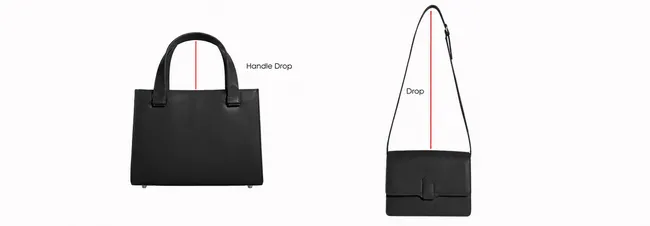
| Handle / Strap Drop | Fiberglass tape measure | Measure from the top of the bag to the highest point of the handle/strap. |
| Internal Volume (Capacity in Liters) | Tape measure + filler (beads/balls) | Fill the bag with small filler material and pour into a box of known volume — the industry standard for capacity verification. |
| Material Thickness | Digital caliper | Measure at 3–5 different points on the sample — average the readings. |
| Stitch Density (SPI) | Stitch counter / seam gauge | Count stitches over 1 inch (2.54 cm) at 3 different seams — consistency is key. |
| Weight | Digital scale | Always weigh the bag empty (without dust bag, box, or tags) with ±1 g accuracy. |
The precise measurement of handbags follows industry standard methods to ensure consistency in production, quality control, and product information. All core dimensions refer to the widest external contour size of the bag when it is naturally filled, and do not include detachable shoulder straps or top handles (unless otherwise specified).
The core of measuring handbag dimensions is to record three main dimensions (length/width/height) + shoulder strap drop, and ensure that the bag is in its natural form and placed on a flat surface. However, the labeling order of “length/width/height” in the industry is not uniform (L/H/W and H/W/D are often mixed), and the external size is not equal to the usable internal space. Therefore, mastering the correct measurement method is more important than just looking at the merchant data.
1. Place the Bag on a Flat Surface
2. Measure Length (Width) — the horizontal size of the bag’s widest point from left to right. Place the bag flat with the front facing up; measure from the left edge to the widest point on the right edge. If the bag structure includes side pockets, liners, or external compartments, include them in the measurement range.
3. Measure Height — the vertical size from the bottom of the bag to the top (excluding handles or shoulder straps). Measure from the bottom seam of the bag to the top edge. Do not include handles, shoulder straps, or detachable accessories.
4. Measure Depth (Side/Thickness) — the measurement from the front to the back of the bag at the thickest point. Place the bag flat (or measure while standing); measure the distance between the front and back panels at the widest or deepest point. For bags with expandable sides, measure both closed and extended states separately and record them.
5. Handle Droop / Shoulder Strap Droop — the distance from the top of the bag to the highest point of the handle or shoulder strap. Place the tape measure on the top edge of the bag (i.e., the handle connection point), then pull it straight up to the top of the handle. For cross-body straps, measure the maximum adjustable length (from one end to the other).
6. Internal Dimensions (Optional but Recommended) — internal length, height, and depth: measure the internal dimensions of the bag (excluding the thickness of the lining). Laptop/tablet compartment: measure the internal width, height, and depth of the bag. Number of compartments: note if there are internal zippers, pockets, or dividers.
Five habits for more accurate data:
| Dimension | Measurement (cm) | Measurement (inches) |
|---|---|---|
| External Length (L) | 30 | 11.8 |
| External Height (H) | 22 | 8.7 |
| External Depth (D) | 14 | 5.5 |
| Handle Drop | 12 | 4.7 |
| Shoulder Strap Drop | 55 | 21.7 |
| Internal Length | 28 | 11.0 |
| Internal Height | 20 | 7.9 |
| Internal Depth | 12 | 4.7 |
| Laptop Compartment | 32 × 24 × 3 | 12.6 × 9.4 × 1.2 |
| Bag Type | Key Measurement Points |
|---|---|
| Flap Bags (e.g., Birkin, Dior Lady) | Measure with the flap closed, and only measure the main body of the bag. The flap height is not included in the overall height, but may be recorded separately as “Flap Height”. |
| Curved Body Bags (e.g., Loewe Puzzle, Gucci Dionysus) | Use the central cross-section of the bag as the reference point, and take the maximum outer contour. Avoid measuring along the curve — use a straight ruler to locate the widest points. |
| Expandable Bags (e.g., Neverfull) | Measure both the unexpanded state and the fully expanded state, and note the difference in the remarks (e.g., “Expandable: +5 cm”). |
| Soft Bags (e.g., Totes, Drawstring bags) | After stuffing, let the bag rest for 5 minutes to allow the material to settle before measuring. This prevents errors caused by elastic rebound. |
| Mistake | Why It’s Wrong | Correct Approach |
|---|---|---|
| Measuring on a soft surface | The bag compresses, giving smaller dimensions. | Always measure on a flat, hard surface. |
| Pulling the tape too tight | Compresses the bag and underestimates size. | Keep the tape snug but not stretched. |
| Including handles in height | Overestimates height — misleading for customers. | Measure bag only, excluding handles. |
| Forgetting to measure depth | Customers need to know how much fits inside. | Always include depth. |
| Not specifying “external” or “internal” | Confuses customers — they may expect larger or smaller. | Label clearly: “External Dimensions” and “Interior Dimensions”. |
| Measuring an empty soft bag | A soft bag expands when filled; dimensions change. | Fill with lightweight filler (e.g., paper) to simulate realistic size. |
| Mistake | Consequence | Correct Practice |
|---|---|---|
| Including the handle in the height measurement | Height is overestimated by 10–20 cm, misleading customers. | Measure the handle separately and list as “Handle Drop: XX cm”. |
| Measuring a soft bag without filling it | Depth is underestimated by 30%+, causing capacity misjudgment. | Always fill the bag to its natural shape before measuring. |
| Placing the bag at an angle | Width and depth readings become distorted. | Use a spirit level or level the bag with blocks. |
| Using a steel ruler on curved surfaces | Dimensions are stretched and deformed. | Use a flexible tape for curves; steel rulers for straight edges only. |
| Taking only one measurement | Error margin of ±5% or more. | Measure at least 3 times, take the average, and record deviation. |
| Not specifying external vs. internal dimensions | Confuses customers about actual capacity. | Clearly label “External” and “Internal” dimensions (L × H × D). |
| Forgetting to measure expandable bags in both states | Misses the bag’s maximum capacity. | Measure both closed and fully expanded; note “Expandable: +X cm”. |
| Measuring on an uneven or soft surface | Readings vary significantly due to bag distortion. | Always measure on a flat, hard surface (e.g., table or floor). |
| Not recording strap length separately | Customers cannot determine if the strap fits their body. | Record “Strap Drop” (top of bag to top of strap) and max total length. |
The size of a handbag may seem like simple numbers, but it plays a crucial role in customer satisfaction, product functionality, and business success.
Medium size (25–32cm) is the golden size for commuting: it can easily accommodate A4 documents, 13-inch laptops, chargers, folding umbrellas, and other daily necessities, accounting for over 60% of market sales, and is the preferred choice for professional women. ✅ A4 compliance: in 2026, public places in first-tier cities in Europe, America, and China (such as museums and concerts) gradually implemented an “A4 bag access system”, and size compliance became a mandatory requirement for commuting.
Small size (18–25cm) is a carrier of a sense of ceremony: it can only hold a phone, lipstick, and keys, suitable for light-load scenarios such as dinner parties and dates. Its “minimalist” form enhances the sense of refinement and fashion symbol — not for practicality, but for expression.
Large size (>33cm) is a mobile storage compartment: it can replace a small suitcase and hold tablets, folders, cosmetic sets, suitable for business trips or tall people, but the weight may exceed the human tolerance threshold.
| Impact | Example |
|---|---|
| Too large | Overwhelms a petite frame; looks bulky and awkward; uncomfortable to carry for long periods. |
| Too small | Appears out of proportion on a taller person; straps may be too short to crossbody comfortably. |
| Strap drop matters | If the handle drop is too short, the bag won’t fit over a winter coat; if too long, it may hit the hip awkwardly. |
Key point: the size of the bag determines whether it fits the wearer’s body shape, not just the clothing it is paired with.
| Scenario | What Happens If Dimensions Are Wrong |
|---|---|
| Too shallow | A 13-inch laptop won’t fit in a compartment listed as “laptop-ready” — returns and negative reviews follow. |
| Too narrow | A water bottle or umbrella won’t fit inside, reducing daily usability. |
| Too deep | The bag becomes heavy and hard to organize; items get lost at the bottom. |
Key point: the internal dimensions must meet the daily needs of the target users; otherwise, the package will fail to fulfill its main function.
| Airline Requirement | Bag Type | Consequences of Oversizing |
|---|---|---|
| Carry-on size: typically ≤ 55 × 40 × 20 cm | Weekenders, duffels, large totes | Bag must be checked at the gate — often with a fee; delays and frustration. |
| Personal item size: typically ≤ 40 × 30 × 15 cm (underseat) | Backpacks, crossbodies, small totes | If too large, it won’t fit under the seat and may be reclassified as carry-on — or rejected. |
Key point: inappropriate dimensions can turn a smooth journey into a stressful airport experience.
| Factor | Impact on Business |
|---|---|
| Unclear dimensions | Customers guess the size — and often guess wrong. |
| No internal dimensions listed | A bag that “looks big” externally may have a tiny interior due to thick padding. |
| No weight listed | Customers expect a lightweight crossbody but receive a heavy bag — leading to disappointment and returns. |
Key takeaway: accurate, transparent dimensions reduce returns, improve trust, and boost repeat purchases.
| Shipping Factor | How Dimensions Matter |
|---|---|
| Carton / Master box size | Oversized bags require larger cartons — increasing dimensional weight and shipping fees. |
| Warehouse storage | Bulky bags take up more shelf space, increasing storage costs per unit. |
| Palletization | Non-uniform dimensions make pallet stacking inefficient, raising transportation costs. |
Key takeaway: accurate dimensions help optimize packaging and reduce supply chain costs.
| Positive Signal | Negative Signal |
|---|---|
| “The bag arrived exactly as described.” | “The bag is much smaller than I expected.” |
| “The measurements on the site were spot on.” | “It looks huge in the photos but is tiny in real life.” |
| Low return rate due to sizing issues | High return rate, negative reviews about size |
Key takeaway: consistent, accurate sizing builds brand trust and reduces the “surprise factor” in unboxing.
| Issue in OEM | Consequence |
|---|---|
| Wrong external dimensions | Bag doesn’t match the sample or tech pack — rejected by QC. |
| Incorrect internal dimensions | Laptop or tablet sleeve doesn’t fit the intended device — product fails target market. |
| Strap length variation | Strap is either too short or too long for the target user. |
Key points: in production, precise dimension design must be adhered to without compromise — it can prevent costly sampling errors and batch failures.
| Occasion | Ideal Size | Why |
|---|---|---|
| Work/Office | Medium–Large (12–15″ wide) | Fits laptop, files, lunch |
| Evening/Dinner | Mini–Small (7–10″ wide) | Just phone, cards, lipstick |
| Weekend errands | Small–Medium (10–12″ wide) | Hands-free crossbody ideal |
| Travel | Large–XL (15–18″ wide) | Carry-on friendly, holds layers |
| Formal event | Clutch (7–10″ wide, slim) | Elegant, minimal profile |
In order to customize the appropriate handbag size for your brand, the factors you need to consider include: the daily needs of the target customers, product functionality, brand positioning, brand visual design style, production feasibility and cost. There is no universal formula, but through a systematic approach, you will find the best size.
First, answer the following questions:
Create a “must-have carry” list for your target group, and then measure the dimensions (length, width, height) of these items to ensure that there is at least 1 to 2 inches of space left in the bag.
| User Profile | Typical Preference | Example Bag Size (L×H×D cm) |
|---|---|---|
| Young / petite women | Compact, lightweight, proportional to smaller frames | 22 × 15 × 8 |
| Working professionals | Medium size, fits laptop/tablet, organized compartments | 30 × 25 × 12 |
| Moms / commuters | Large, roomy, easy to open/close, multiple pockets | 38 × 30 × 15 |
| Fashion-forward / evening | Small, decorative, minimal essentials only | 18 × 12 × 6 |
| Travelers | Large tote or carry-on compliant, spacious interior | 45 × 35 × 20 |
Key question: who is your primary customer, and what do they carry daily?
| Use Case | Typical Items | Minimum Dimensions (L×H×D) |
|---|---|---|
| Everyday crossbody | Phone, cardholder, keys, lipstick, sunglasses | 20 × 14 × 6 cm |
| Work tote | 13–15″ laptop, A4 documents, water bottle, lunch bag | 35 × 28 × 12 cm |
| Weekend bag | Change of clothes, toiletry kit, tablet, small accessories | 40 × 32 × 18 cm |
| Travel duffel | 3–5 days clothing, electronics, shoes, toiletries | 50 × 35 × 25 cm |
Key question: what are the “must-fit” items? Design the bag around them, not the other way around.
The bags must look attractive on the target customers:
At the same time, test the length of the shoulder strap sagging — for example, for a 5 feet 6 inches tall woman, if a cross-body bag lands on the hip, it might be too high or too low for other users. It is recommended to provide adjustable shoulder straps or multiple options for sagging lengths.
| Factor | How It Affects Size Choice |
|---|---|
| Body height | A 28cm-tall tote looks balanced on a 170cm person but may overwhelm a 155cm person. Offer multiple sizes (e.g., Small / Medium / Large). |
| Carry style | Crossbody bags should sit around the hip — adjust strap length based on target height. Handle drop should accommodate average arm thickness and winter coats. |
| Weight expectation | Oversized bags tend to become heavy when filled — consider whether your target user is comfortable carrying that weight. |
Key question: does the bag look and feel proportional to the user’s typical body size?
| Measurement Type | What It Defines | Example |
|---|---|---|
| External L × H × D | Overall physical footprint — affects shipping, packaging, and visual size. | 30 × 22 × 14 cm |
| Internal L × H × D | Actual usable storage space — affected by lining, padding, and compartment walls. | 27 × 19 × 11 cm |
| Handle / Strap Drop | Carry comfort and style. | Handle drop: 12 cm; Strap drop: 55 cm |
Make sure to indicate both the internal and external dimensions — both the customers and the production team need them.
| Category | Brand Example | Size (L×H×D cm) | Why It Works |
|---|---|---|---|
| Medium tote | Neverfull MM | 47 × 28 × 14 | Large enough for daily use, compact enough for most frames. |
| Flap bag | Classic Flap (Medium) | 26 × 16 × 7 | Iconic proportions, fits daily essentials without bulk. |
| Crossbody | Dionysus Small | 24 × 16 × 10 | Compact but functional; sits well on a range of body heights. |
Key question: where does your bag fit among competitors — smaller, larger, or same?
| Segment | Typical Sweet Spot (W × H × D) | Examples |
|---|---|---|
| Affordable contemporary ($100–$300) | 10–12″ × 8–10″ × 4–5″ | Crossbodies, small totes |
| Mid-range contemporary ($300–$800) | 11–14″ × 9–11″ × 4–6″ | Shoulder bags, medium totes |
| Premium/designer ($800+) | 9–12″ × 7–10″ × 3–5″ (smaller, more curated) | Mini bags, structured handbags |
| Constraint | Size Limit | What It Means |
|---|---|---|
| Carry-on | ≤ 55 × 40 × 20 cm | Bags exceeding this may be gate-checked. |
| Personal item (underseat) | ≤ 40 × 30 × 15 cm | If smaller than this, the bag qualifies as a second item on most airlines. |
| Lockers / gym cubbies | Varies (≈ 35 × 40 × 20 common) | Bags that don’t fit may not be practical for commuters. |
Key question: will your customer use this bag for travel or daily commutes? If yes, design with airline and storage limits in mind.
Most brands initially offer 2 to 3 main model sizes:
For each size, the external dimensions (width × height × depth) and internal dimensions (considering lining thickness, pockets and hardware accessories) need to be clearly defined. Please note: external dimensions ≠ actual usable internal space.
| Approach | Pros | Cons |
|---|---|---|
| One size | Simpler production, lower MOQ, easier inventory management. | May not fit all body types; potential returns due to size mismatch. |
| Two sizes (e.g., S / M) | Better fit for more users; reduces size-related returns. | Higher SKU count; higher sampling cost; requires separate production runs. |
| Three sizes (S / M / L) | Full coverage; ideal for brands targeting diverse demographics. | Most complex production; higher inventory risk. |
Recommendation: start with one core size for your first collection, then expand based on feedback.
Before going into production:
| Sampling Stage | What to Check |
|---|---|
| Sample measurement | Confirm external and internal dimensions match your spec sheet. |
| Fit test | Have a model or target user try it — check proportion, strap drop, and carry comfort. |
| Capacity test | Fill the bag with the actual items it’s designed for — does everything fit comfortably? |
| Weight test | Check the empty weight and full weight — is it within acceptable range for the user? |
Never approve bulk production without a dimension-checked sample.
| Spec Item | Example |
|---|---|
| External Length | 30 cm (±0.5 cm tolerance) |
| External Height | 22 cm (excluding handles) |
| External Depth | 14 cm (measured at thickest point) |
| Handle Drop | 12 cm |
| Strap Drop | 55 cm (adjustable) |
| Internal Length | 27 cm |
| Internal Height | 19 cm |
| Internal Depth | 11 cm |
| Laptop Compartment | 32 × 24 × 2 cm (fits 13-inch laptop) |
| Empty Weight | ≤ 600 g |
| Expandable? | No |
| Decision Factor | Question to Ask | Output |
|---|---|---|
| Customer need | What do they carry daily? | Minimum interior dimensions |
| Market gap | What sizes are missing in my price tier? | Competitive advantage |
| Brand DNA | Am I minimalist (smaller) or maximalist (larger)? | Signature proportion |
| Cost target | What retail price am I aiming for? | Maximum material budget |
| Production capability | Can my bag factory handle this size/pattern? | Feasibility check |
To measure a handbag, use a flexible tape measure and follow these steps: Length (Width): measure the widest point from left to right. Height: measure from the bottom to the top opening (excluding handles/straps). Depth: measure the front-to-back thickness at the deepest point. Handle/Strap Drop: measure from the top of the bag to the top of the handle/strap. Internal Dimensions: measure the inside length, height, and depth (optional but recommended).
The size of a handbag typically consists of three main measurements: Length (width) — the maximum horizontal distance from left to right; Height — the vertical distance from the bottom to the top opening, excluding the handle or shoulder strap; Depth (or gusset) — the thickness from front to back at the thickest point. Additionally, handle drop and strap drop are usually noted to describe the way the bag is carried. To ensure accuracy, measurements should be taken on a flat surface and the bag should be filled with an appropriate amount of padding. It is essential to record both the internal and external dimensions and indicate the unit (centimeters/inches).
The standard size of a handbag usually does not include the handle or the shoulder strap. The height is measured from the bottom of the bag to the top opening of the main body. The handle is separately referred to as “handle height” or “shoulder strap droop length”. Some merchants might mistakenly include the handle in the total height, so when purchasing, be sure to check if the description indicates “external dimensions (only the bag body)” and list the handle height separately.
L (Length) refers to the width of the bag at its widest point from left to right. H (Height) is the vertical distance from the bottom to the top opening (excluding the handle). D (Depth) is the depth of the thickest part from front to back. These three factors determine the external volume and capacity of the bag. When measuring, it should be placed on a flat and hard surface. For soft bags, they can be lightly filled before measurement. Pay attention to distinguish between the external dimensions and the internal dimensions. Generally, the height does not include the handle to avoid misunderstanding the actual size.
When measuring handbags for online listings, they should be placed on a flat and hard surface. Use a soft measuring tape to measure the external length (the widest part), height (from the bottom to the top opening, excluding the handle), and depth (the thickest part at the front and back), and record the length of the handle/shoulder strap sagging separately. The internal dimensions should also be noted. Soft bags can be lightly filled before measurement. At the same time, both centimeters and inches should be indicated. Accurate data can enhance customer trust and reduce returns due to size mismatch.
The size of a handbag refers to its external physical three-dimensional data (length, height, depth), which tells you how big the bag is; while the capacity refers to the volume of the space it can hold internally (usually measured in liters), which tells you how much stuff the bag can hold. In simple terms, size determines the appearance size, and capacity determines the actual carrying capacity. The two are related but not equivalent, because the shape, compartments, and thickness of the material of the bag can affect the utilization of space. For example, a square and stiff bag may have a smaller capacity than a soft bag of the same size because it lacks elasticity and flexibility. Therefore, when making a purchase, one must pay attention to both aspects to balance appearance and practicality.
The size of a handbag consists of a set of system data including the overall length and height, the internal space, and the height of the handle. Accurate measurement requires the use of correct tools, standard methods, complete information, and clear distinction of each data item. Precise handbag sizes can directly match ergonomic principles and scene requirements, and are an important foundation for designing and manufacturing bags.
When measuring the size of a handbag, first empty the handbag and place it on a flat and stable surface to allow the soft bag to naturally return to its original shape. Use a soft tape measure to measure the width at the widest point, the height from the bottom to the top, and the depth between the front and back. Usually, the handle and shoulder strap are not included.
If you are looking for a reliable bag manufacturer to design your bag, please contact us. We provide one-stop bag OEM/ODM services from concept design, structural prototyping to mass production delivery.


Mobile Website

Inquires Whatsapp