- +86 13922774531
- info@gionar.com

English


English
June 23 , 2026
How to distinguish the authenticity of a Birkin bag? If you want to purchase a Birkin bag, how can you ensure that the bag you buy is genuine?
Due to the scarcity and high value of Birkin bags, owning one has become a symbol of identity, status and wealth. However, counterfeit versions are also increasing, so it is very necessary to know the methods for identifying authenticity before making a purchase.
Because the production technology of counterfeit Birkin bags has been improving, some “super counterfeits” can replicate top-quality leather, hot stamping, date codes and even hardware components, making it unreliable to rely solely on a single detail for identification.
Therefore, authenticity identification requires systematic checks rather than relying on a single feature.
This post will explore ten steps and methods for identifying the authenticity of a Birkin bag.
The heat transfer stamp “HERMÈS PARIS MADE IN FRANCE” located beneath the flip cover is usually the first and most distinctive checkpoint for identification.
The term “logo stamp” usually refers to two different types of identifications, which many buyers tend to confuse:
Other common issues include:
Professional tip: Observe the seal from different angles under good lighting. The depth should be obvious but not too deep – a common mistake made by counterfeiters is to press the seal too deeply, resulting in bubble-like or stripe-like marks around each letter.
On an authentic Birkin, the stamp reads:
| Detail | Real Birkin | Fake Birkin |
| Font | Clean, crisp serif typeface. Letters are evenly spaced. | Font is often slightly off — too bold, too thin, or uneven kerning |
| “PARIS” stamp | Next to “PARIS” there is a tiny box symbol (Gold Hardware) or a hyphen (Palladium Hardware) | Fakes usually omit this entirely, or stamp it sloppily |
| Depth | Stamp is pressed deep into the leather — you can feel the indentation with your fingernail | Fake stamps are shallow, sitting on top of the leather surface |
| Alignment | Perfectly centered below the flap, consistent spacing between lines | Often slightly off-center, or lines are unevenly spaced |
Look at the letter R in “HERMÈS.” On a real bag, the ® (registered trademark symbol) is small, clean, and sits slightly above the baseline of the text. On fakes, it is often missing, too large, or printed crookedly.
This line is often the biggest giveaway. On a real Birkin bag, it is smaller than the other two lines and sits at the bottom. On fakes, it is often the same size as “HERMÈS” — or worse, it is misspelled as “MADE IN FRANCE” with extra spacing.
| Fake Pattern | Why it’s wrong |
| “HERMES” (no accent) | Modern Hermès spelling carries the È; absence is a classic low-tier tell |
| Thick, swollen letterforms | Usually a converted image/file trace pushed into a stamp plate |
| Sticker / foil label / hang tag as “proof” | Hermès does not authenticate via cards or hang tags; those are counterfeit props |
| Stamp on the wrong panel for the era | Post-2015 blind stamps moved; a “square stamp” claiming 2022 is an era mismatch |
Professional advice: Use a jewelry magnifying glass (with a 10x magnification). Genuine items will show clear and sharp edges at the microscopic level, while fake ones will have blurry or “color bleeding” edges, which is caused by excessive or uneven heat application.
| Feature Dimension | Genuine (Authentic) | Fake (Replica) |
| Stamping Technique | Hand-stamped: applied by a craftsman, giving the stamp a natural depth and “soul” – it is not perfectly uniform. | Machine-pressed: edges are razor-sharp, letters are perfectly uniform, which paradoxically signals a counterfeit. |
| Stamp Depth | Deeply embossed into the leather, creating a subtle but tactile impression. Running your finger over it, the edges feel raised. | Shallow, flat printing that lacks dimensionality. Cheaper versions may use screen-printed logos that peel over time. |
| Font Details | The “HERMÈS” text is crisp, with evenly spaced letters. The “R” has a slight curve at the bottom, and the “É” is a capital E with a perfectly accented uppercase accent. | May use a bolder font, uneven letter spacing, or incorrect accents (e.g., a lowercase “é”). Some knockoffs omit the accent entirely. |
| Stamp Colour & Hardware Match | If gold or silver hot-stamped, the colour must perfectly match the bag‘s hardware (locks, metal pieces). | The stamp colour does not match the hardware, or the gold/silver shade is incorrect. |
| Placement | On standard Birkins, the logo appears on the front flap’s center seam, positioned very close to the top edge. For rare editions like the Himalayan, it may be discreetly placed inside. | Frequently misaligned – placed too high, too low, or off-centre. |
| Exotic Leather / Custom Marks | For exotic leathers (crocodile, lizard, etc.), additional symbols such as **, □, ^, -, = appear. Special Orders (HSS) have a horseshoe stamp; staff-purchase bags have a shooting star stamp. | No corresponding special marks, or symbols are incorrect / misplaced. |
| Date Stamp (Blind Stamp) Format | Follows a strict system: 1971–1996: letter inside a circle; 1997–2014: letter inside a square; 2015–present: letter with no surrounding shape. | The format does not match the claimed production era, or the font is too thin and does not comply with Hermès‘ historical typography. |
| Artisan Stamp Code | Each bag has an artisan code (usually a combination of letters, numbers, and the artisan’s initials), clearly and neatly stamped. | The artisan code is blurry, missing, or formatted entirely incorrectly. |
| Integration with Leather Grain | The stamp blends seamlessly with the leather’s texture – edges are clean but not overly sharp. | The stamp appears “pasted” onto the leather, with harsh edges or an unnatural glossy finish. |
| Alignment & Symmetry | The stamp is straight, centred, and proportionate to the bag’s overall structure. | The stamp is crooked, asymmetrical, or significantly off-centre. |
| Extra Markings Trap | No additional markings (e.g., “Made in France”) appear beneath the logo. | Extra text appears below the logo, or the stamp contains spelling errors. |
Hermès leather is the gold standard in the luxury leather industry, and counterfeiters have never been able to replicate its true quality.
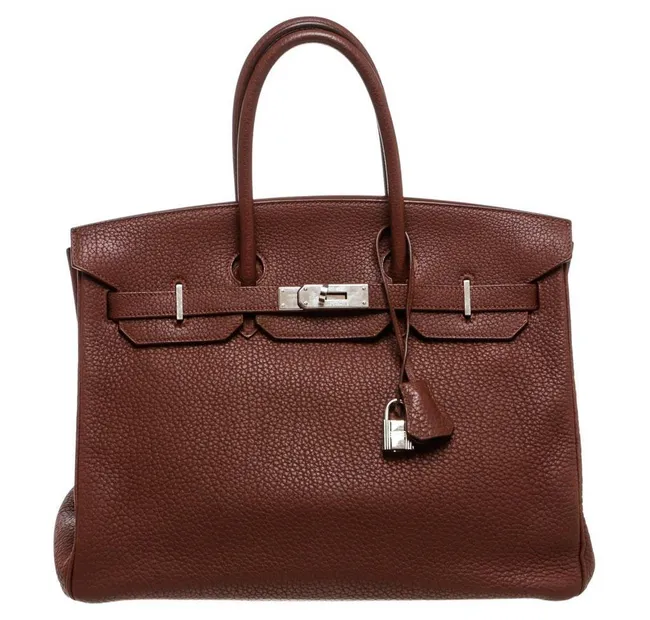
The genuine Birkin leather has a thick, luxurious and “vital” feel. It is soft yet structured, never stiff or like paper. Each type of leather has its unique characteristics, and experienced eyes (and hands) can easily identify them:
The key point is that genuine Hermès leather has a unique and rich luxurious smell, emitting a distinct fragrance of high-end craftsmanship. In contrast, fake bags often emit the smell of chemicals, glue or plastic, especially those mass-produced ones.
| Leather Type | Real Feel | What Your Fingers Detect |
| Togo | Pebbled, slightly grainy, warm to the touch | Natural pores, slight resistance when pressed |
| Epsom | Firm, structured, almost rigid | No give — feels like pressed cardboard with a leather coating |
| Box Calf | Ultra-smooth, almost glassy | Slippery, cool, like touching polished stone |
| Swift | Silky, buttery soft | Feels almost wet — extremely smooth |
| Ostrich | Distinctive raised quill dots | You can feel each quill bump individually |
| Crocodile | Scale pattern is tactile | Each scale has a slight ridge — you can trace the pattern with your fingertip |
Counterfeit Birkin bags are usually made of synthetic leather or embossed small cowhide patterns. These materials are readily available for counterfeiters, but they lack the texture and unique style of the genuine product. Common warning signs include:
| Red Flag | What It Means |
| Plastic-like sheen | The leather has been coated with a synthetic finish to mimic shine |
| Uniform texture everywhere | Real full-grain leather has natural variation — no two square inches feel identical |
| Chemical smell | Real Hermès leather smells like tannery — earthy, organic. Fakes smell like glue, plastic, or nothing at all |
| Too soft or too stiff | Fakes often overshoot in one direction — either unnaturally floppy or unnaturally rigid |
| No “give” when pressed | Real leather compresses slightly under pressure and bounces back. Fake leather either doesn’t compress or stays compressed |
Professional tip: Pay special attention to the lining. The genuine Togo or Clemence Birkins bags have a lining made of chevre (goat) leather. This type of leather has a slightly textured surface, similar to that of glove leather. If the bag does not have a lining or has been lined by the owner, it is a counterfeit.
Drop a drop of water on an inconspicuous area of the leather. Natural leather will slowly absorb the water over a period of about 30 to 60 seconds; while artificial leather will immediately form water droplets (synthetic coating), or be completely soaked (unprotected textured patches).
Warning: Do not perform this test on Box Calf or exotic skins – water may damage them. This test is only applicable to Togo, Epsom and Clemence.
Check if the leather has any wear related to age. Genuine Hermès leather will gradually develop a unique texture over time – Barenia leather will naturally darken, Clemence leather will become softer and may develop water stains, and all types of leather will develop a beautiful patina. Counterfeits may exhibit cracking, peeling or artificial fading, which do not conform to the natural aging pattern.
The stitching of the Bechenbaque can be regarded as the most reliable criterion for determining its authenticity. Hermès employs a labor-intensive process that cannot be replicated by machines.
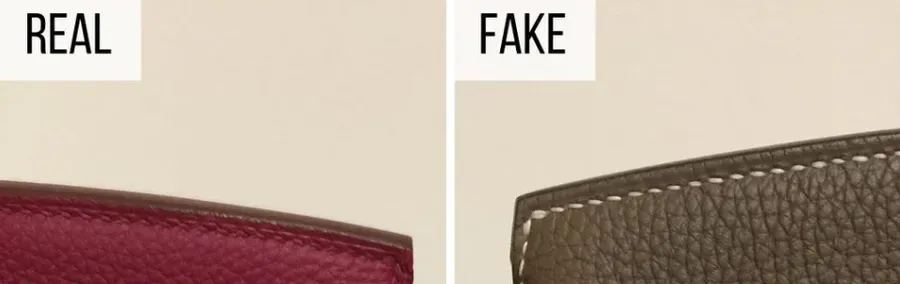
Each Birkin bag is meticulously handcrafted by a skilled artisan from start to finish, using the saddle stitching technique – a double-needle technique passed down through generations in Hermès’ saddlery craftsmanship. The stitches produced by this technique have the following characteristics:
The thread material is linen fiber, and the surface is lightly coated with beeswax, enhancing strength and giving it a soft luster. Apprentices must practice for up to a year before being allowed to sew Birkin bags.
| Feature | Real Birkin | Fake Birkin |
| Needle count | Two needles, one continuous thread | One needle (machine stitch) or two needles with synthetic thread |
| Angle | Each stitch sits at a slight diagonal angle (~45°) — this is the hallmark | Machine stitches are perfectly vertical (90°) — dead giveaway |
| Thread | Waterproof linen coated in beeswax — slightly waxed, matte finish | Synthetic nylon or polyester — shiny, smooth |
| Depth | Stitches are recessed into the leather — you can feel them as grooves | Stitches sit on top of the leather surface |
| Uniformity | Slightly imperfect — tension varies by millimeter because a human hand made it | Perfectly uniform — this is actually a red flag (machines are too perfect) |
| Stitch count | 7–9 stitches per inch on large bags (35–40cm), 9–11 on small bags (25–30cm) | Usually 10–12 per inch regardless of size |
The machine-sewn lines are straight and uniform, lacking the characteristic slanting tilt of saddle stitching. Other warning signs include:
Professional advice: Check the stitches at the connection between the handle and the body – this is a high-stress area, where the true craftsmanship details are revealed. The stitches should be flawless and reinforced, without any traces of glue or adhesive.
The front edge (the part photographed the most and most commonly imitated – but angle tests may still fail)
The handle base – “arrow patch” (a small triangular border at the connection point between the handle and the front piece / main body; the genuine item has a thin straight seam running through the entire area in the center position)
The front strap (front clasp) stitching – uniform tension and continuous stability; imitations will form a “cluster-like” accumulation at the bent part
Counting tips (in combination with the context): The saddle stitching of a Birkin bag is usually about 5-8 stitches per inch (≈ 2-3 stitches per centimeter), if you see more than 10 stitches, which looks like a super-dense sewing machine hem, please be very careful.
Professional advice: Use a slanted light (side flash) to photograph the stitching details. The genuine saddle stitching will present small and neat shadows within each hole, while machine stitching appears flat and textureless.
Please pay special attention to the following areas for stitching verification:
Gently pull on a single pin with a pair of tweezers. The genuine saddle stitch technique ensures that even if one thread breaks, the thread will not come loose – because the double needle lock stitch method can maintain firmness. While the fake one will immediately unravel.
Turn the bag over and examine the inner stitching. For a genuine Birkin bag, the quality of the stitching on the inside is exactly the same as that on the outside – using the same saddle stitch, the same thread, and the same stitching angle. Most imitations, in order to save time and cost, only use machine stitching on the inside. If the outside is hand-stitched while the inside is machine-stitched, then it is a fake.
Expert tip: Services like Entrupy and Rebagbagbag use artificial intelligence to analyze the stitching angles in photos. As long as the deviation from the Hermès standard is 2°, the bag will be marked as suspicious.
If the stitching of the bag appears to be completely machine-made without any flaws, it is almost certain that it is a fake. Genuine Hermès bags embody the art of craftsmanship, and minor imperfections are proof of their authenticity. However, obvious defects such as skipped stitches, loose thread ends, or inconsistent patterns indicate poor craftsmanship and do not meet Hermès’ standards.
The area where forgers are most likely to make mistakes is the hardware components.
Hermès hardware uses solid brass core material, which is then plated with gold, palladium or other surface treatments, all manufactured according to strict standards. This specific weight makes it impossible for counterfeiters to replicate it, unless they use genuine brass; otherwise, their production costs would be difficult to sustain.
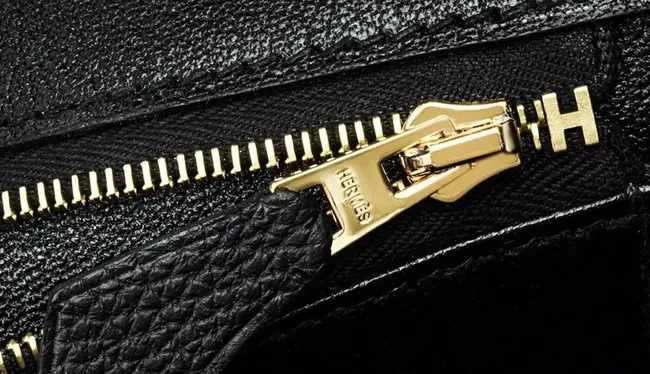
All Hermès hardware components are made of solid brass and are plated with precious metals – usually palladium (silver-white) or gold. This gives the hardware a substantial and solid texture, never being light or hollow. The main features include:
The fake hardware is made of cheaper metals (such as zinc alloy, galvanized brass steel, or even plastic), and feels significantly lighter. Common warning signs:
Professional tip: Slide your fingers along the inner side of the metal track. If it feels rough or has sharp edges, it is likely a fake product – Hermès would never produce metal parts that could scratch or damage the leather.
| Hardware Piece | Real Weight | Fake Weight |
| Touret (turn-lock) | ~12–18g | ~5–8g (zinc alloy) |
| Lock (padlock) | ~8–12g | ~3–5g |
| Keys (each) | ~3–5g | ~1–2g |
| Plaques (each) | ~5–8g | ~2–4g |
| Full set (all hardware) | ~200–350g depending on bag size | ~80–150g |
| Test | What to Do | Real vs. Fake |
| The drop test | Drop the touret from 10cm onto a hard surface | Real: solid, deep “clink.” Fake: hollow, tinny “click.” |
| The spin test | Spin the lock on a flat surface | Real: spins smoothly, slows gradually (brass momentum). Fake: wobbles, stops instantly (zinc has no inertia). |
| The scratch test | Gently scratch an inconspicuous area of hardware with your fingernail | Real: scratches only, plating stays intact. Fake: plating peels or flakes off, revealing silver or black metal underneath. |
| The magnet test | Hold a magnet near the hardware | Real: brass is non-magnetic — nothing happens. Fake: many use steel core — magnet sticks. |
| Finish | Real Look | Fake Look |
| Gold Hardware (GHW) | Warm, deep gold — slightly champagne tone. Even, no orange tint. | Often too yellow, too orange, or uneven. |
| Palladium Hardware (PHW) | Cool, silvery-white. Slightly bluish under light. | Looks like cheap chrome or nickel. |
| Rose Gold | Subtle pink-gold blend. Natural, not painted. | Often looks like copper or rust. |
| So Black PVD | Near-black, matte, consistent. | Uneven, sometimes shiny in spots, or flaking at edges. |
Key details: On genuine hardware, the “HERMÈS” logo on the locks, keys and zipper pulls is engraved using diamond-pointed files, resulting in clear and sharp letters with clean serifs. In contrast, on counterfeit products, the lettering is produced through laser engraving or stamping techniques, making the letters appear thin, rounded or blurry.
| Test | Authentic | Fake Red Flag |
| Lift by handle; feel total mass | 30cm Togo often lands roughly ~1.1–1.4 kg empty | Suspiciously light / “bouncy light” |
| Touch hardware | Cool, smooth, slightly dense | Warm, tinny, hollow-ring when tapped |
| Mirror-finish surfaces | Polished, not “chrome-bright toy” | Too mirror-shiny, plating thin, edges burred |
For the turn lock plate, the hook, the base bottom, and the zipper pull, the following points should be noted:
| Feature Dimension | Genuine (Authentic) | Fake (Replica) |
| Material Composition | Made from solid brass, palladium, or gold-plated metals. Feel substantial and dense, never hollow. | Lightweight alloys or painted plastic that mimic the look but lack heft. |
| Overall Weight | A 30cm Birkin‘s lock alone weighs about 50 grams. The entire hardware set feels dense and weighty. | Replicas may weigh 30% less. If the bag feels top-heavy or flimsy, proceed with caution. |
| Finish Quality | Mirror-polished or micro-brushed texture (depending on plating). Edges are smooth, with no casting marks. | Bubbled paint, visible seams, or rough edges betray cheap manufacturing. |
| Engravings | Locks and keys bear the Hermès logo and unique serial numbers. Engravings are deep, precise, and legible. | Etched or laser-printed markings are often shallow, blurry, or missing entirely. |
| Opening and Closing Feel | Locks and clasps operate smoothly with a crisp, clean mechanical click – no grinding or resistance. | Operation feels stiff, rough, or muted – without the characteristic crisp sound. |
| Colour Consistency Among Hardware | All hardware pieces (lock, rings, zippers, etc.) on the same bag match perfectly in colour – no noticeable variation. | Visible colour differences between hardware pieces, or tones that are too yellow, too dark, or overly shiny. |
| Hardware-to-Leather Junction | Metal parts sit flush and tight against the leather – no gaps or glue residue. | Obvious gaps, glue seepage, or uneven attachment where metal meets leather. |
| Edge Chamfering and Polishing | All metal edges are finely chamfered and polished – smooth to the touch, never sharp. | Edges are sharp, unpolished, or have rough burrs that catch on fingers. |
| Structural Sturdiness | Hardware (e.g., clasps, rings) is rigid and resistant – does not bend or loosen even under moderate pressure. | Metal parts loosen, bend, or deform when lightly pressed or pulled. |
| Wear Consistency (for pre-owned bags) | External hardware (e.g., lock) shows wear that is consistent with internal hardware (e.g., interior zippers), reflecting natural use. | External hardware is heavily worn, but internal hardware looks almost new – suggesting non-original replacement parts. |
| Tarnishing and Fading | Over time, hardware may develop even, natural patina or slight fading, never localised peeling. | Uneven, patchy fading, bubbling, or flaking that reveals cheap base metal. |
| Screw and Assembly Quality | Screws (if present) have clean, symmetrical slots and are seated flush. | Screws are off-centre, uneven in depth, or mix cross-slot and flat-slot inconsistently. |
| Zipper Brand Markings | Zippers (where applicable) are from top-tier suppliers such as riri or Lampo, with clear brand stamps. | Zippers carry no brand marks or use low-end brands; markings are blurry or missing. |
The date stamp (also known as a “braille stamp”) is a small heat-pressed mark used to indicate the production year. It usually also indicates the artisan who made the bag. Although counterfeiters attempt to imitate these marks, few can accurately replicate them.
The date label is located on the inside of the bag, usually on the back wall near the zipper pocket or on a small leather label. It consists of two letters and a number:
Example: A S = 2020, C D = 2023
The date stamps of Hermès follow a specific system that evolves over time:
For example, the appearance of “A” in the square indicates that the bag was produced in 1997. In the modern system, if “A” has no shape, it indicates the year 2017.
The postmark should be clear, uniform, and aligned. It must not be blurry, crooked, or faded. Modern Birkin bags produced after 2016 have a date mark on the left side near the rear cover; Birkin bags produced before 2016 usually have a date mark below the left shoulder strap.
Common date stamp errors include:
Professional tip: The date code must match the type of leather, model and hardware style of the bag for that particular year. If Hermès has never produced such a combination, then this bag is a fake.
| Position | Meaning |
| First letter | Year (A = 2013, B = 2014, C = 2015, D = 2016, E = 2017, F = 2018, G = 2019, H = 2020, J = 2021, K = 2022, L = 2023, M = 2024, N = 2025, O = 2026) |
| Second letter | Month (A = Jan, B = Feb, C = Mar, D = Apr, E = May, F = Jun, G = Jul, H = Aug, I = Sep, J = Oct, K = Nov, L = Dec) — I is skipped to avoid confusion with 1 |
| Number (optional) | Workshop or artisan code |
| Red Flag | Why It Matters |
| No date stamp at all | Every Birkin made after 2002 has one. No stamp = almost certainly fake. |
| Stamp doesn’t match the bag’s claimed age | If the seller says “2019 bag” but the stamp says “N 2025,” something is wrong. |
| Stamp is in the wrong location | Some fakes stamp it on the exterior or on a removable tag — it must be on the interior leather. |
| Font doesn’t match | The date stamp uses a sans-serif font, different from the logo stamp. Fakes often use the same font for both. |
| Stamp is too clean or too blurry | Real stamps are slightly imperfect — the heat press leaves a natural unevenness. Fakes are either too sharp (laser) or too blurry (low-quality press). |
Pro tip: Compare the date stamp with the official Hermès year code chart. If the code does not exist (for example, a certain year has code “Z” but that year is not mapped), it is a fake.
| Era | Format | Example |
| 1945–1970 | Plain letter (A=1945…) | A |
| 1971–1996 | Letter in circle | ○A |
| 1997–2014 | Letter in square | □A |
| 2015–present | Plain letter, new non-alpha sequence, moved inside bag | T(2015), X(2016), A(2017)… |
Since ~2016, the blind stamp is typically found on the interior left panel near the flap, not under the front strap.
The lock and key set is another aspect where counterfeiters often make mistakes. Each genuine Birkin bag comes with one lock, two keys, and a small leather clasp (a small leather keychain attached to the bag).
The locks and keys are all custom-made, and each bag is unique. Key features:
There are several flaws in counterfeit locks and keys:
Professional tip: Counterfeiters often overlook small details, such as the latch ring itself. The leather should be exactly the same as that of the bag, and the stitching should be as precise as that of the bag itself.
| Feature | Real | Fake |
| Material | Solid brass core, gold/palladium plated | Zinc alloy, thin plating |
| Engraving | “HERMÈS” in crisp serif font, diamond-burr engraved | Laser-etched, shallow, often misspelled |
| Keyhole | Precise, clean edges | Rough, uneven, sometimes too large or too small |
| Clasp mechanism | Smooth, satisfying click. Lock turns 90° with slight resistance. | Loose, wobbly, or too tight. Often turns 180° or doesn’t lock at all. |
| Weight | 8–12g | 3–5g |
| Feature | Real | Fake |
| Number of keys | Always 2 keys per lock | Fakes sometimes include 1 or 3 |
| Key shape | Slightly tapered, with a rounded tip | Often blocky, flat, or overly detailed |
| Engraving | “HERMÈS” on the key bow (the round part) | Often missing or poorly done |
| Fit | Keys fit only their specific lock — you can feel the pins align | Fake keys often fit multiple locks (low-quality pins) |
| Clochette | Leather lanyard holding both keys, stitched with saddle stitch | Often glued, or stitched with machine stitch |
The small bell (keychain) is a small leather tag attached to the handle. On the genuine Birkin:
Certification key: Hermès locks cannot be interchanged between different bags. Each lock is paired with the key in the factory. If the seller claims that the key is “lost and has been replaced”, this is a major warning sign – Hermès will not sell replacement keys to the public.
| Feature Dimension | Genuine (Authentic) | Fake (Replica) |
| Lock Mechanism | Features a rotating dial with Hermès initials. Turning it aligns the letters to unlock. The mechanism glides smoothly. | Most replicas use a simple clasp or a non functional imitation. Even if the design is copied, the movement feels gritty or stuck. |
| Key Design | Keys are etched with the Hermès logo and have a heavy, cold-to-the-touch feel. They fit snugly into the lock. | Keys may be lightweight, poorly engraved, or come with a plastic tag. |
| Functional Test | Insert the key and turn it – genuine locks require minimal force. After locking, the key can only be removed by properly disengaging the mechanism. | The key may get stuck or turn roughly – a strong indication of a fake. The key may also pull out easily without proper disengagement. |
| Hidden Details | The lock’s interior shows intricate gears through a tiny window. | Hollow interiors or plastic components are revealed upon inspection. |
| Front Engraving | The “HERMÈS PARIS” engraving is crisp, deep, and consistent with the bag‘s logo style. Letter spacing is even. | Engraving is shallow, blurry, or uses a different font style. Letter spacing may be uneven. |
| Bottom Number & Serial Match | The lock bears a unique number that exactly matches the number on the key and the accompanying card, and corresponds to the bag’s identity. | The number on the lock does not match the key or card, or follows an incorrect format. |
| Brass & Plating Quality | Made of solid brass with thick, even plating (gold/palladium). Colour is natural; edges show no exposed base metal. | Plating is thin and uneven, with exposed base metal at edges. Gold tones are overly bright yellow, or palladium appears too starkly white and cheap. |
| Lock Size & Proportion | Lock size is proportional to the bag (e.g., smaller lock for Birkin 25, standard for 30/35). | Lock is too large or too small for the bag, or its shape deviates noticeably from the genuine design. |
| Keyhole Shape | The keyhole is regular in shape, with smooth edges – no burrs or deformation. | The keyhole has shape irregularities, rough edges, or does not match the key properly. |
| Key Surface Texture | Key surface is smooth and fine, with no rough spots or raised burrs around engravings. | Key surface shows visible machining marks, burrs, or raised edges around engravings. |
| Lock Engagement Feel | Closing the lock produces a crisp metal click. The tongue and slot engage tightly with no wobble. | Closing is muffled or silent; the tongue and slot have gaps and feel loose. |
| Engraving Font & Method | The bottom number is deep laser-engraved with a thin, clear font. Digits are neatly arranged and uniformly deep. | Numbers are shallowly etched, using a thicker, rounder font, with uneven depth or blurred characters. |
| Clochette Match | The lock fits perfectly into the clochette – no looseness. The clochette leather matches the bag’s leather exactly. | The lock is loose or protrudes too far from the clochette. The clochette leather may differ in quality or texture. |
| Bottom & Side Assembly | The joint between the lock’s bottom and sides is tight and smooth – no glue residue or gaps. | Visible gaps, glue seepage, or unevenness at the joints. |
| Protective Pouch (if present) | Any protective pouch provided is original Hermès, matching the bag in material and quality. | The pouch is made of inferior material and shows no consistency with the bag. |
| Era-Specific Differences | Locks from different eras have normal variations (e.g., 1980s locks are slightly smaller). | Fakes often ignore era differences, using a single mould for all periods, resulting in details that do not match the claimed production year. |
The Birkin handle is one of the most complex and time-consuming components in the manufacturing process, and it is also the most revealing part when it comes to identification.
Each handle is made of multiple layers of leather, which are bonded, shaped and sewn together. The entire process takes approximately four hours. The final result is:
| Feature | Detail |
| Material | Same leather as the bag body — cut from the same hide |
| Shape | Slightly curved, not perfectly straight — ergonomic for hand grip |
| Attachment | Connected via D-rings riveted to the bag body with solid brass hardware |
| Stitching | Saddle stitch along both edges of the handle — visible from the outside |
| Edge finish | Hand-painted edge coat, smooth, no drips |
| Flexibility | Handle bends slightly under pressure but returns to shape — no creasing |
| Interior reinforcement | A thin strip of leather or canvas runs inside the handle for structure (invisible from outside) |
Construction management is one of the earliest areas to demonstrate cost-saving effects:
| Red Flag | What It Means |
| Handle is too straight | No ergonomic curve — looks like a rigid strap |
| Handle creases permanently | No internal reinforcement — the leather is too thin |
| Stitching is machine-made | Visible vertical stitches, not diagonal saddle stitch |
| Handle leather is different from body | Fakes often use cheaper leather for handles to save cost |
| D-rings are loose or wobbly | Poorly riveted — will detach under weight |
| Handle feels hollow | No internal reinforcement — just a tube of leather |
Professional tip: Check the fixation method of the handle and the bag. The genuine handle fixation employs reinforced stitching and structural integrity, which is impossible for counterfeiters to replicate.
| Feature Dimension | Genuine (Authentic) | Fake (Replica) |
| Rolled Leather Edges | Handles are hand-rolled, creating a seamless, rounded edge. The roll remains firm and tight, even after years of use. | Edges are flat, stiff, or frayed – revealing machine-cut, inferior materials. |
| Handle Stitching | Vertical stitches run parallel, with no crossed threads. Stitch spacing is uniform and consistent. | Stitching is diagonal or haphazard, exposing rushed assembly. |
| Handle Curve / Slope | Handles curve downward gracefully, allowing the bag to stand upright on its own. | Handles are overly arched or droopy, disrupting the bag‘s overall structure. |
| Attachment Points | Handles are secured with hidden screws or rivets, covered by leather tabs. No glue is used. | Connections are glued or show visible weld marks – clear signs of a counterfeit. |
| Handle Filling Material | The interior is filled with multiple layers of leather or natural cork, giving a firm yet resilient feel – it springs back after pressing. | Filled with cheap foam or cardboard – feels soft and saggy, with slow or no rebound after pressing. |
| Leather Tabs Connecting Handles to Bag | The leather tabs (often called “ears”) that attach the handles to the bag match the bag exactly in shape, thickness, and leather quality. Edges are cleanly cut. | Tabs show shape deviations, different leather quality, or rough, uneven cuts. |
| Gap at the Attachment Base | The base of the handle sits flush against the bag – no visible gap, and fingers cannot slip through. | There is a noticeable gap at the attachment point; fingers can easily slip through, or the inner filling is visible. |
| Metal Rings at Handle Base | Metal rings (if present) have a matte or brushed finish, matching the bag’s hardware colour. Rings are perfectly shaped. | Rings have a glossy finish, mismatch the bag’s hardware, or are irregular in shape. |
| Left-Right Handle Symmetry | Both handles are consistent in height, curve, and thickness – no noticeable difference to the naked eye. | Obvious asymmetry between the two handles – one higher, one lower; one thicker, one thinner; or curves that do not match. |
| Handle Cross-Section | A cross-section view reveals multiple distinct layers of leather, tightly laminated with no voids. | The cross-section shows single-layer material or foam, with voids or separation between layers. |
| Leather Consistency with the Bag Body | The handle leather comes from the same batch as the bag – texture, colour, and sheen are identical. | The handle leather shows colour differences or texture mismatch – indicating different batches. |
| Aging Characteristics | Over long-term use, handles develop an even patina and natural imprint marks, while remaining full and plump. | Handles become severely distorted, collapsed, or develop uneven cracking after use. |
| Inner Side of Handles (skin-contact surface) | The inner side (where the hand holds) is equally smooth and fine, with neat stitching throughout. | The inner side is rough, has loose threads, or shows crooked, messy stitching. |
| Spacing between Handle and Clochette | When the handle hangs naturally, there is reasonable clearance from the clochette – they do not press against each other. | The handle presses against the clochette or the gap is excessively wide – indicating abnormal handle curvature or clochette placement. |
| Handle Length Proportion to Bag Size | Handle height is in fixed proportion to the bag size (e.g., Birkin 25 has shorter handles, Birkin 35 slightly longer) – consistent with brand standards. | Handle length does not match the bag size (e.g., short handles on a large bag, or long handles on a small bag) – proportions are off. |
Edge paint (also known as edge varnish) is the coating applied to the edges of the leather cut. On a Birkin bag, this process must be carried out with the precision of a delicate surgical procedure.
The edge coating on a genuine Birkin bag is a fine and uniform, clean line. It has the following characteristics:
| Feature | Detail |
| Color | Perfectly matched to the leather — not slightly off |
| Application | 3–5 thin layers, each dried before the next |
| Texture | Smooth, slightly raised, rubbery to the touch |
| Coverage | Complete — no raw leather visible at any edge |
| Durability | Does not chip, crack, or peel for years |
| Consistency | Uniform thickness along the entire edge |
The counterfeit Birkins reveals the genuine features through poor edge treatment:
| Red Flag | What It Means |
| Color mismatch | Edge paint is slightly darker or lighter than the leather |
| Drips or blobs | Applied too thick in one spot — signs of spray or machine application |
| Cracking | Edges chip or flake within weeks of use |
| Uneven thickness | Thick in some areas, thin in others — not hand-applied |
| Raw leather visible | Paint doesn’t reach the very edge — the cut leather is exposed |
| Chemical smell | Real edge paint is water-based and nearly odorless. Fakes often smell like nail polish or acrylic. |
Professional tip: Use a magnifying glass or a macro lens to carefully examine the edge finish. Under high magnification, the significant differences between the meticulously handcrafted and layered edges of Hermès and the hastily applied edges of imitations can be clearly observed.
| Location | What to Look For |
| Handle edges | Both sides should be evenly painted |
| Flap edges | The most visible edge — should be flawless |
| Strap (sangle) edges | Often faked — check carefully |
| Interior pocket edges | Fakes often skip this — real bags paint every edge |
| Bottom edge | Hard to see, but real bags paint it too |
| Feature Dimension | Genuine (Authentic) | Fake (Replica) |
| Smoothness & Uniformity | Edges are coated with multiple layers of paint, sanded between coats for a glass-like finish. The colour harmonises with the hardware tone. | Paint appears thick, streaky, or mismatched; cracks or bubbles form quickly. |
| Durability Test | Gently rub the edge with a white cloth – authentic paint will not smudge or transfer. | Fake paint leaves residue or wears off entirely, exposing the base material. |
| Colour Consistency | Edge paint colour harmonises with the hardware (e.g., gold hardware pairs with warm-toned edge paint). | Clashing colours (e.g., silver hardware with yellowed edge paint) signal inconsistency. |
| Thickness & Layering | Edge paint has a subtle layered appearance, with a natural gradation of sheen created by multiple thin coats and sanding – not a single thick layer. | Edge paint is too thick or too thin, appearing flat with no depth or gloss variation. |
| Edge Paint-to-Leather Transition | The paint meets the leather surface flush – no bleeding, no recession, no adhesive residue. The junction is clean and sharp. | Paint bleeds onto the leather surface, or recedes inward, leaving glue marks or rough edges at the junction. |
| Edge Plumpness & Three-Dimensionality | After multiple coats, leather edges have a full, rounded three-dimensional profile, feeling smooth and fluid to the touch. | Edges are flat, thin, or uneven, with a stiff or rough feel. |
| Ageing Characteristics | Over time, edge paint develops even, natural ageing (e.g., slight maturing), but does not crack or peel. | Fake edge paint quickly shows uneven cracking, flaking, or becomes chalky or sticky. |
| Consistency Across Different Areas | The edge paint process and colour are perfectly consistent on all edges – including handles, flap, base, and sides. | Different areas show varying thickness, colour inconsistencies, or poor workmanship – indicating separate handling. |
| Shrinkage Compatibility with Leather | As the leather naturally stretches or contracts, the edge paint moves with it – no separation or peeling. | The paint separates from the leather, or lifts away, creating visible gaps. |
| Gloss Level | Edge paint has a soft, natural sheen – not overly shiny, and consistent with the leather’s lustre. | Edge paint is too glossy (plastic-like) or completely matte and lacks quality, clashing with the leather’s finish. |
| Surface Detail (under magnification) | Under magnification, the paint surface shows fine sanding marks and hand-finished texture – not perfectly uniform. | The surface is perfectly uniform (machine-applied), or rough with pinholes. |
| Reinforced Bottom Edges | The bottom edge (which contacts surfaces) is noticeably thicker, more rounded for extra durability. | The bottom edge shows no thickness difference from side edges, or is rough and easily damaged. |
| Colour Contrast with Leather | Dark leather uses matching-tone edge paint or classic natural-coloured edge paint (translucent beige/light brown) that blends harmoniously. | The edge paint clashes harshly with the leather, or uses the wrong colour (e.g., black leather with bright white paint). |
| Treatment at Seam Junctions | At seam junctions (e.g., corners, flap turns), the edge paint transitions smoothly – no build-up, no breaks, continuous and fluid. | Paint builds up in lumps, breaks, or is missing at junctions – revealing poor workmanship. |
| Era-Specific Edge Paint Characteristics | Different eras show normal variations in texture and sheen (e.g., older edge paint is more matte, modern ones have slight lustre). | Fakes often ignore era-specific traits, using the same modern gloss regardless of claimed production date. |
Although the packaging itself cannot prove the authenticity of the bag, it provides useful supplementary evidence – and counterfeiters often overlook this point.
The brand new Birkin handbag comes with:
The counterfeit packaging clearly shows signs of poor quality:
Professional tip: Compare the logo on the dust bag with the picture of the genuine Hermès dust bag. The font, spacing and position of the logo should be exactly the same. Any minor differences may indicate that it is a counterfeit.
| Feature | Real | Fake |
| Material | Thick, soft felt (cotton-flannel blend) | Thin, cheap fabric — often polyester |
| Color | Warm dark brown (chocolate tone) | Often too light, too orange, or too gray |
| Drawstring | Thick cotton cord with a wooden or leather toggle | Thin nylon string with plastic toggle |
| Logo | “HERMÈS” printed in dark brown ink — slightly raised, not glossy | Printed in black, glossy, or smudged |
| Stitching | Clean, even, no loose threads | Loose threads, uneven stitching |
| Size | Fits the bag snugly — not too big, not too small | Often too large or too small for the bag |
| Feature | Real | Fake |
| Color | Signature Hermès orange — specific Pantone shade (165 C) | Often too bright, too yellow, or too matte |
| Texture | Slight grain, like high-quality cardboard | Smooth, glossy, or too rough |
| Logo | “HERMÈS PARIS” in dark brown, centered, crisp | Off-center, blurry, or wrong font |
| Lid | Fits snugly — slight resistance when opening | Loose, wobbly, or too tight |
| Interior | Lined with cream-colored tissue paper, folded neatly | No tissue paper, or cheap white paper |
| Ribbon | Dark brown cotton ribbon tied in a specific bow | Wrong color, wrong knot, or missing |
| Item | Real | Fake |
| Receipt | Printed on Hermès letterhead, with store name, date, and artisan code | Often generic, missing details, or with a different font |
| Artisan code | Matches the code stamped inside the bag | Often missing or doesn’t match |
| Care booklet | Small booklet with care instructions in multiple languages | Often missing, or poorly printed |
| Clochette with keys | Present, matching the bag | Sometimes missing, or wrong leather/color |
| Feature Dimension | Genuine (Authentic) | Fake (Replica) |
| Dust Bag Material | Made of thick, felt-like cotton with an embossed Hermès logo (not printed). The drawstring is braided, not twisted. | Made of thin, shiny fabric with a printed logo. Drawstrings are often flimsy twisted cords that easily fray. |
| Dust Bag Logo Placement & Font | The logo is positioned slightly below the centre on the front. The font matches the bag’s stamp – crisp, with even depth. | Logo is off-centre, uses incorrect fonts, or is too shallow/deep with blurry edges. |
| Dust Bag Stitching | Seams are neat and tight, no loose threads. Bottom seams are flat and smooth. | Stitching is loose, crooked, with exposed threads. Bottom seams are rough or wrinkled. |
| Box Material & Construction | Cardboard box is sturdy and thick, with a magnetic closure. The logo is foil-stamped, not printed. | Cardboard is flimsy and easily bent, with sticker labels or crooked printing. |
| Box Interior | Includes a removable white inner divider to secure the bag. The divider has smooth edges and fits perfectly inside the box. | No divider, or the divider is poorly made, incorrectly sized, or the box is filled with cheap foam. |
| Box Bottom Information Label | A specification label is attached to the bottom, clearly stating model, colour code, leather type, etc. The label is flat and neatly applied with standardised fonts. | The label is missing, has incorrect information, or blurry fonts. It may be crooked, wrinkled, or handwritten. |
| Included Accessories | Comes with a care booklet (multi-language), a small card (not an “authenticity card”), and the orange box. No plastic shrink wrap is used. | Comes with extra tags, non-official receipts, or sealed plastic bags – all suspicious. |
| Care Booklet Features | The booklet is multi-language, printed on thick, high-quality paper with crisp text. The cover is Hermès orange, binding is neat. | Booklet is thin, blurry, with off-colour cover (non-standard orange), and rough binding. |
| Ribbon & Wrapping Paper | The orange box is usually tied with a thick orange cotton ribbon and a white camellia or H-shaped tag. The ribbon feels substantial, the tag is embossed. | The ribbon is thin and flimsy, colour is off. The tag is plain printed with no texture. |
| Lock & Key Packaging | The lock and keys come in a small orange cotton drawstring pouch – same material as the dust bag, with a braided string. | Packaged in plastic bags or cheap thin pouches of inferior material. |
| Use of Plastic Wrapping | Hermès never wraps leather goods in plastic shrink film. All protective materials are cotton, paper, or non-woven fabric. | The bag, handles, and hardware are covered in excessive plastic film – a common fake trait. |
| Warning Signs | Missing dust bag or box: While not definitive, for a bag claimed as “new” it is highly unusual. | Sellers who over-provide “extra” documents (e.g., certificates, authentication cards) – genuine Hermès rarely includes such items. |
| “Authenticity Card” Issue | Hermès never includes an “Authenticity Card”. Only the care booklet and separate item cards for accessories are provided. | Fakes often include a hard-plastic authenticity card to appear credible – this is a clear counterfeit signal. |
| Barcode / Label on the Box | Some boutiques attach an internal management barcode on the box side – a white label with clear fonts, placed in a fixed position. | Barcode is missing, label colour is wrong, or placement is random. |
| Era-Specific Packaging Differences | Boxes from before the 1990s had no magnetic closure, using flap-and-tab closure. Ribbons and tags have subtle stylistic changes over the decades. | Fakes ignore era-specific features, using uniform modern packaging for all styles, mismatching the claimed production period. |
| Pre-Owned / Resale Packaging Completeness | Authentic pre-owned bags often still come with the original dust bag and box (if well-preserved). Missing them doesn’t mean fake, but requires caution. | Fake sellers often claim “packaging lost” to avoid detail comparison – a red flag. |
Perhaps the most crucial step in the certification process occurs before you make the purchase. The seller’s reputation is your first line of defense.
Hermès leather products can only be purchased at Hermès stores and on Hermès.com. Kelly, Birkin and Constance handbags are only sold at Hermès stores. Key information:
| Channel | Authentication Level | Notes |
| Hermès boutique | 100% guaranteed | But you need a purchase history to get offered a Birkin |
| Rebag / Fashionphile | Professionally authenticated | Each bag inspected by trained authenticators; resale price 80–120% of retail |
| The RealReal | In-house authentication team | Accepts returns if bag is found to be fake |
| Vestiaire Collective | Third-party authentication available | Buyer pays for auth service — worth it |
| Christie’s / Sotheby’s | Fully guaranteed | Auction houses guarantee authenticity — but you pay a premium |
| Private resale (eBay, Poshmark, etc.) | No guarantee unless you pay for auth | Highest risk — always use Entrupy or a professional service |
New Birkin bags are being sold online at discounted prices or with limited-time offers.
The seller is unable to provide macro photos of the stamps, hardware, and stitching.
The price is much lower than the market price.
The seller claims to have “internal channels” or “information directly from the factory”.
The seller provides a counterfeit “authenticity card” (Hermès does not offer such cards).
The seller is unwilling to meet in person or provide additional photos.
| Red Flag | Why It’s Dangerous |
| Price is “too good to be true” | A 30cm Togo Gold Birkin retails for ~12,000.Ifit′slistedat6,000, it’s fake. Full stop. |
| No receipt or provenance | Legitimate resale always includes receipt, date stamp verification, and artisan code. |
| Seller is vague about sourcing | “I got it from a friend” or “It’s from my collection” without specifics = red flag. |
| Seller refuses authentication | Any legitimate seller will welcome third-party authentication (Entrupy, Rebag, Fashionphile). Refusal = almost certainly fake. |
| Seller is new or has no reviews | Check the seller’s history on platforms like Vestiaire Collective, The RealReal, or eBay. |
| Seller ships from a high-risk country | Counterfeits most often originate from China, Turkey, and Italy. Shipping from these regions doesn’t guarantee fake, but increases risk. |
| Multiple listings of the same bag | If you see the same bag listed by 5 different sellers at different prices, it’s likely a counterfeit being resold. |
Professional tip: If the seller claims that the bag is “brand new”, but cannot provide the original receipt, packaging box, dust cover and protective case, you should be highly skeptical. A genuine brand-new Birkin bag purchased from Hermès will come with all these items.
| Channel Type | Trustworthy Practices | Red Flags |
| Authorised Retailers | Buy directly from Hermès boutiques whenever possible; staff will not sell defective items. | Non-official channels claiming “brand new authentic” without providing proof of purchase from a boutique. |
| Request proof of purchase, such as a dated receipt from the store. | Unable to provide a receipt, or the receipt format is suspicious (e.g., handwritten, incomplete details). | |
| Second-hand Platforms | Choose platforms with authentication services (e.g., The RealReal, Vestiaire Collective). | The platform offers no authentication service or does not accept returns. |
| Ask for clear photos of the date stamp, logo, and hardware before bidding. | The seller refuses to provide detailed photos, or the photos are blurry or taken from only one angle. | |
| Private Sellers | Ask about the purchase source and reason for selling; genuine owners usually know the bag’s history. | The seller is vague, contradictory, or cannot provide any purchase record. |
| Insist on meeting in person (for local sales) to inspect the bag live. | Refuses to meet in person, only accepts shipping without providing an inspection opportunity. | |
| General Warning Signs | — | Prices significantly below market value – defying supply and demand logic. |
| — | Sellers refusing returns or avoiding detailed questions. | |
| — | Listings using stock photos or official promotional images instead of actual photos of the item. |
| # | Checkpoint | Pass = Likely Real | Fail = Likely Fake |
| 1 | Logo stamp depth, font, box/hyphen | Deep, crisp, correct symbol | Shallow, blurry, missing symbol |
| 2 | Leather feel and smell | Full-grain, organic, warm | Plastic, chemical, uniform |
| 3 | Stitch angle and thread | Diagonal, beeswax linen | Vertical, synthetic nylon |
| 4 | Hardware weight and plating | Heavy, solid brass, no peeling | Light, hollow, peeling |
| 5 | Date stamp location and code | Interior, correct format, matches age | Missing, wrong location, invalid code |
| 6 | Lock, key, clochette quality | Crisp engraving, 2 keys, saddle-stitched clochette | Laser-etched, wrong key count, glued |
| 7 | Handle construction | Curved, reinforced, same leather | Straight, hollow, different leather |
| 8 | Edge paint quality | Smooth, matched, multi-layer | Chipping, mismatched, uneven |
| 9 | Packaging and documentation | Correct orange, felt dust bag, receipt | Wrong color, cheap fabric, no receipt |
| 10 | Seller credibility | Authorized or professionally authenticated | Anonymous, no auth, too cheap |
How to tell if a Birkin bag is genuine or fake? If all of the above 10 items pass the test, then the bag you hold in your hand is a genuine Birkin bag – one of the most exquisite items in the world.
Because a genuine one is a harmonious unity of all details: the natural depth of hand-pressed impressions, the uniform slope of saddle stitching, the weight of solid hardware, the warm luster of edge oil, and the color coordination between leather and hardware.
If there is any missing or contradictory detail, it is worth being vigilant. If you have any doubts, be sure to seek professional identification institutions (such as Entrupy, Real Authentication) for final confirmation. The cost is much lower than the loss from purchasing counterfeit goods.
If you are building your own luxury bag brand and are seeking reliable suppliers, please feel free to contact us.


Mobile Website

Inquires Whatsapp