- +86 13922774531
- info@gionar.com

English


English
May 21 , 2026
Sheepskin is the natural leather obtained from adult sheep, renowned for its extreme softness, lightness, breathability, and natural oil content, which makes it highly skin-friendly and comfortable.
Sheepskin leather is commonly found in mid-to-high-end fashion, soft handbags, gloves, and shoes. Its price falls in the mid-range, being more expensive than cowhide but much lower than lambskin. It is a leather specifically designed for comfort and texture, suitable for users who seek a soft and lightweight experience and are willing to take good care of it.
If you are exploring various luxury quality leather materials, sheepskin leather is worth your in-depth study.
This post will explore the characteristics of sheepskin leather and its suitability for making bags.
Sheepskin is a natural leather made from the skins of adult sheep through tanning processes. It is highly favored for its extreme softness, lightness, and excellent insulation properties. Compared to lambskin (from young lambs), sheepskin is slightly thicker and more durable while maintaining a soft texture.
It is often processed into various forms to meet different needs. For instance, the familiar shearling is sheepskin with retained wool, commonly used for making warm boots and coats. After removing the wool, its smooth surface is also frequently used to make handbags, clothing, and gloves, etc.
| Feature | Description |
| Feel & appearance | Extremely soft, smooth, fine grain, small and uniform pores. |
| Weight & thickness | Very lightweight – much lighter than cowhide. |
| Durability | Low to medium – not as strong as cowhide; avoid sharp objects. |
| Comfort | Excellent – natural oils make it breathable, skin friendly, and temperature regulating. |
| Warmth | Good – ideal for winter jackets and boot linings. |
| Main uses | Coats, jackets, gloves, footwear, soft bags, furniture, auto upholstery. |
| Type | Description | Used For |
| Single-face | Smooth leather side out, wool on the inside | Jackets, linings, gloves |
| Double-face / Wool-out | Wool side is the visible surface | UGG boots, shearling coats |
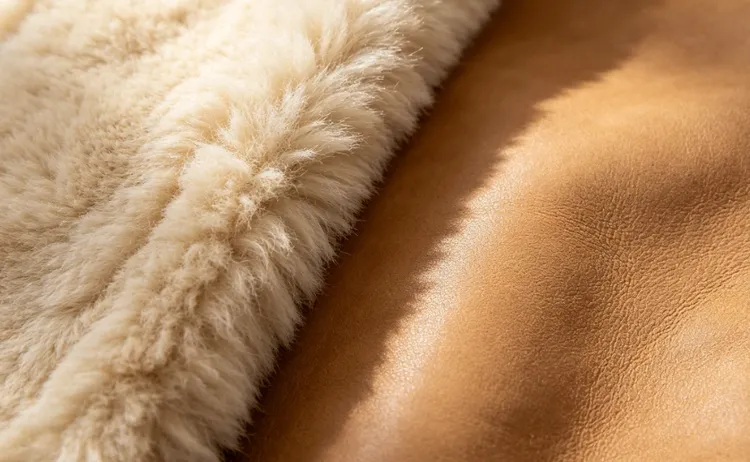
The production of sheepskin leather is a complex process that combines traditional craftsmanship with modern chemistry. A rough raw hide needs to undergo both physical and chemical treatments before it can be transformed into the soft and durable leather we hold in our hands.
The main purpose of this stage is to clean the raw skin and remove unnecessary parts, preparing it for the subsequent chemical treatment.
| Key Step | Main Operation & Purpose |
| Soaking | Soak the hide in a rotating drum to wash off dirt, salt, and blood. |
| Fleshing | Use a machine to scrape off residual fat and connective tissue from the flesh side, ensuring even chemical penetration. |
| Liming & Unhairing | Soak in lime and sulfides to dissolve wool and open up fiber structure, making the hide plump for tanning. |
| Deliming & Bating | Neutralize residual lime and use proteolytic enzymes to further loosen fibers, increasing softness and fullness. |
| Degreasing | A critical step for sheepskin – use strong degreasers to remove high fat content; otherwise the leather may smell and have poor performance. |
| Pickling | Soak in an acidic solution to clean further and swell the hide, readying it to absorb tanning agents. |
Tanning is the core chemical process that converts the easily rotting raw skin into stable and durable leather through the combination of chemical substances.
Chrome Tanning: Using chromium salts as the tanning agent is the most common method nowadays. Its main feature is efficient process, allowing for large-scale production and relatively low cost. The leather produced through chrome tanning is extremely soft, elastic, and has a blue-white color (also known as “blue wet leather”), making it ideal for making clothing, gloves, and handbags and other soft leather goods. However, its main drawback is that the chromium-containing wastewater produced during the chrome tanning process, if not properly treated, may cause environmental pollution.
Vegetable Tanning: Using plant tannins (such as extracts from tree bark, fruits, etc.) for tanning. This is an ancient process that is slow and may take several weeks. The leather produced by vegetable tanning is environmentally friendly, odorless, free of harmful metals, and has a solid, resilient texture with a unique retro feel that develops a charming luster over time. However, it is less absorbent of chemical dyes than chrome tanned leather, so the coloring is not as vibrant.
Other Tanning Methods: For environmental and health reasons, the industry is also exploring other solutions. For example, using metal tanning agents such as aluminum, zirconium, titanium, synthetic tanning agents, or aldehyde tanning agents.
The leather that has undergone tanning already possesses basic properties, but further processing is necessary to achieve its final color, texture and appearance.
| Key Step | Main Operation & Purpose |
| Retanning | Apply a secondary tanning to improve fullness, softness, and physical properties. |
| Fatliquoring | Introduce natural or synthetic oils into the leather fibers to keep them soft and supple, and increase tensile strength and tear resistance. |
| Dyeing | Penetrate dye into the leather fibers in a water bath to give vibrant, even color. |
| Drying | Remove moisture to set the leather. Common methods include hanging, vacuum drying, etc. |
| Staking / Milling | Mechanically beat or tumble the leather to make it softer and restore natural grain. |
| Finishing (Coating) | Spray a film forming material on the surface to unify color, cover defects, improve water resistance, and protect the leather. |
The overall durability of sheepskin leather is rated as moderately low. It is not as sturdy and durable as cowhide or goatskin, but it is better than the extremely delicate lambskin.
| Factor | Impact |
| Thin hide | Less material to resist abrasion and tearing |
| Loose fiber structure | Stretches and softens with stress; can lose shape |
| Softness priority | The same qualities that make it comfortable reduce its toughness |
| Lightweight | Good for comfort, but means less substance for protection |
| Factor | Rating | Detail |
| Tear Resistance | ❌ Weak | Very thin (0.5–1.0mm), prone to tearing and stretching |
| Abrasion / Scratch Resistance | ❌ Poor | Easily scuffed; doesn’t hide scratches well |
| Water Resistance | ❌ Poor | Absorbs moisture; stains and deforms when wet |
| Structural Strength | ❌ Weak | Too soft to hold shape; not good for bags or heavy use |
| Lifespan (with care) | ✅ 10–30 years | High-quality sheepskin jackets can last 15–30+ years |
| Lifespan (daily abuse) | ❌ 2–5 years | Without careful maintenance, it wears out fast |
| Leather | Durability | Softness | Best For |
| Cowhide | ⭐⭐⭐⭐⭐ | ⭐⭐⭐ | Daily work shoes, heavy bags |
| Goatskin | ⭐⭐⭐⭐ | ⭐⭐⭐⭐ | Best all-rounder for bags ✅ |
| Sheepskin | ⭐⭐ | ⭐⭐⭐⭐⭐ | Jackets, gloves, boots (UGG), linings |
| Lambskin | ⭐ | ⭐⭐⭐⭐⭐ | Dress shoes, luxury gloves |
| Source | What They Say |
| Billy Tannery | “Sheep leather strikes a balance between goat and lamb — moderately flexible, but less durable than goat” |
| Zhihu (2024) | “Sheepskin has thin epidermis, poor abrasion resistance, easy to damage. Unless you’re a rich lady who barely wears them, choose cowhide” |
| Xiaohongshu (2023) | “Sheepskin shoes are much softer than cowhide, but lifespan is shorter. Cowhide is tough; sheepskin is fragile” |
| Amrika Leather | “With proper maintenance, sheepskin is resilient and long-lasting” — but admits it’s less durable than other leathers |
| Sheepskin Jacket Data | Average lifespan: 15 years minimum, up to 30+ years for premium quality |
| Condition | Result |
| ✅ High-quality full-grain sheepskin | Can last 15–30 years (e.g., sheepskin bomber jackets) |
| ✅ Proper care (conditioner, protect from water) | Lasts much longer |
| ✅ Low-impact use (jackets, gloves, linings) | Very durable in its intended role |
| ❌ Daily heavy use (bags, work shoes) | Will fail quickly — tears, stretches, stains |
| ❌ Rain / wet conditions | Destroyed — absorbs water, stains permanently |
| Reason | Explanation |
| Thinnest hide | Only 0.5–1.0mm (vs. cowhide 1.2–1.8mm) |
| Loose collagen fibers | Naturally soft = naturally weak |
| High porosity | Absorbs moisture, dirt, and stains easily |
| No structural rigidity | Can’t hold shape under stress |
| Wool side | Wool fibers can mat, shed, and degrade over time |
The price of sheepskin leather falls in the mid-range category and is often regarded as a choice that combines high quality with high value for money. Its price is usually higher than that of economical leathers like cowhide, but much lower than that of luxurious leathers such as lambskin. This pricing strategy well reflects its unique balance between comfort and durability.
If you see a sheepskin leather bag priced high in a luxury store, the main reason is:
Raw Materials: In the leather trading market, sheepskin/lambskin is usually cheaper than cowhide. For instance, in certain regions, the price of raw sheepskin is only 1/3 to 1/2 that of cowhide. This is because cowhide has a larger area and stronger fibers, with higher industrial utilization rate.
Finished Products: Once transformed into luxury handbags or sheepskin coats, sheepskin tends to be more expensive than ordinary cowhide. This is because sheepskin has high processing losses (thin surface, many flaws), and the brand positions it as a high-end series with “soft touch” characteristics.
Cheapest → Most Expensive:
Synthetic leather < Ordinary cowhide < Goatskin < Sheepskin < Lambskin
| Leather Type | Price Trend | Comfort | Durability | One-line summary |
| Cowhide | Affordable | Stiffer, needs break-in | Very high | Tough, economical workhorse |
| Sheepskin | Mid-range | Soft, skin-friendly, no break-in | Low-medium, needs care | Soft and comfortable “high-performance” choice |
| Goatskin | Good value (often cheaper than sheepskin) | Supple, unique pebbled grain | High | Supple yet tough all-rounder |
| Lambskin | Expensive | Extremely soft, luxurious | Very low, extremely delicate | Luxurious “jewel” to be treasured |
| Product | Price | Material |
| Sheepskin leather gloves (Zavelio) | 79–129 | Premium shearling |
| Wholesale sheepskin gloves (Alibaba) | 15–26 / pair (100+ pcs) | Double face sheepskin |
| Kids sheepskin snow boots (Made-in-China) | 12–18 / pair (100+ pcs) | Sheepskin collar |
| Sheepskin hiking shoes (BLT) | 13–15 / pair | Sheepskin leather |
| Sheepskin hide (Distant Drums, 7.5 sq.ft) | 35–40 | Full grain chocolate |
| Sheepskin full grain black (wholesale) | 11–30 / hide (~8 sq.ft) | Dyed black |
| Sheepskin bag (Taobao 2026) | 40–73 | Genuine sheepskin |
The final price of sheepskin is affected by the flexible combination of the following elements:
| Rank | Leather Type | Typical Bag Price Range | Key Notes |
| 1
(Most Expensive) |
Shearling / Sheepskin w/ Fur | 500-6,500+ | The “ultimate” luxury — leather + wool/fur attached. James Begg sheepskin bags: ~
480-6,500+ (designer). Unmatched softness & warmth, but fragile. |
| 2 | Exotic Skins (Crocodile, Alligator, Ostrich, Python) | 800-15,000+ | Hermès Birkin (croc/ostrich):
15K–50K+. Even “croco-print” Italian leather bags hit 850–1,350 (Maxwell-Scott). Rarity = premium. |
| 3 | Premium Calfskin (Full-Grain, Veg-Tan, Italian/Spanish) | 300-1,500 | Polène:
300–500 (full-grain Spanish calfskin); Mansur Gavriel: 500–900 (veg-tan Italian); Strathberry: ;∗SenreveMaestra∗: ; Leatherology: 125–375. The “sweet spot” for luxury bags — durable, develops patina. |
| 4 | Cowhide (Full-Grain / Top-Grain) | 100-600 | Portland Leather Goods: ~
59–79 (sale); Coach: $$–$$$; Cuyana: 250–600 (Italian/Turkish cowhide). Most common for totes, work bags, laptop bags. Very durable, structured. |
| 5 | Goatskin (Full-Grain / Suede) | 80-500 | Goatskin ≈ 90% of sheepskin quality at lower cost & longer life (per Lee & Sons pipe bag analysis). Polène, Strathberry also use goat. Excellent value — supple but tougher than sheepskin. |
| 6 | Sheepskin Skin-Only (Lambskin, no wool) | 100-480 | St. Moritz Sheepskin Handbag:209-299; Begg Sheepskin Bags:99–$165. Lighter & more flexible than cowhide, used for small accessories, crossbody bags, clutches. Less durable than cow/goat — stretches over time. |
| 7 | Pigskin (Head-Grain / Suede) | 40-150 | Pigskin is tough but rougher (pebbled grain). Found in budget crossbody bags (€27–€40) and work bags. Least expensive “real leather” option. |
| 8 (Cheapest) | Split Leather / Bonded Leather / Faux Leather | 20-80 | Alta woven leather bag: under $100 (competes with Dragon Diffusion); budget Italian brands:€40–€93. Not genuine full-grain — peels and cracks faster. |
| Leather | Price Tier | Durability | Softness | Best For |
| Shearling (wool-on) | Luxury | ⭐⭐ | ⭐⭐⭐⭐⭐ | Statement purses, winter bags |
| Exotic (croc, ostrich) | Ultra-Luxury | ⭐⭐⭐⭐ | ⭐⭐⭐ | Evening bags, investment pieces |
| Full-Grain Calfskin | Premium | ⭐⭐⭐⭐⭐ | ⭐⭐⭐⭐ | Everyday luxury (totes, satchels) |
| Cowhide (full/top-grain) | Mid | ⭐⭐⭐⭐⭐ | ⭐⭐⭐ | Work bags, laptop bags, totes |
| Goatskin | Mid | ⭐⭐⭐⭐ | ⭐⭐⭐⭐ | Crossbody, hobo bags — best value |
| Sheepskin (skin-only) | Upper-Mid | ⭐⭐⭐ | ⭐⭐⭐⭐⭐ | Clutches, small crossbody, pouches |
| Pigskin | Budget | ⭐⭐⭐⭐ | ⭐⭐ | Casual bags, bum bags |
| Split / Faux | Cheapest | ⭐⭐ | ⭐⭐ | Trendy fast-fashion bags |
No, the leather made from sheepskin is not completely waterproof. Sheepskin is one of the types of leather that is more sensitive to water.
| Property | Sheepskin |
| Waterproof? | No – prolonged rain or soaking will penetrate |
| Water-resistant? | Yes – can handle light splashes and brief exposure |
| Natural protection | Contains lanolin (natural oil) that repels light moisture |
| Factor | Explanation |
| High porosity | Sheepskin has an open fiber structure with natural pores → water penetrates easily |
| Hydrophilic collagen | The collagen protein in sheepskin contains amino, carboxyl, and hydroxyl groups that attract water |
| Fine grain = less barrier | Thinner, softer grain means less natural resistance to moisture compared to cowhide |
| Suede variant is worse | Sheepskin suede has no protective coating at all — it soaks up water instantly |
| Damage | Severity |
| Discoloration / staining | Water dries unevenly → permanent dark spots |
| Wrinkling & warping | Fibers swell then shrink unevenly |
| Stiffening | Loses its signature buttery softness |
| Mold / mildew | Especially in humid conditions (sheepskin absorbs ~15–17% moisture — similar to wool) |
| Stretching over time | Wet-then-dry cycle weakens fiber structure |
Yes — but with trade-offs:
| Method | Waterproof? | Downside |
| DWR / fluorocarbon spray (e.g., 3M Scotchgard) | ✅ Moderate | Slightly changes hand-feel |
| Polyurethane top-coat | ✅ Good | Makes it stiff & plastic-like — kills the luxury feel |
| Wax emulsions / paraffin finish | ✅ Moderate | Can darken color, needs re-application |
| Silicone-based waterproofing | ✅ Good | Best balance of water-repellency + softness |
| Patent “waterproof sheepskin” (2025 Chinese patent) | ✅ Engineered | Multi-layer with waterproof membrane — not traditional sheepskin |
Luxury brands (Hermès, Chanel) sometimes apply a thin invisible waterproofing layer to sheepskin bags, but it’s never 100% waterproof — just water-resistant.
| Leather | Water Resistance | Why |
| Cowhide (full-grain) | ⭐⭐⭐⭐ | Dense fiber, natural oils = best natural water resistance |
| Goatskin | ⭐⭐⭐ | Tighter grain than sheepskin, moderate resistance |
| Sheepskin (skin-only) | ⭐⭐ | Porous, soft — absorbs water fast |
| Sheepskin suede | ⭐ | Almost zero — soaks instantly |
| Exotic (croc, lizard) | ⭐⭐⭐⭐⭐ | Dense scale structure = naturally very water-resistant |
| Patent leather | ⭐⭐⭐⭐⭐ | Plastic coating = fully waterproof |
Although it is impossible to achieve complete waterproofing, the following methods can enhance resistance:
| Feature | Sheep Leather | Cow Leather |
| Source | Adult sheep | Adult cow |
| Feel / Hand | Extremely soft, smooth, silky, no break-in needed | Firm at first, becomes softer with use |
| Weight | Very light – almost no burden to carry or wear | Heavy – substantial feel |
| Durability | Low to medium – scratches and wears relatively easily, edges prone to damage | Very high – abrasion-resistant, tear-resistant, very tough |
| Tear strength | Low (loose fiber structure, small tears expand easily) | Very high (tightly interwoven fibers) |
| Water resistance | Fair (limited natural oils, prone to water stains) | Fair to good (usually requires a top coating) |
| Breathability | Excellent – fine pores, comfortable against skin | Medium – thicker, less breathable than sheepskin |
| Warmth | Good (especially with wool on) | Fair |
| Appearance / Grain | Very smooth, fine grain, small uniform pores | Coarser grain, natural growth marks or embossed patterns |
| Price | Mid-range (generally more expensive than cowhide) | Affordable to mid-range (depends on grade) |
| Common uses | Fashion jackets, high-end handbags, gloves, shoe uppers, linings | Briefcases, belts, boots, furniture, durable backpacks |
| One-line summary | Made for comfort and feel – needs gentle care | Made for strength and utility – a reliable daily companion |
| Feature | Sheepskin | Cowhide |
| Softness | ⭐⭐⭐⭐⭐ Unbeatable | ⭐⭐⭐ Good after break-in |
| Durability | ⭐⭐ Fragile | ⭐⭐⭐⭐⭐ Built to last |
| Water Resistance | ⭐⭐ Poor | ⭐⭐⭐⭐ Good |
| Scratch Resistance | ⭐⭐ Shows everything | ⭐⭐⭐⭐ Hides scratches |
| Weight | Very light | Heavier |
| Shape Retention | ⭐⭐⭐ Loses shape | ⭐⭐⭐⭐⭐ Holds forever |
| Luxury Feel | ⭐⭐⭐⭐⭐ | ⭐⭐⭐⭐ |
| Price Range | 100–480 (skin-only) / 500–6,500+ (shearling) | 100–600 |
| Best For | Evening bags, clutches, occasion wear | Everyday bags, work bags, travel |
Choose sheepskin if you:
Choose cowhide leather. If you:
| Your Profile | Choose |
| Budget-conscious, want something that lasts decades | Cow Leather |
| Want luxury feel immediately, fashion-forward | Sheep Leather |
| Need rugged gear (motorcycle, outdoor work) | Cow Leather |
| Want light, elegant, everyday wear | Sheep Leather |
| Best overall value | Cow Leather (80% of quality at 50% of the price) |
| Want the absolute softest leather money can buy | Sheep Leather (Nappa / Lambskin) |
Yes, sheepskin leather is suitable for making bags, but it is better suited as a soft and fashionable material rather than for use in high-stress applications. But it depends on what you value most. Its durability is not as good as that of cowhide or goathide, but its softness, lightness, and luxurious feel are all excellent.
| Feature | Why It Works for Bags |
| Extremely soft & supple | Comfortable to carry, drapes beautifully – ideal for slouchy, casual styles. |
| Very lightweight | Adds minimal weight to the bag, perfect for totes and shoulder bags. |
| Breathable & skin-friendly | Natural oils make it pleasant against the body. |
| Good drape | Creates a relaxed, elegant silhouette. |
| Aesthetic | Smooth, fine grain looks premium and takes dye well. |
| Feature | Why It Can Be a Problem |
| Low durability | Easily scratched, scuffed, and worn, especially at corners and edges. |
| Poor tear strength | Loose fiber structure means a small tear can quickly enlarge. |
| Not water-resistant | Water stains easily; heavy rain can damage it. |
| High maintenance | Requires regular conditioning and careful handling. |
| Shorter lifespan | With daily use, a sheepskin bag may last 3–5 years – much less than cowhide (10–30 years). |
| Leather | Softness | Durability | Best for |
| Sheepskin | Very soft | Medium-Low | Fashion-forward, soft bags (occasional use) |
| Goatskin | Soft & supple | High | Everyday premium bags |
| Cowhide | Firm to medium | Very high | Structured, heavy-duty bags |
| Lambskin | Extremely soft | Very low | Luxury evening bags |
| Bag Type | Sheepskin Rating | Why |
| Clutch / Evening bag | ⭐⭐⭐⭐⭐ ✅ Perfect | Low abrasion, high elegance — this is where sheepskin shines |
| Crossbody / Small shoulder | ⭐⭐⭐⭐ ✅ Great | Light, soft, doesn’t get beat up much |
| Tote (structured) | ⭐⭐⭐ ⚠️ Okay | Works if lined & structured (e.g., The Row Terrace) |
| Work bag / Laptop bag | ⭐⭐ ❌ Bad idea | Too much friction, weight, and abuse |
| Backpack | ⭐ ❌ No | Sheepskin will be destroyed in weeks |
| Woven / Braided bag | ⭐⭐⭐⭐ ✅ Surprisingly good | Weaving adds structure — a 2025 trend that solves the “too soft” problem |
| Bag | Material | Price |
| Longchamp Le Pliage Cuir (lambskin) | Sheepskin | ~$400–500 |
| The Row Terrace Tote | Full sheepskin | ~$2,000+ |
| Chanel Classic Flap (lambskin) | Sheepskin | $8,000+ |
| Polène Numéro One | Cowhide/Goatskin | $300–500 |
| Coach Tabby | Sheepskin | $300–450 |
| 1688 wholesale sheepskin bag (China) | Sheepskin | ~$10–55 |
| Custom veg-tan sheepskin tote | Plant-tanned sheepskin | ~$88 |
Sheepskin leather is the “White Rich Beauty” of the leather industry – with an unparalleled level of appearance, but it requires meticulous care and is not suitable for rough daily use. It sacrifices some durability in exchange for top-notch comfort and elegant temperament.
The advantages of sheepskin leather lie in its superior texture, lightness, and comfortable feel, making it ideal for those who pursue a soft and luxurious style. Sheepskin leather is an ideal material for making evening bags and clutches, providing bags with unparalleled skin-like experience and high-level drape.
If you are creating your own luxury bag brand, please feel free to contact us at any time to work together for your brand.



Mobile Website

Inquires Whatsapp