- +86 (0) 20-86655668
- info@gionar.com

English


English
July 29 , 2026
What is the standard backpack size? Generally speaking, the most common standard size is a 30-liter backpack, which strikes a balance between capacity and portability. It is suitable for both all-day school use and short overnight trips, and can accommodate a 15.6-inch laptop.
The capacity of backpacks ranges from 10L to 50L+. The size of the backpack determines its purpose. Different people will choose different sizes based on their needs.
The selection of backpack size should take into account four factors: the usage scenario, the items to carry, the body fit, and external restrictions.
This post will explore the size of backpacks. If you are considering customizing backpacks collection, you can learn about the knowledge of backpack sizes in detail.
There is no uniform “standard” size for backpacks. It mainly depends on your purpose (going to school, commuting, traveling, or hiking).
For daily use, the core size of a standard backpack is typically 25-30 liters. The regular external dimensions are approximately 18-20 inches (height) × 12-14 inches (width) × 6-8 inches (depth), suitable for most daily scenarios such as commuting and light school trips. It can easily accommodate a 13-inch laptop, A4 files, and small personal items, and won’t appear bulky.
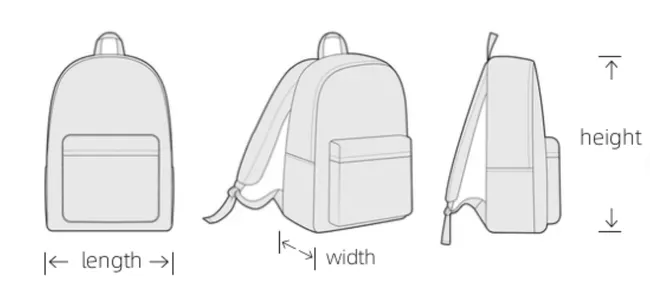
The size of a backpack is defined by its capacity (in liters) and its external physical dimensions (height × width × depth, in centimeters/inches). Although there is no unified single standard, a medium-capacity daypack of 20–30 liters is widely recognized globally as the mainstream standard backpack for daily commuting, office work, high school/college students, and daily urban travel.
| Use | Capacity | Typical Dimensions |
| Small daypack | 10–20 L | ~16–18 × 10–12 × 5–7 in (40–46 × 25–30 × 13–18 cm) |
| Everyday/school backpack | 20–30 L (most common) | ~18 × 12 × 6 in (46 × 30 × 15 cm) |
| Carry-on travel backpack | 30–40 L | ~20 × 14 × 8 in (51 × 36 × 20 cm) |
| Hiking backpack | 40–70+ L | Varies based on capacity |
Global standard daily-use backpack (the most common universal size)
Capacity: 20L – 30L (25L is the core standard specification)
Typical External Dimensions
Metric: 45–50 cm (height) × 30–34 cm (width) × 16–23 cm (depth)
Imperial: 18–20 inches × 12–13.5 inches × 6–9 inches
Can accommodate 14 to 16-inch laptops, textbooks, lunch boxes, water bottles, lightweight jackets and daily small items. This size strikes a balance between portability and storage space, is not overly bulky, is suitable for use in subways, offices or campuses, and complies with most airline luggage check-in restrictions.
Target users: College students, office workers, daily commuters, and short-distance city travelers.
It is divided into two mainstream standard models:
Dimensions: 70–76 cm × 40–45 cm × 28–32 cm Suitable for standard outdoor equipment for 2–4-day hiking, equipped with frame plates and waist support belts, used for storing camping supplies.
(5) Expedition Large-Capacity Backpack (Over 65 Liters)
According to the health standards for student schoolbags as stipulated by the Chinese national standards, matching by height is as follows:
The size of the laptop compartment inside the standard backpack is uniformly set according to the screen size of the laptop:
The biggest pitfall when buying backpacks (especially hiking ones) is choosing based on height:
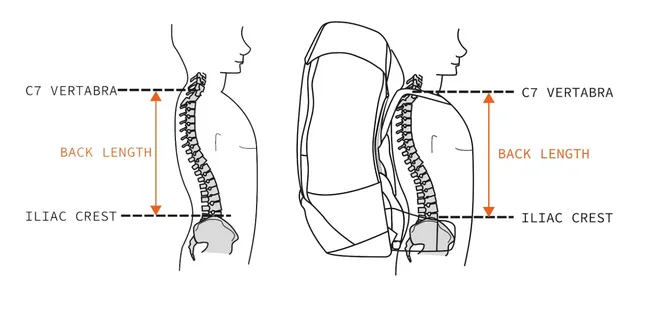
Torso (back length) = The length from the C7 cervical vertebra to the iliac crest (the upper edge of the waist belt)
For someone who is 175cm tall, some have a torso of 18″, while others have 20″ → The feeling when wearing the same model of backpack can vary greatly
Daily commuting models (20–30L) usually have adjustable chest straps and shoulder straps, and a torso length of 16–20″ will fit all; but for 30L+ hiking models, you must mark S/M/L according to the torso length; otherwise, the weight will be borne entirely on the shoulders without reaching the hips.
| Factor | Guidance |
| Torso length | More important than overall height; measure from base of neck to top of hip bones |
| Hip belt position | Should sit on top of hip bones, not waist |
| Load distribution | Heavier items close to back and centered |
| Airline limits | Most carry-on max: 22 x 14 x 9 inches (56 x 36 x 23 cm) |
Measuring the size of a backpack mainly involves two core aspects: capacity (volume, measured in liters) and external dimensions (height, width, and depth, measured in inches or centimeters). The following describes the measurement methods.
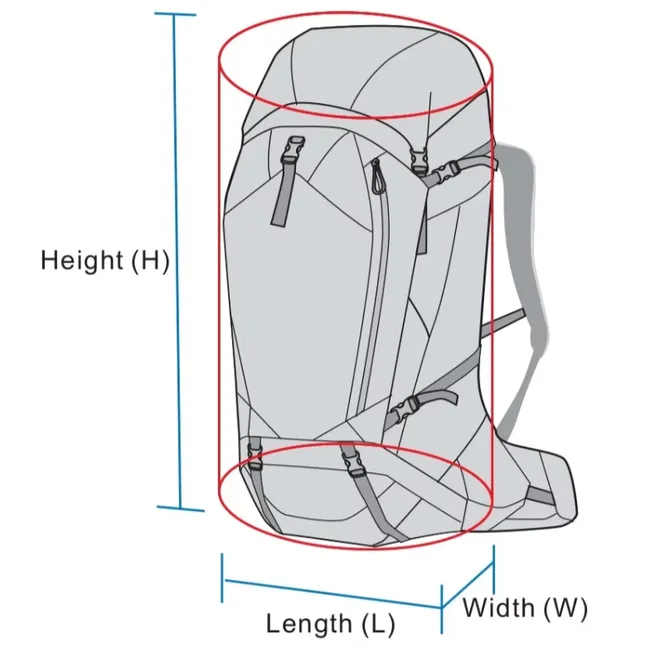
This is the key data for determining whether the backpack can be used as carry-on luggage or placed in the designated storage compartment.
You need to prepare: a soft tape measure or a flexible ruler. Empty the backpack and place it naturally.
Measurement steps:
Capacity is the core indicator for measuring the carrying capacity of a backpack. There are several methods to obtain or estimate this value.
Check the official specifications (the most direct method): This is the most accurate and effortless way. You can find it on the tag of the backpack, the product label, or the product details page of the brand’s official website. It usually clearly states “Capacity: XX L”.
Use the “filling box” method to measure (the most precise physical method): This is an industry standard measurement method, although the operation is slightly more complex, but the result is the most accurate.
Prepare a large box with known internal dimensions (for example, 1 cubic foot = 28.3168 liters).
Fill the box with small balls, beans, or specially made small filling particles (such as table tennis balls).
Pour the filled particles into the backpack until it is full (until the zipper can be closed).
Calculate the proportion of the particles filled into the backpack to the volume of the box, and you can obtain the capacity. For example, if it exactly fills a 1 cubic foot box, the backpack capacity is approximately 28 liters.
Measure the dimensions to estimate (the estimation method): If you don’t have official data at hand, you can make a rough estimate by measuring the external dimensions.
Formula: Capacity (liters) ≈ Length (cm) × Width (cm) × Height (cm) ÷ 1000
Note: This method estimates the external space of the backpack, ignoring the thickness of the material and internal compartments. The result will be larger. Please use it only as a reference.
The size data should match your body to ensure comfort. Here are the key steps:
Measure your torso length: This is the most important body measurement for choosing the backpack size, and it is more crucial than height.
Locate the position: Find the seventh vertebra at the base of your neck (the most prominent bone at the back of your neck when your head is lowered forward) and the iliac crest at the top of your hip bone (the upper edge of the pelvis that you can touch when you cross your hands over your hips).
Measure: Use a soft tape measure to measure the vertical distance between these two points, which is your torso length.
Compare with size chart: Based on the measured torso length, select the corresponding size from the brand’s size chart.
Luggage size reminder: If you plan to carry it on board, please double-check with the external dimensions. The standard upper limit for most airlines’ standard carry-on luggage is 22 x 14 x 9 inches (approximately 56 x 36 x 23 cm), and the size of personal items is smaller (such as 18 x 14 x 8 inches). Please follow the specific regulations of the airline you are flying with.
Different backpack sizes correspond to different needs. And different backpack sizes may seem abstract in your mind until you relate them to actual scenarios, at which point they will become clear. The following is a clear and practical comparison of 10-liter, 20-liter, 30-liter, 40-liter and 50-liter backpacks to help you choose the appropriate style based on your own needs.
| Capacity | Size Category | Typical Dimensions (H×W×D) | Best For |
| 10L | Mini / Sling | ~7″ × 5″ × 3″ (variable) | Minimalist outings, running, cycling |
| 20L | Daypack / Commuter | 18″ × 12″ × 6″ | Daily work/school, lunch, light errands |
| 30L | Large Daypack / Weekend | 19″ × 13″ × 8″ | 1–2 day trips, gym, short business travel |
| 40L | Travel / Carry-on | 22″ × 14″ × 9″ | Multi-day travel, fits most airline carry-on limits |
| 50L | Expedition / Large | 24″ × 15″ × 11″ | Long treks, camping, moving abroad |
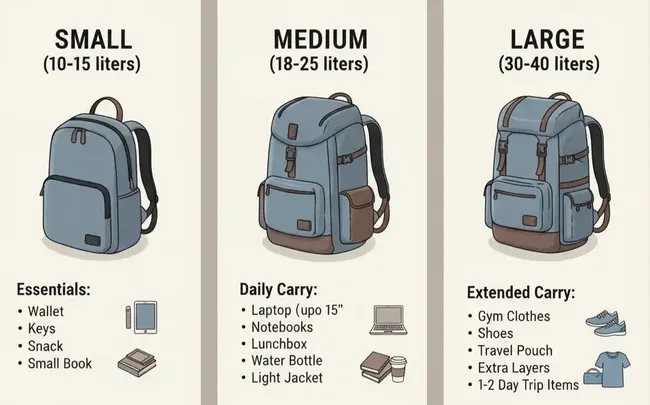
| Aspect | Detail |
| Dimensions | ~15 × 9 × 5 inches (38 × 23 × 13 cm) |
| Best for | Minimal daily carry, cycling, running errands |
| Fits | Wallet, phone, keys, small water bottle, light jacket, tablet (small) |
| Does not fit | Laptop (most), books, extra clothing |
| Who it’s for | Urban commuters who travel light; cyclists; festival-goers |
| Aspect | Detail |
| Dimensions | ~17–18 × 11–12 × 6–7 inches (43–46 × 28–30 × 15–18 cm) |
| Best for | Everyday use, school, light work commute, day trips |
| Fits | 13–15-inch laptop, 1–2 books, water bottle, jacket, lunch, small accessories |
| Does not fit | Multiple textbooks, overnight gear, bulkier items |
| Who it’s for | Students, office commuters, casual day hikers, city travelers |
| Aspect | Detail |
| Dimensions | ~19–20 × 13 × 8–9 inches (48–51 × 33 × 20–23 cm) |
| Best for | Heavy school or work loads, overnight trips, light travel, gym |
| Fits | 15–17-inch laptop, multiple books, change of clothes, shoes, toiletries, light jacket |
| Does not fit | Sleeping bag, camping gear, extended travel wardrobe |
| Who it’s for | Graduate students, business travelers (1 night), gym-goers, photographers with compact kit |
| Aspect | Detail |
| Dimensions | ~21–22 × 14 × 10–11 inches (53–56 × 36 × 25–28 cm) |
| Best for | Weekend travel, carry-on compliance, overnight hiking, digital nomad work |
| Fits | 2–3 days of clothing, laptop, toiletries, shoes, light jacket, travel essentials |
| Does not fit | Multi-day camping gear; pushes carry-on limits when fully packed |
| Who it’s for | Weekend travelers, minimalist backpackers, remote workers, light campers |
| Aspect | Detail |
| Dimensions | ~24–26 × 15–16 × 12–13 inches (61–66 × 38–41 × 30–33 cm) |
| Best for | Multi-day hiking, extended travel (checked bag), camping, backpacking |
| Fits | 4–7 days of clothing, sleeping bag (strapped externally), camping gear, food, extensive equipment |
| Does not fit | Airline carry-on limits; must be checked |
| Usage Scenario | Recommended Capacity | Key Rationale |
| Urban Commuting | 10–15L | Lightweight and shoulder-friendly; avoids security check delays. Guangzhou subway handrail gaps are only 34cm wide, so a narrow bag fits better. |
| Day Hiking | 20–25L | Balanced load and weight. The Decathlon MH500 (22L) can carry water, a raincoat, and energy bars in real-world tests. |
| 2–3 Day Short Trip | 30–35L | The “golden capacity” range. The Toread 30L backpack can fit a sleeping bag, a change of clothes, and a camera. |
| Light Camping | 40L | The Makanu 40L can hold a tent, a sleeping pad, and 2-person rations, with a stable carrying system. |
| 7+ Day Heavy Trekking | 50L+ | The Tasmanian Tiger Cavalry 50L measures 61×36×31cm when fully packed, requiring a professional suspension system. |
| Capacity | Weight of a Typical Load | Best Carry-on? | Key Trade-off |
| 10L | 1–2 kg | Yes (personal item) | Very limited space |
| 20L | 3–5 kg | Yes (personal item) | Can’t carry extra layers or multiple outfits |
| 30L | 5–8 kg | Yes (but check your airline) | Heavier when full; might be bulky for daily use |
| 40L | 8–12 kg | Yes (for most airlines) | Getting heavy — comfort matters |
| 50L | 12–18 kg | No (must be checked) | Too big for urban carry; requires good hip support |
If you are a consumer and want to purchase a backpack for your own use, how should you make the choice? When choosing the size of the backpack, sometimes it depends on the purpose, and more often it depends on your Torso Length.
Core selection logic: It’s not about choosing the capacity, but about choosing “person + scenario”.
The selection of backpack size should not be based on height or age, but rather on “torso length” and “usage scenario” as the two core factors.
International authoritative standards: Brands such as Osprey, Deuter, and Arc’teryx all use “torso length” as the selection benchmark, rather than height.
When choosing a backpack, the first step is to determine how you will use this backpack. Here are the common usage situations and their recommended size ranges:
Stand upright, with your head slightly tilted forward. Locate the most prominent bone at the back of your neck – the C7 vertebra (the bulge at the bottom of your neck when you lower your head).
Use a soft measuring tape to measure from the C7 vertebra along the natural curve of your spine to the top of the iliac crest (the highest point of the hip bone, which can be felt when your hand is placed on your waist).
| Torso Length | Osprey / Deuter Size | Recommended Capacity Range | Suitable For |
| ≤ 40 cm | XS / S | 10–25L | Women (< 158 cm / 5’2″), teenagers |
| 41–48 cm | S / M | 20–40L | Asian women (158–170 cm / 5’2″–5’7″) |
| 49–56 cm | M / L | 30–55L | Men (170–185 cm / 5’7″–6’1″) |
| ≥ 57 cm | L / XL | 45–70L+ | Tall/large frames (> 185 cm / 6’1″) |
| Your Use | Recommended L | Logic |
| Urban EDC / cycling / minimal carry | 10–15L | Tablet + wallet + power bank + light jacket; might not even bring a laptop |
| Commute / campus / daily office | 20–25L (standard anchor) | 15–16″ laptop + charger + notebook + lunch + light layer |
| Weekend overnight / heavy tech load / 3-day business | 28–32L | 20L contents + 1–2 changes of clothes + shoes |
| 3–5 day travel / carry-on limit | 35–40L | 3–4 days clothing + toiletries + laptop; most airlines carry-on limit 55×40×20cm |
| Multi-day hiking / mountaineering / camping | 50–65L | Sleeping bag + tent + food/water + 5+ days clothing |
| Mistake | Why It Fails |
| Buying too large “just in case” | Empty space encourages overpacking; bag feels bulky daily |
| Ignoring torso fit | Shoulder pain and poor weight distribution |
| Prioritizing looks over function | Uncomfortable straps or lack of organization ruin daily use |
| Choosing expedition size for commuting | Overkill; you will leave it at home |
Customizing the backpack size for a brand is a systematic project that starts from market positioning and user needs, and ultimately translates into production specifications. It is much more than just choosing a number; it is a strategic decision that concerns product experience, brand image, and business success.
The starting point for customizing a backpack is not the size, but who it will be used by and for what scenario. Here are capacity references for different target markets and scenarios:
| Target Market / Use Case | Recommended Capacity | Key Rationale & Design Points |
| Children (6–12 years) | 15–20L | Lightweight design to reduce stress on developing spines; consider adding reflective strips for safety. |
| Students & Commuters | 20–30L | The “sweet spot” for daily use. Must accommodate 17-inch laptops, A4 folders, etc. For urban commuting, Asian markets prefer slim profiles around 18–22L. |
| Business Travelers | 25–35L | Ideal for professionals carrying laptops. Needs dedicated laptop compartment, cable management, and quick-access pockets. |
| Short-Trip Travelers | 30–40L | Sufficient for 3–4 day trips, typically compliant with TSA carry-on standards (22″ × 14″ × 9″). |
| Outdoor / Hiking | 40L+ | For camping and trekking, carrying tents, sleeping bags, etc. 40–50L is the fastest-growing segment. |
Just determining the capacity is not enough. The fit of the backpack directly affects the user experience.
Size is just a framework. The true customization lies in the internal structure and functional design. This part is crucial in demonstrating the brand’s profound understanding of user needs.
Precise specification: When providing specifications to the factory, both the capacity (in liters) and the external dimensions of the finished product (depth x width x height) should be specified.
Brand narrative is bound to the material, and size cannot be expanded randomly without considering the material:
Common brand pitfalls: Full leather hard version 30L → Customer complaint “shoulder pain + empty weight 2kg+” → Return rate soared. Solution is either reduce capacity to 25L or switch to plant-based/fabric structure.
| Brand Niche | Target Audience | Custom Size Specifications |
| Minimalist Urban | Young professionals (18-35) | 15L capacity, dimensions 38×25×12 cm. Slim profile with a 13-inch laptop sleeve, quick-access front pocket, and padded shoulder straps. |
| Family Camping | Parents with children (30-45) | 50L capacity, dimensions 55×35×20 cm. Expandable to 60L, with a dedicated compartment for a baby carrier, side pockets for water bottles, and a hip belt for weight distribution. |
| Children’s School | Kids (6-12 years) | 30L capacity, dimensions 40×25×15 cm. Adjustable straps, ergonomic back panel, and external reflective strips for safety. |
| Brand Position | Size 1 | Size 2 | Size 3 | Size 4 |
| Urban minimalist | 18L daypack | 24L work bag | — | — |
| Travel specialist | — | 30L carry-on | 40L one-bag | — |
| Outdoor full-range | 20L daypack | 34L overnight | 50L multi-day | 65L expedition |
| Student / value | 22L basic | 28L standard | 34L deluxe | — |
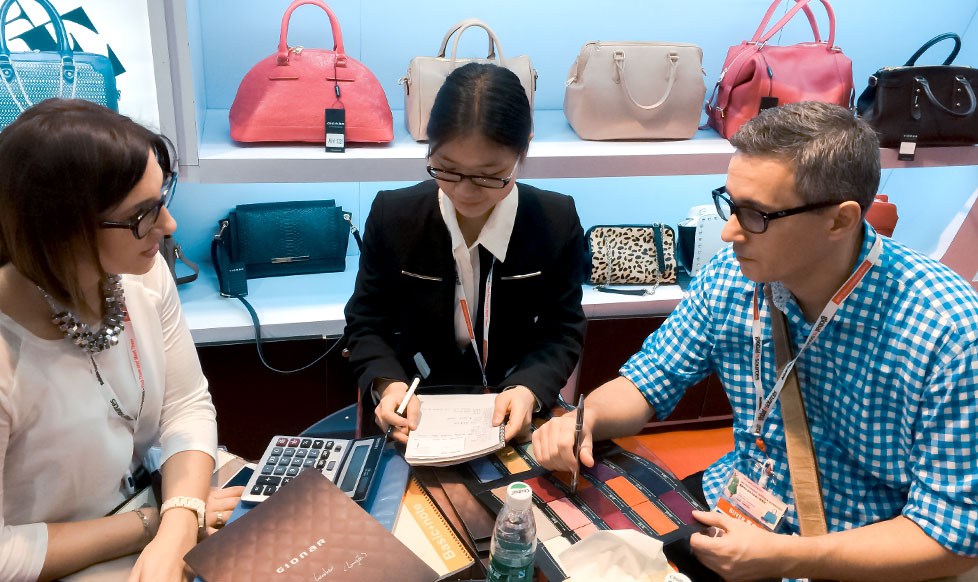
Gionar has been specializing in leather bag manufacturing since 2006. It has accumulated over 20 years of industry experience. Its headquarters is located in Baiyun District, Guangzhou, and it has a modern production base of over 10,000 square meters with more than 300 employees. It is an OEM/ODM professional manufacturer that focuses on the high-end leather product field.
The company does not target the mass market. Instead, it focuses on providing one-stop services from design, prototyping to mass production for European and American mid-to-high-end fashion and outdoor brands. Its product lines include handbags, business backpacks, travel bags, wallets and belts. With the philosophy of “Quality is the life line of the brand”, it serves customers in over 20 countries around the world.
The size of backpacks varies in many specifications. The most common standard size is a 30-liter backpack.
If you are a consumer, choosing the appropriate backpack size involves a three-dimensional decision regarding capacity (in liters), external dimensions, and body fit.
If you are an entrepreneur and are considering to custom a bulk of backpacks for your brand, first clearly identify the needs of your target users, and then choose a manufacturing partner that can balance quality, cost, and delivery time.
Gionar is a reliable partner. Please feel free to contact us.


Mobile Website

Inquires Whatsapp