Coach, as a classic American leather goods brand, positions its handbag prices in the “light luxury” or “entry-level luxury” range. It can not only meet the public’s pursuit of quality but also is not as expensive as top luxury brands.
The price differences of Coach mainly stem from the materials, the complexity of the craftsmanship and the scarcity of the design. Overall, Coach, through its multi-level pricing strategy, not only maintains the quality image of a light luxury brand and retains the exquisite leather craftsmanship, but also meets the diverse consumer demands ranging from budget-sensitive to those seeking uniqueness.
This post will explore whether Coach is a luxury brand and the prices of its various series of bags.
What is a Coach bag?
Coach is an American high-end lifestyle fashion brand founded in 1941, with its headquarters in New York. It is renowned for manufacturing high-quality leather goods and fashionable bags, positioning itself as “affordable luxury within easy reach”, and is a representative brand in the light luxury market.
Brand history and positioning
- Establishment background: Founded in New York in 1941 by Miles Cahn and his wife Lillian Cahn, it initially had only six artisans and was based on the leather craftsmanship of making baseball gloves by hand.
- Brand evolution: In 1962, the first tanned leather goods were launched. In the same year, designer Bonnie Cashin was invited to join and design the first shopping bag. In 2017, the company was renamed Tapestry, symbolizing the brand’s history and heritage.
- Market positioning: Positioned as a light luxury brand, with prices approximately one quarter of those of top luxury goods, it focuses on the concept of “luxury within easy reach”, and product pricing typically ranges from 100 to 1,000 yuan
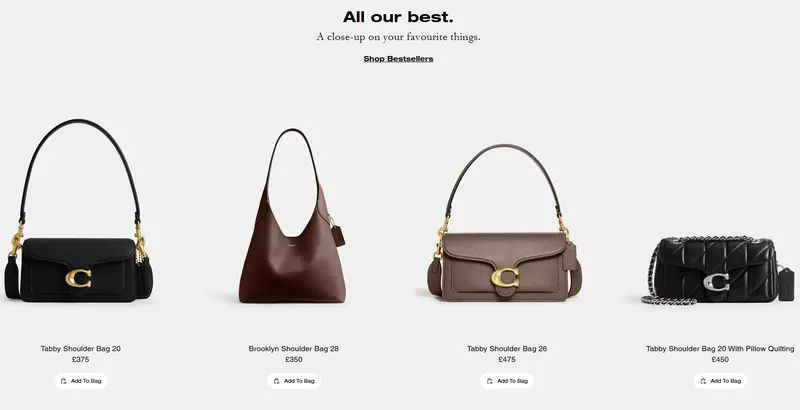
- Signature styles: Bags like Tabby (a modern “it bag” with the iconic “C” clasp) and Willis (a retro-style rotating lock design) both cater to trends and classic tastes.
- Materials: Polished leather, signature canvas, and occasional exotic finishes, balancing durability and style.
- Global appeal: It is extremely popular in North America and East Asia (such as Japan, South Korea, and China), thanks to astute marketing, celebrity collaborations, and a focus on understated elegance.
Recommendations for Popular Series
- Tote Series: A classic large-capacity Tote bag that can hold daily items such as laptops and water cups. It is suitable for office workers and students and is the brand’s best-selling series.
- Tabby series: Based on the classic bag styles of the 1970s, it features the iconic “C” -shaped metal accessory as a highlight. Available in various sizes and colors, it is versatile and practical.
- Madison Series: Classic Camellia series. The camellia lock design is the most distinctive feature. It can be worn diagonally or under the arm. The retro metal chain has a superior texture.
- The Rogue series: The 1941 collection of handbags launched in 2016 was inspired by “COACH girls who love wandering”, blending retro and innovative elements, and is deeply loved by young consumers.
- Brooklyn series: Ranked first on the Lyst list of “The World’s Most Popular Bags” in 2024, it features a minimalist triangular silhouette design and is available in two sizes, 39 and 28, suitable for various styles of wear.
Brand revival and market performance
- Youth-oriented transformation: In 2014, the brand was in a slump and was jokingly called a “grocery package”. However, through design innovation and a precise understanding of the consumption psychology of Generation Z, it successfully achieved brand revival.
- Market performance: In the third quarter of 2025, Coach achieved a revenue of 1.29 billion US dollars, representing a year-on-year growth of 13%. It ranked fifth on Lyst’s “Most Watched Brands” list, with a year-on-year increase of 332% in search volume.
- Consumer group: Acquire over 6.5 million new customers in North America in 2024, more than half of whom are Generation Z and millennials. The brand positioning has been upgraded from “Accessible Luxury” to “Expressive Luxury”.
Purchase advice
- Suitable for: Office workers, students, and stay-at-home moms who pursue both practicality and fashion. Consumers who prefer classic and versatile styles and pay attention to the durability of brands.
- Purchasing channels: It is recommended to choose the brand’s official website, official flagship store or physical counters in large shopping malls to ensure authenticity and after-sales service.
- Cost performance: Compared with top luxury brands like Louis Vuitton and Hermes, Coach offers more cost-effective options, allowing you to own quality leather goods for just over a thousand yuan.
Yes. Coach is a light luxury brand, belonging to the entry-level segment of the luxury market. It is positioned as “affordable luxury goods within easy reach“, with prices approximately one quarter of those of top luxury brands. It mainly targets middle-class consumers and is particularly favored by the younger generation.
Why is Coach a luxury brand?
Inheritance and Craftsmanship
Coach was founded in New York in 1941 as a small leather workshop and is renowned for its high-quality and durable leather products, especially its soft pebble leather handbags, which are inspired by baseball gloves.
High-quality materials
Using exquisite leather, signature coated canvas and high-quality hardware – although not always at the same level as top European houses.
Design and Innovation
Under the leadership of creative directors such as Stuart Vevers (since 2013) Coach has elevated its aesthetic through avant-garde fashion collections, catwalk shows and collaborations (such as those with Jean-Michel Basquiat’s property or Michael B. Jordan).
Global presence
It operates hundreds of independent boutiques worldwide, including in luxury shopping districts such as Fifth Avenue in New York, Ginza in Tokyo and Covente Garden in London.
Brand reputation
Regarded as a symbol of American luxury goods, it is usually associated with timeless style, practicality and modern complexity.
Coach is an accessible luxury item
Price range
Most handbags are priced between $300 and $800, significantly lower than those of ultra-luxury brands (which usually start at over $2,500).
Wider availability
Not only are they sold in flagship stores, but also in department stores (such as Nordstrom) and online – unlike exclusive brands that are restricted in sales.
Mass appeal
Target a broader audience, including young consumers and first-time buyers of luxury goods.
Manufacturing
Although designed in New York, production takes place in multiple countries (such as China, Vietnam, and India), which helps to reduce costs, unlike traditional brands that insist on “Made in France/Italy”.
Here’s how it fits in the fashion hierarchy:
| Category |
Examples |
Where Coach Fits |
| Ultra-luxury |
Hermès, Chanel, Dior |
❌ |
| Luxury |
Louis Vuitton, Gucci, Prada |
❌ |
| Modern / Affordable Luxury |
Coach, Michael Kors, Kate Spade, Tory Burch |
✅ |
| Premium / Contemporary |
Fossil, Calvin Klein |
❌ |
The difference from top luxury brands
- Price threshold: Top luxury brands (such as LV and Hermes) usually cost over $1,000 and are not frequently discounted. In contrast, Coach offers more affordable prices with larger discounts, which better aligns with the purchasing power of the general public.
- Consumer groups: Top luxury goods mainly target high-net-worth individuals (approximately the top 3% of households), while Coach focuses on the top 20% of households, with a broader consumer base.
- Product philosophy: Top luxury goods emphasize scarcity and uniqueness, while Coach pays more attention to the combination of practicality and fashion sense, and its product design is closer to the needs of daily life.
Market segmentation of fashion bags
The table below summarizes how Coach compares to other segments of the fashion market:
| Market Segment |
Representative Brands |
Price Point & Positioning |
| Ultra-Luxury |
Hermès, Chanel |
Very high price, exclusive, heritage-focused |
| Traditional Luxury |
Louis Vuitton, Gucci |
High price, strong brand heritage and global recognition |
| Accessible Luxury (Coach) |
Coach, Michael Kors, Kate Spade |
Accessible price, positioned between high-end and mass-market |
Coach bags are not expensive compared to top luxury brands, but they are relatively expensive compared to ordinary mass brands. They fall into the category of “affordable luxury goods within easy reach”, with prices usually ranging from 1/4 to 1/2 of those of top luxury brands. They are the first choice for many young people when purchasing their first luxury item in life.
In the United States, the price of Coach bags usually ranges from $150 to $1,300, and the most popular styles are priced between $300 and $600.
Coach’s market positioning
Coach’s pricing strategy is a key component of its brand image and is influenced by the following factors:
- The positioning of “affordable luxury” : Coach invented the concept of “affordable luxury” to attract consumers who desire quality and design but find brands like Chanel or Hermes out of reach. The brand’s CEO pointed out that although the prices of traditional European luxury brands have soared, Coach has maintained more affordable prices, which has made the price gap between them “unprecedented”.
- The strategic shift towards “expressive luxury” : In recent years, Coach has shifted its brand positioning from “accessible luxury” to “expressive luxury”. This focuses on personalization, unique styles and connections with young consumers. This includes slightly raising prices and reducing reliance on discount channels to enhance brand value.
- Comparison with other brands: Coach’s main competitors are all in the same “budget luxury” field, such as Michael Kors and Kate Spade. An earlier analysis pointed out that historically, the price of Coach handbags was approximately one-third that of Louis Vuitton handbags.
Analysis of Price Rationality
“Affordable luxury goods” positioning:
Miles Cahn, the founder of Coach, initially positioned it as “affordable luxury goods within easy reach“, filling the market gap between high-end luxury brands and mass-market brands.
Compared with luxury bags from big brands like Louis Vuitton and Gucci, Coach’s prices are “very affordable”, but its quality still remains at a high level.
Cost-performance advantage
- Material and craftsmanship: Coach insists on using top-grain cowhide/rare leather, which is highly scratch-resistant, finely crafted, and of superior quality for hardware accessories.
- Practicality: Coach bags are designed with a focus on practicality. For instance, the average daily cost of Laurel on 31 days is less than 0.5 US dollar, which is far lower than the cumulative expense of frequently changing cheap bags.
- Value retention: Classic styles maintain good circulation in the second-hand market. With proper maintenance, their resale price can reach 50% to 70% of the original price.
Consumer group positioning
Coach mainly targets middle-class consumers, especially professional women aged 25 to 45, who pursue fashion but pay more attention to practicality and cost-effectiveness.
Compared with top luxury goods that mainly target the top 3% of families, Coach focuses on the top 20% of families, having a broader consumer base.
Compared with other luxury brands:
Much cheaper than high-end residences in Europe:
- Gucci, Prada, Louis Vuitton: 1200-3500 +
- Chanel, Hermes: 5,000-10,000 +
Therefore, in the context of luxury goods, Coach is not expensive – it is regarded as an “affordable luxury”.
| Brand |
Category |
Price Range (Handbags) |
Production Focus |
| Hermès |
Ultra-luxury |
10,000–200,000+ |
Handmade in France |
| Goyard |
Heritage luxury |
1,500–5,000+ |
Handmade in France |
| Coach |
Accessible luxury |
300–800 |
Global (Asia, etc.) |
Real-Life Comparison:
| Item |
Price |
Notes |
| Fast-fashion bag |
$40 |
May wear out in months |
| Coach Willow Tote |
$495 |
Full leather, daily use, 5+ years |
| Gucci Marmont |
$2,980 |
Status symbol, higher prestige |
| Goyard Saint Louis |
$1,715 |
Canvas, handmade in France, ultra-discreet |
Price influencing factors
- Style and design: The prices of Coach bags vary greatly among different styles and designs. Classic and simple styles are relatively cheaper, while those with strong design sense and special materials are more expensive.
- Materials: Coach bags are usually made of high-quality leather, and the prices of different types of leather also vary. For instance, there may be a price difference between smooth leather and grain leather.
- Series and Limited Editions: Coach will launch various series and limited edition products. These products are usually more expensive because they have unique collectible value and design sense.
How much are Coach bags?
The price of Coach bags varies greatly depending on the style, size and material, generally ranging from around 300 US dollars to over 600 US dollars.
Price Breakdown by Category
Entry-Level Options ($150-300)
- Small crossbody bags (e.g., Mini Rowan, Hudson)
- Simple totes and canvas styles
- Outlet-exclusive designs
- Perfect for first-time Coach buyers
Core Collection ($300-600)
- Best-selling styles like the Tabby Shoulder Bag ($395-550)
- Brooklyn Shoulder Bag ($295-350)
- Medium-sized totes and satchels
- Signature canvas with leather trim options
Premium Collection ($600-1,000+)
- Empire Carryall (large sizes, $795-1,200)
- Special collaborations
- Exotic leather finishes (snake, crocodile embossing)
- Limited edition designs
The price range of Coach bags
- The price of entry-level bags (especially direct sales series or small sizes) ranges from 100 to 300 US dollars.
- Mid-range retail models (leather handbags, signature styles) are usually around $300 to $600.
- High-end, limited edition or special material bags can cost over 600 US dollars, and some even reach four figures.
- The prices in direct-sale stores usually have significant discounts: some models in direct-sale stores are under $200, and even lower during promotional periods.
The influence of materials on prices
| Material |
Price Impact |
Examples |
| Signature Canvas |
Base price |
Most affordable option |
| Smooth Calf Leather |
+10-20% |
Elevated everyday look |
| Quilted Leather |
+20-30% |
Tabby quilted styles |
| Pebbled Leather |
+15-25% |
Classic Coach texture |
| Exotic Finishes |
+50-200% |
Limited availability, premium feel |
Popular Styles & Price Examples
| Bag Model |
Price |
Key Details |
| Brooklyn 39 Tote |
~NT$21,800 (≈$675) |
Largest size, fits 15″ laptop |
| Brooklyn 34 Tote |
~NT$17,800 (≈$550) |
Medium size, versatile for commutes |
| Brooklyn 28 Hobo |
~NT$13,800 (≈$425) |
For petites (155-160cm height), fits tablet |
| Brooklyn 23 |
~NT$11,800 (≈$365) |
Smallest, compact for essentials |
| Cassie Crossbody |
~SAR 1,095 (≈$290) |
Multi-style crossbody bag |
| Quilted Tabby 20 |
$315 (Sale Price) |
Classic style with crystal rivets |
| Bleeker Bucket Bag |
$450 |
Suede material, fits a 13″ laptop |
What should be remembered
- Currency and regional issues: In some cases, the above prices are calculated in euros (Europe) or US dollars. Therefore, local prices in the Netherlands/EU may vary due to taxes, duties, and exchange rates.
- Material and size: Larger bags, high-quality leather or special finishes are more expensive. As a source pointed out: “Bags made of high-quality leather or with unique decorations…” It is usually more expensive.”
- Collection and exclusivity: Limited editions or works in collaboration with designers are more expensive.
- Outlet vs Standard retail: Outlet models typically use older collections, simpler materials or discounts. This is why you will see that the prices in the outlet list are significantly lower.
- Sales and discounts: Many retailers, especially those through direct sales channels or during promotional events, offer significant discounts. So the “typical” retail price and the “selling” price may be quite different.
Official vs. Outlet Prices
| Channel |
Discount Range |
Example |
| Official Stores |
0-30% (occasional sales) |
Tabby 26: $450 retail |
| Outlet Stores |
40-70% off retail |
Same Tabby 26: $179-249 at outlet |
| Seasonal Sales |
Up to 50% additional |
Major holidays (Black Friday, Chinese New Year) |
Why is Coach outlet so cheap?
The goods at Coach Outlets are cheaper, mainly because they are usually specially made for outlet stores, using different materials and structures, rather than being overstocked or out-of-season items from mainline stores. This enables Coach to offer lower prices while protecting the brand image of its full-price range.
Analysis of the Core Reasons why Coach outlet is cheap
-
Differences in product origin and positioning
- Out-of-season inventory and out-of-stock items: Coach Outlet mainly sells out-of-season, off-shelf, out-of-stock items and other discounted items. These items are no longer within the current season’s sales cycle. The brand needs to clear the inventory through discount channels to recover funds.
- Exclusive outlet production line: Coach has a dedicated outlet production line, which is “two different designs and production lines” from the products in the counters. Outlet styles are not simply discounted sales of counter items, but rather different designs and production specifically for discount channels, with a inherently lower cost structure.
- The material difference of the products: The outlet models mostly use PVC-coated canvas (embossed) and ordinary cowhide as materials, while the counter models choose the expensive top-quality first-grain cowhide, resulting in a significant cost difference.
-
Advantage in operating costs
- Geographical location advantage: Outlet malls are usually located in areas far from the city center, with relatively low rent and operating costs. This savings can be translated into a price advantage.
- Lower channel costs: In Outlets, the comprehensive commission that brand stores need to bear is 18%-20%, while in urban commercial plazas, it is as high as 25%-30%, reducing the overall operating costs.
- Advantages of bulk purchasing: Outlet stores have long-term cooperative relationships with brand manufacturers, enabling them to purchase goods in bulk at lower prices and create a scale effect.
-
Market strategy considerations
- The difference in customer group positioning: Coach Outlet mainly targets married professional women over 45 years old. They have higher requirements for cost performance and practicality rather than pursuing the latest fashion trends.
- Brand value protection: Coach has avoided the problem of “discounts damaging brand image” by strictly distinguishing discounted items from those in its counters, while its counters still maintain a high-end positioning.
- Inventory management strategy: Coach regards outlet stores as an important channel for inventory digestion rather than simply reducing prices. It achieves a balance between inventory and brand image through specially designed outlet product lines.
The essential difference between outlet style and counter style
Design and Production
- Counter: Showcases the brand’s latest and proudest designs and quality. All the runway items come from the counter
- Outlet: Self-designed, most styles are different from those in the counter, pursuing practicality and cost performance
Product identification
- Counter: Usually has a horse-drawn carriage image logo
- Outlet: The styles mostly use the word “Coach” rather than the logo of a carriage
Packaging and Service
- Counter: Complete packaging and professional sales consulting services are provided
- Outlet: The packaging is relatively simple and the service is relatively simplified
Coach main line VS Coach outlet
| Feature |
Coach Main Line (Full-Price) |
Coach Outlet |
| Product Source |
Designed and produced for regular retail stores |
Specifically produced for outlet channels with different materials/construction |
| Design & Materials |
Features latest designs, often using higher-quality leathers and materials |
Often uses simpler designs and more cost-effective materials |
| Target Customer |
Fashion-focused, younger demographic |
Price-sensitive customers seeking value |
| Pricing Strategy |
Full price, with controlled promotions |
Lower initial price points |
The business strategy behind the outlet mall
Coach’s use of its own stores is a well-considered strategy, aiming to serve different customer groups without seriously damaging its brand image.
- Reaching out to different customers: Coach’s market research has found that its boutique customers and outlet customers are often different groups. Main store shoppers tend to be younger and more fashion-conscious, while outlet shoppers pay more attention to value and practicality. By launching different products, Coach can attract customers from both sides at the same time.
- Double-edged sword: Although the direct-operated stores helped Coach increase its sales, this strategy also brought problems. At one point, over-reliance on direct-sale stores and discounts weakened the brand’s image of luxury. In response, Coach embarked on a major transformation, closing many direct-sale stores and significantly reducing discounts in an effort to rebuild its reputation as a satisfying luxury brand.
Quality difference summary
| Feature |
Regular Coach |
Coach Outlet |
| Leather |
Higher-grade (pebble, glove-tanned) |
Lower-cost or mixed leather |
| Hardware |
Heavy, detailed metal |
Simpler metal finish |
| Craftsmanship |
More hand-finished |
More mass-produced |
| Design |
Latest seasonal styles, exclusive collaborations |
Modified versions of classics or outlet-specific designs |
| Serial Number |
Full number, no “F” prefix |
Starts with “F” indicating factory/outlet production |
| Price range |
€300–€800 |
€100–€300 (often discounted) |
Conclusion
The price system of Coach bags shows a distinct stratified feature, with an overall positioning in the light luxury field, taking into account both quality and cost performance.
The price of basic handbags usually ranges from 100 to 400 US dollars. These products mainly feature practical designs and basic materials, making them suitable for daily use.
The mid-range models are priced between 400 and 700 US dollars. These products are mostly made of high-quality leather and incorporate the brand’s signature elements, combining both design sense and practicality.
The price of high-end and limited edition products may exceed $1,000. Such products usually use rare materials, special craftsmanship or collaborative designs and have collection value.
If you are running your own bag business and also want to customize bags of the same quality as Coach’s, please feel free to contact us.