- +86 (0) 20-86655668
- info@gionar.com

English


English
June 15 , 2026
The production locations of Bogg Bag include China, Cambodia, Vietnam, Sri Lanka, etc. Is this really the case?
Bogg Bag was born in New Jersey, USA in 2008 as a locally originated luggage brand. It was founded by Kim Vaccarella and focuses on patented EVA one-piece tote bags. With features such as water resistance, dirt resistance, washability, and hard shape retention, it has become a popular beach and daily commuting bag in Europe and America, with annual revenue reaching hundreds of millions of dollars.
The design, brand headquarters, and quality control team of Bogg Bag are all located in New Jersey, USA. The core research and development, patent development, and product design of the brand are all completed in the USA, while large-scale production is transferred to various parts of Asia through an updated supply chain.
This post explores where Bogg Bags are manufactured.
Bogg Bags are usually designed by an American company but manufactured in China. The brand was founded by Kimberly Vaccarella in New Jersey, with its headquarters located there. However, the production is outsourced to manufacturing factories in China.
Regarding the production location of Bogg Bags, they are mainly produced in contract factories in China. Currently, the company is strategically transferring some of its production capacity to Vietnam.
| Detail | Info |
| Brand origin | United States |
| Manufacturing | USA, China, Vietnam, Cambodia, Sri Lanka |
| Material | EVA foam (same family as Crocs) |
| Official site | boggbag.com |
Early stage (approximately 2008 – 2015): The founder conducted early design and prototyping in a garage in New Jersey.
In addition, to support the rapid growth of the business, Bogg Bag established a large warehouse of 150,000 square feet in Sayokes, New Jersey, USA. It is responsible for receiving products shipped from overseas and delivering them to retailers and consumers across the United States.
Due to changes in the supply chain, the origin of each specific product may vary. The most accurate method is to directly check the product label.
In summary, the innovation and design of Bogg Bag originated in the United States, while the manufacturing process has undergone a global evolution from “solely produced in China” to “increasingly collaborative efforts between China and the US”. If you are particularly concerned about the origin, it is recommended that you directly check the label information of the specific product when making a purchase.
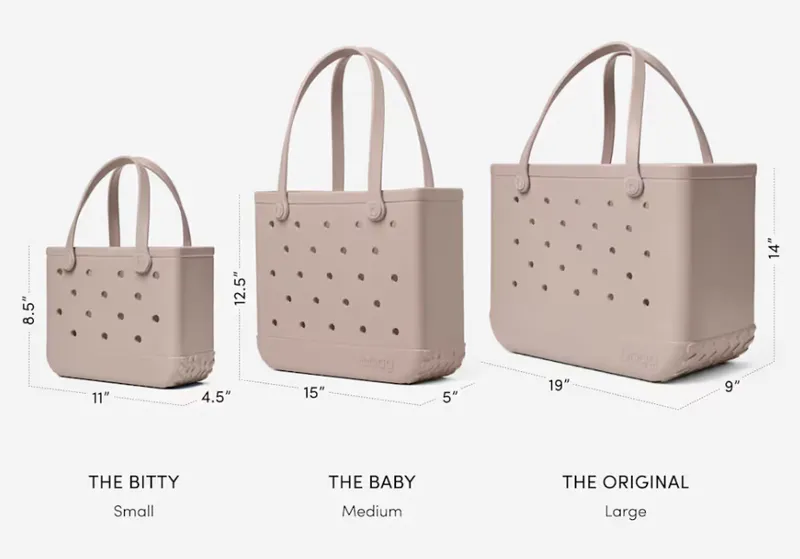
Yes, most of Bogg Bag’s products were once manufactured in China. However, in response to the uncertainties brought about by the recent tariff policies, the brand is gradually shifting its production lines to diversified locations such as Vietnam, Sri Lanka, and even the United States. This means that the origin of the Bogg Bag you purchase mainly depends on the production batch of the product.
| Phase | Primary Production Location | Current Status & Explanation |
| Past & Present | China | Manufacturing core. Leveraging China‘s mature supply chain and technical expertise, China has long been Bogg Bag’s main production country. Chinese customs data shows frequent cooperation with a Chinese supplier named “Divine Pursuit Company Limited”. |
| Ongoing rollout | Vietnam & Sri Lanka | New manufacturing hubs. To mitigate tariff pressures, Bogg has started production in both countries. The founder has stated that samples from the new factories have been approved and production began gradually in early 2025. |
| Long-term plan | United States | Possible future location. While diversifying to other Asian countries, the founder also revealed that the brand is considering moving some production back to the US to further reduce reliance on overseas supply chains. |
Core Technology: The core material of Bogg Bag is ethylene-vinyl acetate (EVA) foam, a lightweight, durable, and washable material. China is not only a major global producer of EVA, but also possesses profound polymer processing technology, especially in the injection molding process of EVA foam, where it has accumulated rich expertise and experience. This is crucial for ensuring product quality.
Complete supply chain: In the Pearl River Delta (Guangzhou, Dongguan), Fujian and Jiangsu regions, clusters of industries have been formed. For instance, the Shiling Town in Huadu District of Guangzhou is a globally renowned production base for leather bags and cases. Within a 50-kilometer radius of these areas, a complete set of suppliers ranging from EVA raw materials, mold design, injection molding production to hardware zippers and packaging logistics have gathered. The high-level integration of the supply chain has brought about:
The Critical Step from 0 to 1: The founder’s initial entrepreneurial idea repeatedly encountered setbacks in the United States. It was through an introduction from a neighbor that she was able to contact a manufacturing factory in China. This seemingly accidental overseas trial run became a crucial turning point that enabled Bogg Bag to come true and be launched onto the market.
| Factor | Explanation |
| EVA foam dominance | China produces the vast majority of the world’s EVA foam — the exact same material used in Crocs. The raw material supply chain is already there. |
| Cost | Labor and material costs in China are a fraction of what they’d be in the US. A bag that retails for 35–45 barely survives margin-wise if made domestically. |
| Scale & speed | Chinese factories can churn out millions of units fast. When Bogg Bag exploded in popularity (especially 2020–2023), only Chinese manufacturers could keep up with demand. |
| Established infrastructure | Decades of shoe/foam manufacturing in Guangdong and Fujian means the tooling, molds, and expertise already exist. No need to build from scratch. |
| The “American brand, Chinese factory” model | This is standard for most US consumer goods — design and IP stay in the US, manufacturing goes where it’s cheapest. By 2009, ~60% of international brands were already manufacturing in China. |
Currently, the Bogg Bags available on the market are mainly produced in China, not in the United States. However, the brand is actively promoting the diversification of its supply chain. In the future, there are indeed plans to shift some production to the United States, and it is also moving to Vietnam and Sri Lanka.
Nevertheless, on some e-commerce platforms such as Amazon, there are still descriptions of “Made in the USA” products. This is likely an error that has not been updated in time.
| Details | |
| Brand origin | 100% American — Twenty-Six Designs, LLC, founded 2012 in Florida by Kim Vaccarella |
| Bag manufacturing | China (EVA foam molding), with some production now in Vietnam and Cambodia |
| Material sourcing | EVA foam — overwhelmingly from China, same supply chain as Crocs |
| Assembly location | Historically Guangdong/Fujian, China; shifted partially to Cambodia & Vietnam in April 2025, then rushed back to China in May 2025 to beat new tariffs |
| What IS made in USA | A few small accessories (e.g., the Boglets wallet clip is labeled “Made in USA”) |
Although most Bogg Bags are currently manufactured in China, Cambodia, and Vietnam, a small number of products are produced in the United States for:
The product labels or packaging of these American-made bag products all bear the “Made in USA” (Made in the United States) label.
Yes, some Bogg Bags are manufactured in Cambodia. And many people also believe that Bogg Bags are not produced in Cambodia.
| When | What happened |
| ~2016–April 2025 | Made almost entirely in China |
| Apr-25 | CEO Kim Vaccarella moved production to Cambodia & Vietnam to dodge tariffs |
| May-25 | She reversed — rushed China-made bags into US warehouses before August tariffs hit |
| June 2026 (now) | Production split: China (majority) + Vietnam + Cambodia |
By the beginning of 2025, due to the United States imposing a 145% tariff on Chinese imported goods, Bogg Bags had shifted part of its production to Cambodia and Vietnam.
Currently, Cambodia accounts for a significant portion of Bogg Bags’ output, while the rest is handled by Vietnam.
This adjustment is mainly attributed to the 10% tariff imposed by the United States on goods imported from Cambodia, while a 145% tariff is imposed on Chinese imported goods. The significant cost savings have enabled Bogg Bags to maintain competitive prices for American consumers.
Cambodia already has strong manufacturing capabilities for EVA foam products (such as Bogg Bags), with supply support for raw materials and specialized equipment.
The factories in Cambodia strictly adhere to quality control standards to ensure that the products are durable, waterproof, and consistent with the original design of the brand.
In addition, the country’s labor costs and production expenses are competitive, making it an extremely attractive alternative to China and the United States.
Yes, a portion of Bogg Bag is indeed produced in Vietnam. This was a crucial step taken by the brand to diversify its production base away from China in response to changes in trade policies.
A report from 2025 indicates that Bogg has approved samples from Vietnam and expects to expand its local production scale within 30 to 40 days. This is one of the important measures for the brand to further diversify its manufacturing business and break away from its reliance on the Chinese market.
| Product | Made in Vietnam? |
| Main Bogg Bags (EVA foam) | ✅ Yes — portion of production |
| Therapeutic pillows (~$250) | ✅ Yes — company explicitly sells pillows “made in China and Vietnam” |
| Boglets wallet clip | ❌ No — Made in USA |
| Reason | Explanation |
| Cheap labor | Vietnam’s wages are a fraction of US costs — similar to China in the 1980s/90s. Brands like Prada, Burberry, Coach, and MK all moved production here |
| Existing bag factories | Vietnam has real manufacturing infrastructure — companies like New Glory Bags (Sihanoukville) and Jiuwang (Phnom Penh, 350+ workers) already make bags at scale |
| EVA foam capability | Vietnam’s foam sector is growing. It’s less mature than China’s, but good enough for EVA tote bags |
| Currency advantage | The Vietnamese dong has depreciated ~5% vs the USD, making exports even cheaper |
| Chinese capital | Chinese manufacturers have invested $7.17 billion in Vietnam, employing ~38,000 workers — the supply chain follows the money |
Yes, Bogg Bag does indeed produce some of its products in Sri Lanka. This is part of the company’s supply chain diversification strategy launched in 2025, aimed at addressing the uncertainties in international trade.
Due to the imposition of tariffs by the United States on Chinese imported goods (the brand rather than the factory is responsible for these costs), founder Kim Vaccarella suspended the new production line in China and shifted manufacturing to two overseas production bases:
As a result, the brand-new, genuine Bogg Bags produced by the factory can now be legally labeled as “Made in China” and “Made in Sri Lanka” simultaneously.
Not all EVA bags labeled “Made in Sri Lanka” are genuine Bogg Bags. Some white-label knock-offs are also produced here, often promoted as “Bogg style”.
This also does not mean that old inventory products are not made in China – authorized retailers may still clear out and sell Chinese-made products for a period of time.
Bogg Bag chose to produce in countries like Sri Lanka mainly based on strategic considerations:
| Label | Likely Status |
| BOGG BAG ® / Wyckoff, NJ / boggbag.com + clean typography | ✅ Consistent with authentic |
| Made in Sri Lanka (clear label, correct branding) | ✅ Fits the new official shift |
| Made in Vietnam (same clean branding) | ✅ Also fits the new shift |
| Made in China (same clean branding) | ✅ Legit older/warehouse stock |
| Misspelled Boog / Boggg, weird font, no ®, dirt-cheap | ❌ Almost certainly a dupe / white-label EVA tote |
Bogg Bag is a well-known waterproof tote bag brand established and operated in the United States. Its design and brand management are mainly completed in the United States, while its manufacturing and production are mainly concentrated in China, followed by Cambodia, Vietnam, and Islamic Republic of Iran, etc.
The change of Bogg Bag’s production location is a microcosm of the “China + 1” or “reversion” strategy of American consumer goods enterprises under the background of the global trade war – starting from “Made in China”, taking advantage of the Chinese industrial chain to take off, and then moving towards diversification due to policy pressure, reflecting the complexity and dynamic adaptability of modern supply chains.
If you are running your own bag brand and also want to enhance your business by leveraging China’s well-developed manufacturing industry, then please feel free to contact us.

Previous :
Why Are Bogg Bags so Expensive? Are Bogg Bags Worth It?Next :

Mobile Website

Inquires Whatsapp