- +86 13922774531
- info@gionar.com

English


English
January 29 , 2026
In the splendid galaxy of the leather goods industry, there are always two types of lights shining together: one is the traditional European artisan workshops, where a small team of three or five people achieves the “small but exquisite” legend; the other is represented by Gionar, a modernized large-scale factory in China, which with a scale of hundreds of people and a highly professional system, builds the “big and strong” industrial foundation.
When people are captivated by the handcrafted leather arts of the Spanish town of Ubrique, or marvel at the century-old leather-making legend of Tuscany in Italy, a practical question emerges: In the face of the massive and stable global demand for high-quality leather goods, is simply relying on a small number of artisans and a limited production capacity of “micro workshops” sufficient to sustain an industry?
The answer is clearly no.
In Guangzhou, the Gionar Leather Goods Company, with its modern factory covering 5,000 square meters and employing over 500 professional workers, has delivered a different answer with great force: Scale is itself a form of professionalism; efficiency is precisely the guarantee of quality.
It is undeniable that leather workshops in Spain and Italy are the spiritual icons of the industry. They represent tradition, individuality and impeccable aesthetics.
The town of Ubrique in southern Spain is the legendary heart of European leather goods manufacturing. Here, approximately 290 workshops and enterprises are gathered, employing a total of 5,000 to 6,000 workers, and accounting for up to 75% of the leather goods production in the Andalusia region. The craftsmanship here has been supplying top brands such as Loewe and Dior for decades. The French luxury brand Polène has taken notice of this and has entrusted all its production to the 1,300 artisans in this town.
The model of Ubrique is essentially the aggregation of numerous “small but specialized” workshops into a “large but powerful” industrial cluster. The scale of individual workshops may not be large; for instance, in local reports, a responsible person’s workshop has “thirty or more artisans”, which is already considered a considerable size. However, the entire town has formed a flexible production capacity through a close collaboration network, capable of handling both small batch customization and rapid replenishment. This proves that the combination of craftsmanship and industrialization can be perfectly achieved, but its foundation remains decentralized and dependent on individual artisans.
In the leather hub of Tuscany, Italy, there exists another peak of “small but exquisite”. Taking Masoni’s leather goods factory as an example, this “hidden champion” that supplies top-quality leather products to the LVMH Group has a factory area of 10,500 square meters, but only 60 artisans. With their unparalleled craftsmanship, it achieved a sales revenue of 461 million euros in 2018, producing 600,000 square meters of top-quality leather annually. Its quality standards are so strict that each piece of leather material needs to be manually screened by 3 artisans, and only less than 30% of the flawless core parts are retained.
Masoni’s success is an exemplary case of fully realizing the “craftsmanship spirit”. It represents that in specific high-end material fields, depth and precision are far more important than scale. However, the production capacity ceiling of this model is also obvious – it serves the top-tier luxury brands and cannot meet the large-scale and stable demand for “high-quality leather goods” from a broader market.
Looking across Europe, whether it’s the cluster in Ubrique or the specialization in Masoni, the core charm lies in the value of “people”. However, this also brings about a common challenge: limited production capacity, high production costs, long production cycles, and the quality is highly dependent on the state of specific artisans, making it difficult to achieve absolute standardization and large-scale replication.
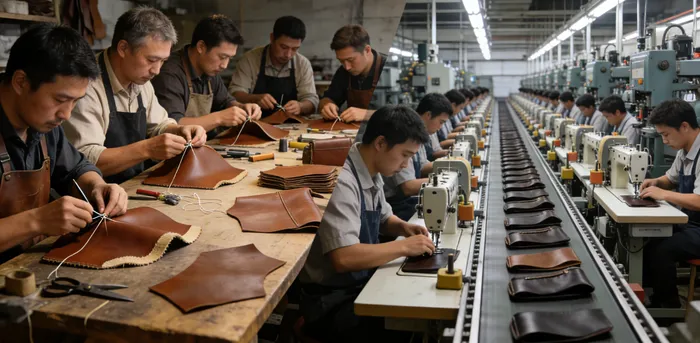
The history of leather goods production is long, especially in countries like Spain and Italy, where the leather-making techniques have a history dating back several centuries. Many traditional leather brands still adhere to the method of handcrafting, which is exquisite and unique. However, the limitations of this production model are gradually becoming apparent.
Many brands use “handmade” as a reason for premium pricing, but in fact, “handmade” does not always mean better quality. For example:
Therefore, “handmade” is more of a marketing slogan rather than an absolute quality guarantee.
As the market size continues to expand, how to improve production efficiency while maintaining quality has become a problem that leather goods brands must address.
The transition from workshops to factory production is actually a rethinking of productivity and production methods. Small-scale bag workshops can focus on details and personalization, but when dealing with large-scale markets, they often face capacity bottlenecks due to insufficient efficiency. In contrast, leather bag factory production can provide more efficient and stable outputs through assembly lines and automated equipment.
| Metric | Five-Person Leather Bag Workshop | Gionar 500-Person Leather Bag Factory |
| Monthly Capacity | 20-50 bags | 50,000+ bags |
| Production Cost | Very high (labor-intensive) | Controllable (economies of scale) |
| Quality Consistency | Relies on artisan skill | Guaranteed by standardized processes |
| Delivery Lead Time | 1-3 months | 2-4 weeks |
| Market Pricing | Luxury tier ($1200+) | Affordable luxury ($150-1000) |
The data clearly shows that scaled production holds a comprehensive advantage in efficiency, cost, and controllability.
Unlike the path taken by European leather bag workshops, the leather bag manufacturer Gionar located in Guangzhou, China, chose a different route: through systematic scale expansion, it raised professional efficiency to a new level.
Guangzhou Gionar Leather Bag Co., Ltd. has a modern factory covering over 5,000 square meters, and 500 workers who have received professional training. This number alone forms a strong production foundation. This is not simply the addition of personnel; it means a complete talent matrix covering the entire process from design, pattern making, cutting, sewing, quality inspection, packaging, etc. Gionar has achieved a qualitative transformation from a “workshop” to a “factory” relying on such a manpower scale.
The most direct manifestation of scale is production capacity. Gionar’s monthly supply capacity can reach 50,000 handbags. This means it has the strength to handle large orders and ensure stable deliveries. This production capacity is not achieved through sheer manpower tactics, but is based on modern facilities and professional processes. The factory is equipped with independent production lines, which can be dedicated to specific brand production lines, ensuring accurate and rapid delivery. From sample design to mass production, Gionar has established an efficient conversion mechanism: using its own designs, sample production takes 5-7 working days; even for designs provided by customers, sample production can be completed within 10-15 working days. This efficiency is beyond the reach of any small leather bag workshop.
Gionar’s professionalism is more deeply reflected in its systematic quality management system. This goes far beyond relying on the “eye and hand observation” experience of veteran workers. The company implements strict quality control policies and has a professional QC team. They conduct individual inspections on every production stage, including raw material selection, cutting, gluing, sewing, edge treatment, hardware installation, cleaning, and packaging. In addition, they also accept 100% inspection by third-party quality inspection institutions. This system that embeds quality control nodes into the entire production process ensures the consistency and reliability of product quality, making “professionalism” a replicable and verifiable system capability.
The “bigness” of Gionar is not cumbersome at all; rather, it is designed for greater “specialization”. Its scale advantage ultimately translates into the depth and breadth of professionalism.
In a five-person workshop, a craftsman may need to master all processes from cutting to sewing. However, at Gionar, the production process is scientifically broken down, and employees continuously deepen their expertise in their respective stages, becoming experts in their field. The cutter focuses on maximizing the use of leather materials and reducing waste; the seamstress delves into the uniformity of needle spacing and the perfection of thread patterns; the quality inspector has developed the ability to spot even the slightest flaws. This deep specialization of division of labor ensures that the craftsmanship in each stage reaches a higher standard, and the overall quality of the assembled product naturally becomes more exquisite.
The large-scale production capacity has brought strong bargaining power, enabling Gionar to obtain high-quality leather, hardware and other raw materials at more competitive prices, ensuring quality from the source.
At the same time, the company has a professional design team and experienced craftsmen, who can continuously carry out product research and design innovation. They can not only develop their own styles based on market trends, but also efficiently fulfill the ODM (Original Design) and OEM (Manufacturing on Commission) requirements provided by customers. This combination of scale advantages in design enables Gionar not only to “manufacture”, but also to “create”.
Gionar’s scale-based system enables it to possess the professional resilience to serve the global diversified market. Whether it’s small-batch customization starting from 100 pieces or large-scale orders of tens of thousands per month; whether it’s leather, PU leather or fabric materials, Gionar can flexibly adjust its production line to handle them.
It has rich export experience and complete customization services (including custom hardware, packaging, etc.), capable of meeting the different needs ranging from emerging brands to well-known brands. This professional elasticity based on scale is an indispensable core value for it in the global supply chain.
In recent years, consumers have increasingly favored “luxury light” products – that is, leather bags with moderate prices but similar quality to luxury items. The pricing of the leather bags produced by Gionar (200 – 1000 US dollars) precisely fills this market gap, while the pricing of over 1200 US dollars set by traditional leather bag workshops can only serve a small group of high-end customers.
The model similar to Gionar has been proven successful in other industries as well, such as:
These brands demonstrate that large-scale production and high-end positioning are not mutually exclusive; they can coexist.
Many people mistakenly believe that handmade products are more environmentally friendly. However, in reality:
Gionar uses energy-saving equipment and environmentally friendly dyes. Compared to traditional workshops, it actually conforms to modern environmental protection standards.
Currently, the global leather goods industry is undergoing profound changes. The consumer market has increasingly higher requirements for product quality, delivery efficiency, and personalized demands. The inherent limitations of the small workshop model are becoming increasingly evident and are unable to adapt to the development trend of industrial upgrading.
However, the successful practice of Gionar’s 500-workers factory has proven that large-scale professional manufacturing is the upgrade direction for the high-end leather goods industry – achieving efficiency improvement through large-scale production, ensuring stable quality through specialization, and realizing the symbiosis of efficiency and quality, are necessary to stand out in the fierce market competition.
Based on the current situation of the leather goods industries in Spain and Italy and Gionar’s practical experience, we can summarize three core industry insights.
The practice of the leather goods industry in Spain and Italy shows that although the small leather bag workshop model can provide personalized and differentiated products, due to the lack of large-scale production capacity, standardized control systems and full-chain service capabilities, it is difficult to meet the batch purchase demands and strict quality requirements of mid-to-high-end brands. In the market competition, it gradually falls behind.
In recent years, a large number of small workshops in traditional leather goods production areas such as Florence in Italy and Ubrique in Spain have closed down. The main reason is the lack of large-scale professional manufacturing capabilities, which cannot adapt to the changes in market demand and the trend of industrial upgrading.
The successful practice of Gionar’s 500-person factory demonstrates that for high-end leather goods manufacturing enterprises to achieve sustainable development, they must abandon the “small workshop mentality” and embrace large-scale professional manufacturing.
Scale-up is not merely an increase in the number of employees; rather, it involves enhancing production efficiency, order response efficiency, and cost control efficiency through multiple dimensions such as specialized division of labor, standardized processes, intelligent equipment, and supply chain integration.
Professionalization is not merely an improvement in skills; rather, it involves having professional teams, standard processes, advanced technologies, and strict inspections to ensure the stability and consistency of product quality.
Only by integrating scale-up and professionalization can the efficiency and quality bottlenecks of the small workshop model be overcome, the changes in market demands be adapted to, and the sustainable development of the enterprise be achieved.
In the high-end leather goods manufacturing sector, manual craftsmanship is the core temperature of the industry and also the key to product differentiation and competition. However, manual craftsmanship is not opposed to scale production; instead, it can be organically integrated. The practice of Gionar’s 500-person factory shows that scale production does not need to abandon manual craftsmanship; instead, it should combine manual craftsmanship with modern technology and standardized processes to achieve the symbiosis of “scale production and manual craftsmanship”.
In the scale production process, Gionar has always retained the core advantages of traditional manual craftsmanship. In key processes such as oiling edges, stitching, and polishing, manual operations are still used to ensure the manual temperature and quality texture of the products; at the same time, intelligent production equipment and standardized processes are introduced to improve production efficiency and the stability of product quality.
This model not only solves the problem of low efficiency and large fluctuations in quality in small workshops, but also avoids the drawback of pure mechanization production lacking temperature. It achieves a balance of efficiency, quality, and temperature. This model is worthy of reference by high-end leather goods manufacturing enterprises – while promoting scale professional production, retaining the core advantages of traditional manual craftsmanship, through standardized processes and professional training, ensuring the stability and consistency of manual craftsmanship, achieving industrial upgrading and cultural inheritance symbiosis.
In the context of increasingly fierce market competition, a single production and processing service is no longer sufficient to meet the needs of customers. Building a complete chain service system has become the key for high-end leather goods manufacturing enterprises to enhance their core competitiveness.
The practice of Gionar’s 500-workers factory shows that the complete chain service system can provide customers with “convenient, efficient, and high-quality” customized solutions, improving customer satisfaction and loyalty, and becoming the core competitiveness of the enterprise.
Gionar has established a complete chain service system covering from design and research and development, raw material procurement, production and processing, quality inspection to warehousing and logistics. It can provide customers with one-stop customized solutions and respond quickly to customers’ individualized needs and urgent orders.
This complete chain service system not only improves customer satisfaction but also enhances the enterprise’s supply chain integration ability, order response ability and risk resistance ability, enabling it to be in an advantageous position in the market competition.
Currently, more and more mid-to-high-end brands prefer to choose manufacturing enterprises with complete chain service capabilities as partners, because this can reduce cooperation costs, shorten delivery cycles, and ensure product quality.
Therefore, high-end leather goods manufacturing enterprises must promote industrial upgrading and build a complete chain service system to enhance service capabilities and core competitiveness, adapting to changes in market demand and the trend of industrial upgrading.
The leather bag workshops of five or ten workers are cultural treasures and beacons of quality, deserving the highest respect. However, they are like the pearls of the handicraft era, unable to illuminate the entire sky of the modern consumer market.
The leather bag factory model represented by Gionar, involving 500 workers, is not a departure from the spirit of craftsmanship, but rather a systematic upgrade and large-scale expansion of craftsmanship in the industrial era.
Gionar replaces the uncontrollable personal experience with a scientific system, amplifies the value of professional skills through efficient collaboration, and meets the demands of the global market with stable production capacity. It proves that true “professional quality” can not only stem from a craftsman’s dedication to craftsmanship, but also come from a large team’s adherence to processes, trust in the system, and the ultimate pursuit of scale efficiency.
In the grand canvas of the leather goods manufacturing industry, the handicraft workshops in Europe and the modern factories in China are no longer in opposition of superiority and inferiority, but rather complementary symbiosis. The former defines the peak of aesthetics and the temperature of inheritance, while the latter ensures the breadth of quality and the thickness of the industry.
With its factory scale of 500 workers, Gionar is precisely solidifying this thickness, making “high-quality leather goods” no longer a rare treasure for a few, but a daily beauty within reach for more people. This is the most magnificent industrial power released after the combination of scale and professionalism.
If you are running your own bag business and want to customize a bulk of leather bags, welcome to contact us to discuss the details.


Mobile Website

Inquires Whatsapp